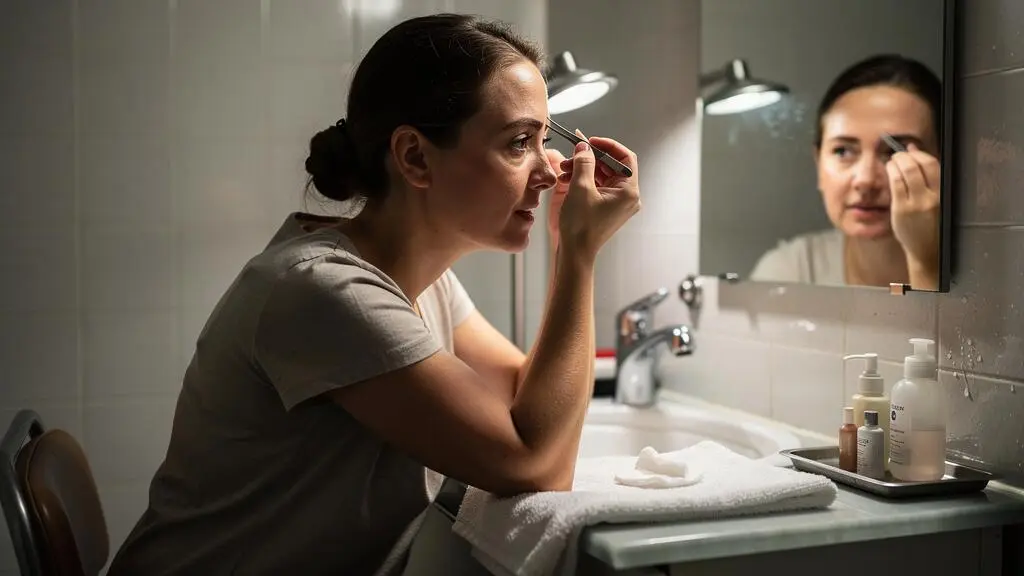
The best ergonomic tweezers for hands that cramp easily combine accurately aligned tips, manageable closing resistance and a grip that feels secure without excessive squeezing. For most people shaping their eyebrows at home, a quality slant-tip tweezer with a comfortable, slightly wider gripping area is a sensible starting point. Pointed tips are better reserved for occasional detailed work requiring greater control.
Precision depends on more than the tweezer itself. An unsupported elbow, poor bathroom lighting and repeated attempts to catch the same hair can make even an expensive tool uncomfortable. Conversely, a mid-priced tweezer that closes evenly may perform better than a premium model with awkward handles.
For Belgian consumers, durability matters too. A tool stored beside a damp sink can develop surface damage or lose tip alignment long before its handles wear out. Choosing the right design, checking its grip and storing it correctly form one practical approach to comfortable brow grooming.
Ergonomic tweezers: the essentials
- Choose accurately aligned slant tips with comfortable closing resistance for routine eyebrow shaping; consider wider grips or alternative handles if pinching causes fatigue.
- Support your elbow, work in directional light and grip only one hair at a time to limit unnecessary squeezing and repeated attempts.
- Clean and thoroughly dry stainless-steel tweezers after use, protect their tips and avoid trying to extract hairs buried beneath intact skin.
- Why Do Tweezers Snap Brow Hairs Instead of Pulling Them Cleanly?
- How to Tweeze Brows With Less Hand Strain Using a 2-Minute Setup Change?
- Slant Tip or Pointed Tip: Which Tweezer Is Better for Ingrown Hairs?
- The Dim-Light Tweezing Mistake That Leaves Brows Uneven for 4 Weeks
- When Should You Tweeze Brows to Avoid Redness if You Have a Morning Meeting?
- How to Do a 3-Minute Morning Facial Massage Without Tugging or Redness?
- How to Clean and Dry Stainless Tools in 3 Minutes So They Don’t Rust in the Bathroom?
- Which Stainless Steel Beauty Tools Actually Stay Rust-Free in a Humid Belgian Bathroom?
Why Do Tweezers Snap Brow Hairs Instead of Pulling Them Cleanly?
Tweezers commonly snap eyebrow hairs when their tips fail to grip evenly, the hair is pulled against its natural growth direction or the user applies inconsistent pressure. Misaligned or worn tips may hold only part of a hair, allowing it to break near the skin instead of being removed from the follicle. Hand fatigue can make these problems harder to control.
Start by distinguishing tip alignment from closing pressure. Alignment describes whether the two gripping surfaces meet correctly. Closing pressure describes how consistently they hold an object as the tweezer is squeezed. A tool can look straight but still contact mainly at one corner, leaving insufficient grip elsewhere.
Hold the closed tips against a bright background and examine their contact edges. A visible gap, crooked meeting point or obvious unevenness suggests a potential alignment problem. This is a practical screening method, not a calibrated measurement of precision.
Next, try a simple paper-tissue test:
- Separate a small, thin strip from a clean tissue.
- Grip its edge gently with the tweezer tips.
- Pull the tissue slowly while maintaining comfortable, steady pressure.
- Repeat at different positions across the gripping surface.
If the tissue slips consistently at one edge, the tips may not be contacting evenly. If they hold only with an uncomfortable squeeze, closing resistance or contact quality may be unsuitable. Tissue behaves differently from hair, so this test helps identify obvious problems rather than proving professional-grade alignment.
Pull direction matters. Isolate one hair, grasp it close to the skin without pinching the skin itself, and pull smoothly in the direction the hair grows. Avoid twisting the tweezer or jerking sideways. A hair can still break despite good technique, especially if it is fragile or already damaged.
Cramping introduces another variable. As the thumb and fingers tire, pressure may become intermittent. The tips can slip, prompting a harder second squeeze. Repeating this cycle increases effort without improving control.
Before buying a replacement, assess whether the main problem is mechanical or ergonomic. A perfectly aligned tweezer that requires an uncomfortable squeeze may still be a poor match for your hands.
Once the tool can hold a fine hair reliably, the next improvement comes from reducing the physical effort needed to position and operate it.
How to Tweeze Brows With Less Hand Strain Using a 2-Minute Setup Change?
A two-minute adjustment can make eyebrow tweezing more comfortable: support your working elbow, raise the mirror to eye level and hold the tweezer with a relaxed, controlled grip. These changes reduce unnecessary arm movement and awkward positioning, while helping you avoid excessive squeezing. They cannot prevent every hand cramp, but they are practical adjustments worth testing before replacing your tool.
Set a chair beside a stable surface and place a folded towel under your elbow. Adjust the mirror so you can see your brows without leaning your neck forward. Bring the working hand comfortably toward the face, keeping the wrist close to neutral rather than sharply bent.
Hold the tweezer like a pen, using the thumb and index finger with support from another finger where comfortable. This relaxed tripod grip gives more controlled movement than clenching the entire tool in a fist. Try holding around the middle of the tweezer body, then adjust slightly until you find the position requiring the least effort without losing stability.
The ideal position varies with handle length, hand size and spring resistance. Holding farther from the tips is not automatically easier with every design.
The NIOSH guide to selecting non-powered hand tools identifies operating force, repetition and awkward positioning as important ergonomic considerations. Its principles support thoughtful tweezer selection, although it does not directly test cosmetic tweezers or establish a clinically validated two-minute grooming routine.
When choosing ergonomic features, distinguish actual mechanical benefits from marketing language. Wider, soft-touch gripping surfaces may distribute finger pressure more comfortably. Offset or scissor-style handles can suit people who find conventional pinching awkward. Spring-assisted designs may change how force is applied, but added springs do not necessarily reduce the effort required to close the tips.
Test whether the tool can be operated repeatedly without forcing your fingers into an uncomfortable position. Handle texture alone cannot compensate for poor tip alignment or excessive resistance.
Your five-point low-strain tweezing setup
- Support your elbow: place a folded towel under the working arm and confirm the elbow stays stable while the wrist moves comfortably.
- Raise the mirror: position it at eye level and check that your neck stays upright rather than leaning forward.
- Adjust finger placement: try a relaxed mid-body tripod grip and identify the position with the lightest comfortable squeeze.
- Test one hair: grasp a visible stray near the skin and remove it with one controlled pull in its growth direction.
- Set a stopping signal: identify the earliest sign of aching, slipping or reduced fingertip sensation and end the session when it appears.
There is no universal safe session length for cramp-prone hands. Grip force, repetition, posture and individual sensitivity all matter. Pause before discomfort escalates, gently relax the hand and continue only if control feels normal. Persistent, recurrent or worsening cramps, numbness or weakness warrant assessment by a healthcare professional.
A steadier hand makes ordinary slant-tip tweezers easier to manage, but choosing the correct tip geometry becomes particularly important around ingrown hairs.
Slant Tip or Pointed Tip: Which Tweezer Is Better for Ingrown Hairs?
Slant-tip tweezers are generally the better everyday choice for shaping eyebrows, while pointed-tip tweezers provide more targeted access to a fine hair tip or an already exposed ingrown-hair loop. Combination slant-point designs offer a compromise. However, a pointed tweezer should never be used to dig into intact skin, especially when hand cramping affects control.
The decision is not simply about sharpness. A broad slanted contact area makes it easier to grasp ordinary eyebrow hairs without requiring extremely precise tip placement. A pointed design concentrates contact into a much smaller area, which can help with detailed work but increases the importance of steady hands.
The following comparison separates suitable uses from situations that require caution.
| Feature | Slant tip | Pointed tip | Slant-point combination |
|---|---|---|---|
| Best everyday use | Eyebrow shaping and visible stray hairs | Fine detail or an already accessible hair tip | General shaping with occasional detailed work |
| Grip contact | Relatively broad gripping edge | Small, concentrated contact area | Mixed contact geometry |
| Control required | Usually easier for general grooming | More precise hand control | Depends on which edge is used |
| Cramp-prone hands | Practical starting choice | Less forgiving of sudden movement | Worth testing for comfort |
| Important limitation | Cannot access buried hairs safely | Must not penetrate intact skin | Does not eliminate injury risk |
An ingrown hair curls or grows back into the skin, potentially causing tenderness, inflammation or a raised bump. Tweezing and other hair-removal methods can contribute to this problem.
According to Cleveland Clinic‘s medical guidance on ingrown hairs, an already exposed hair loop may sometimes be released gently using a sterile instrument. That is different from digging into the skin or forcibly extracting a buried hair.
For home care, avoid manipulating an ingrown hair when no hair is visibly accessible. A warm compress may help, but painful, swollen or infected areas require greater caution. Do not squeeze bumps or attempt to open the skin with a pointed tweezer.
These precautions also apply to splinters. A visible, protruding splinter may be grasped with a clean, suitably aligned tweezer, while deeply embedded material, difficult locations or signs of infection warrant professional assessment.
Hygiene is especially important near compromised skin. Clean the instrument after each use and use an appropriate disinfection or sterile-instrument protocol when skin injury is possible. A routine alcohol wipe should not automatically be treated as sterilisation. Do not move directly from an irritated or broken area to eyebrow grooming without properly reprocessing the tool.
When purchasing, look for clear material specifications, protective tip storage and evidence of consistent tip contact. A stated steel grade is more informative than an undefined claim such as « professional quality. » Alignment tolerances and warranty coverage are useful when manufacturers disclose them.
Cheap tweezers may suffer from poor alignment, but higher prices alone do not establish better precision. An inexpensive tool that passes a careful contact check may be more useful than a fashionable model with an uncomfortable grip.
Even the right tip design becomes difficult to control when lighting makes fine hairs hard to distinguish from the intended brow shape.
The Dim-Light Tweezing Mistake That Leaves Brows Uneven for 4 Weeks
Tweezing under a bathroom ceiling light can make eyebrows look uneven because the brow ridge casts shadows that conceal fine hairs and distort their apparent position. This encourages repeated gripping attempts and accidental over-plucking. Side-positioned light, a normal-distance symmetry check and restraint around borderline hairs help protect precision. An over-plucked eyebrow may take several weeks to recover, but four weeks is not a guaranteed regrowth period.
Overhead lighting often illuminates the forehead more effectively than the area immediately beneath the eyebrow. Thin hairs can blend into the shadow, making their direction and position difficult to judge.
Move a small, adjustable lamp to one side of the face. A daylight-like light is useful for revealing detail without relying exclusively on warm bathroom lighting. Adjust the angle until fine hairs are visible against the skin, while avoiding glare directly into the eyes.
A phone flashlight can provide temporary directional lighting, preferably when supported or held by someone else. Holding a phone in one hand while manipulating tweezers with the other can be awkward for someone already experiencing hand fatigue.
Strong magnification introduces a different problem. It makes tiny hairs visible that would not normally affect the overall brow shape. Removing every visible hair at high magnification can gradually thin the brow beyond the intended outline.
A moderate magnifying mirror may help isolate individual hairs, but the final shape should be judged at conversational distance.
- Identify the intended brow outline in an ordinary mirror.
- Use directional light to locate hairs clearly outside that outline.
- Remove only the obvious strays, one at a time.
- Step back to arm’s length and face the mirror directly.
- Compare the overall balance before deciding whether any further removal is necessary.
Perfect bilateral symmetry is not a realistic requirement. Natural differences in brow growth, muscle position and facial structure mean that matching every individual hair can make the overall result less harmonious.
For cramp-prone hands, lighting also affects physical effort. Every unsuccessful attempt adds another squeeze, another repositioning movement and another opportunity to pinch the skin. Better visibility helps reduce unnecessary manipulation, although the exact reduction in fatigue has not been established in clinical studies.
Hair regrowth varies by follicle and individual. Some removed hairs may reappear within weeks, while others can take longer. Repeated over-plucking may also affect long-term density. The four-week period in the section title should therefore be understood as a practical warning about potentially noticeable unevenness, not a fixed biological timetable.
Once lighting and technique are controlled, timing the grooming session can help reduce the chance that temporary irritation is visible during an important appointment.
When Should You Tweeze Brows to Avoid Redness if You Have a Morning Meeting?
The evening before a morning meeting is usually a more sensible time to tweeze eyebrows than immediately before leaving home. Plucking can temporarily irritate the skin, causing redness, tenderness or slight swelling. An overnight interval gives the area more opportunity to settle, although redness may persist longer in sensitive skin and no timing guarantees a clear complexion.
A warm shower before grooming can soften hairs and make the skin feel more comfortable. It does not literally open skin pores or follicles like mechanical doors, and it does not guarantee painless extraction.
After the shower, dry the brow area and use clean tweezers under good lighting. Avoid stretching the skin aggressively or repeatedly pulling at the same hair. A controlled, one-pass approach is preferable to returning to already irritated areas.
For a meeting the next morning, a simple routine is to shape the brows the preceding evening, allow the area to settle and postpone unnecessary further adjustments.
When same-morning tweezing cannot be avoided, use a clean, cool compress briefly on intact skin if the area feels irritated. Avoid direct application of ice and stop if cooling causes discomfort.
Strong exfoliating acids and retinoids may increase irritation when applied around recently plucked skin, so avoid introducing or applying irritating active products directly to the affected area. If concealer is necessary, apply it sparingly only after the skin is intact and settled; do not cover broken or visibly inflamed skin simply to conceal a reaction.
The NHS advice on ingrown hairs confirms that plucking can contribute to ingrown hairs and warns against picking, scratching or squeezing affected bumps. Its guidance also identifies significant pain, heat and swelling as reasons to seek medical attention.
People with reactive skin or rosacea may experience more noticeable or longer-lasting redness. If that describes your skin, schedule brow maintenance well ahead of important events and avoid experimenting with unfamiliar methods immediately before a meeting.
Professional waxing or threading is not automatically gentler than tweezing. Both may cause irritation, and threading can also contribute to ingrown hairs. Any change of method should be tested well before an important occasion rather than treated as a guaranteed solution.
If redness increases while grooming, stop. Repeatedly handling swollen skin makes fine hairs harder to isolate and can contribute to further irritation, especially once the hand starts tiring.
A gentle morning routine can complement this preparation without requiring further hair removal or intensive manipulation of the brow area.
How to Do a 3-Minute Morning Facial Massage Without Tugging or Redness?
A gentle three-minute facial massage uses light pressure, broad finger movements and enough cream or oil to prevent skin dragging. It may help the face feel more relaxed or temporarily less puffy, but its benefits vary and it does not reliably prevent tweezing pain or hand cramps. For sensitive skin, fingers offer useful pressure feedback and are a practical starting point.
Apply a small amount of a familiar moisturiser or suitable facial oil to clean skin. The product should provide enough slip for fingers to glide without pulling the surface. Avoid products that have previously caused stinging, redness or irritation.
Use this short sequence without rushing:
- First minute — cheeks and forehead: glide flat fingers gently from the centre of the face outward across the cheeks, then make light outward movements over the forehead.
- Second minute — brows and eye area: use the pads of the fingers to make gentle, stationary presses along the brow bone. Avoid pressing the eyeballs, rubbing eyelids or stretching delicate under-eye skin.
- Third minute — jaw and neck: use broad, comfortable strokes along the jaw and down the sides of the neck without applying deep pressure or compressing the throat.
The movements are intended for comfort rather than forceful manipulation. Facial massage should not visibly pull or distort the skin. If skin folds, drags or becomes red during a stroke, reduce pressure or add a little more product.
Avoid using knuckles aggressively around the eyes. Vigorous rubbing, massage on dry skin and unnecessary repeated passes are more likely to aggravate sensitive areas than improve comfort.
There is no need to follow an elaborate directional map or claim that a particular sequence medically drains the lymphatic system. Gentle movements can provide a pleasant routine without presenting cosmetic massage as a treatment for underlying swelling.
For someone whose fingers cramp during precision work, broad hand movements may feel easier than prolonged pinching. However, massage is not a proven warm-up for preventing hand cramps. If your hand itself is painful or weak, avoid using facial massage as a way to push through symptoms.
Hands also provide immediate feedback about applied pressure. A roller or gua sha tool may be used gently by someone who prefers it, but neither is essential. Any tool should glide without tugging and should be cleaned appropriately after contact with skincare products.
Do not massage over damaged, infected or substantially inflamed skin. If the brow area is still irritated from tweezing the night before, leave that region alone rather than adding friction.
Whether you use your fingers, tweezers or another facial tool, keeping the equipment clean and dry helps preserve its condition between sessions.
How to Clean and Dry Stainless Tools in 3 Minutes So They Don’t Rust in the Bathroom?
Clean stainless-steel tweezers after use with mild detergent and warm water, rinse them carefully and dry them thoroughly before storage. A three-minute routine can make this habit convenient, although no exact duration guarantees rust prevention. Removing residue and avoiding prolonged moisture exposure both matter, particularly in humid bathrooms and around delicate tweezer tips.
Skincare residue, finger oils and moisture can remain on the gripping surfaces after grooming. Leaving these contaminants inside a closed case may encourage discolouration or corrosion over time, depending on the steel, surface finish and storage conditions.
The British Stainless Steel Association cleaning recommendations describe mild detergent with warm water, clean-water rinsing and drying as suitable routine cleaning methods for stainless steel. The guidance also discusses appropriate solvents for oily contamination, but it is not a validated sterilisation procedure for cosmetic tools used on injured skin.
For ordinary home grooming on intact skin, the following routine provides a practical starting point:
- Immediately after use: wipe visible hair fragments, oils and cosmetic residue from the gripping area.
- Clean: wash the metal surfaces gently using warm water and a small amount of mild detergent, following any manufacturer instructions for grips or coatings.
- Rinse: remove detergent residue with clean water without leaving the tool soaking unnecessarily.
- Dry: use a clean, soft cloth to dry the arms, joint or bend and especially the tip contact surfaces.
- Store: place the fully dry tool in a clean, protected location away from direct splashes.
Alcohol may be useful for removing certain residues when compatible with the tool materials. However, cleaning, disinfection and sterilisation are different processes. Where skin has been broken or infection is suspected, follow suitable instrument-hygiene guidance rather than assuming a quick wipe makes the tweezer sterile.
Stainless steel resists corrosion through a protective surface layer, but it is not immune to damage. Moisture, residues and unsuitable cleaning agents can contribute to staining or pitting.
A common mistake is to rinse the tweezer and immediately put it inside a closed travel case while it is still wet. Trapped moisture can remain around the tips and in small crevices.
Another mistake is storing tweezers loose alongside scissors, nail clippers or other metal tools. Contact with hard surfaces may damage fine edges or affect alignment.
Once a month, examine the tips against a light background and repeat the tissue-grip test. Look for visible gaps, rough contact edges, discoloration or changes in gripping performance.
Minor surface deposits may respond to gentle cleaning with a soft cloth and suitable mild cleaner. Avoid abrasive treatment of the precision gripping edges. Deep pitting, roughness or persistent loss of alignment is a reason to replace the tool rather than continue using it on delicate skin.
Proper maintenance is valuable, but the steel grade and construction also influence how well a beauty tool tolerates everyday bathroom conditions.
What to remember before buying
- Precise tip contact and comfortable resistance are more relevant to eyebrow performance than premium packaging or an undefined ergonomic label.
- Material specifications matter, but even corrosion-resistant stainless steel benefits from thorough drying and protected storage.
- For a humid Belgian bathroom, evaluate the tweezer and the storage routine together rather than expecting a product to remain rust-free under all conditions.
Which Stainless Steel Beauty Tools Actually Stay Rust-Free in a Humid Belgian Bathroom?
No stainless-steel beauty tool can be guaranteed to remain rust-free in every humid bathroom. For durable tweezers, prioritise a clearly identified corrosion-resistant steel grade, sound construction, accurately aligned tips and a dry storage location. Austenitic stainless steels such as appropriately specified 300-series grades can offer strong corrosion resistance, but performance depends on the exact alloy, finish, environment and maintenance.
Bathrooms with limited ventilation may remain humid after showers. In a compact Belgian apartment or an older house, tools left close to the shower, on the sink edge or inside a damp cabinet can experience repeated moisture exposure.
The label stainless steel describes a family of alloys rather than a universal quality level. Differences in alloy composition, manufacturing and surface treatment influence resistance to corrosion and wear.
The term « surgical-grade » is also insufficient by itself. It is often used as a marketing description without identifying the alloy. A specific grade designation is more useful than an unqualified promise that a tool will never rust.
When examining products, use a short set of purchasing criteria rather than treating every claim as equally important:
- Declared material: look for a specific steel grade or sufficiently detailed construction information rather than a generic stainless label.
- Reliable construction: inspect joins, coatings and attached grip components for areas that could retain water or deteriorate during cleaning.
- Surface finish: smooth, properly finished metal should be easy to clean. Matte or brushed appearances do not automatically provide better corrosion resistance.
- Tip quality: check that the contact surfaces meet evenly without a visibly crooked edge or persistent gap.
- After-sales support: review any stated alignment warranty, manufacturing-defect coverage or replacement terms before purchasing.
A fully metallic tweezer may be simpler to dry than a design with multiple assembled components, but soft-touch grips can improve comfort for some users. The correct choice balances cleaning practicality, gripping effort and control rather than treating one construction type as universally superior.
For shoppers in Belgium, beauty retailers such as Kruidvat and Di, pharmacies and department stores may provide opportunities to compare basic and more specialised tools. Availability, pricing, actual steel specifications and after-sales terms should be checked for each product rather than assumed from the retailer or brand category.
A budget tweezer with satisfactory tip contact may be perfectly adequate for occasional grooming. A more expensive model becomes worthwhile when its measurable or inspectable features address a real limitation: an uncomfortable handle, difficult closing resistance, unreliable grip or poorly protected tips.
In a damp bathroom, combine the purchase with better storage habits. Ventilate after showering where possible, keep tweezers out of splash zones and avoid sealing moisture inside protective cases. Store the tool with its tips protected from impacts, ideally in a clean, dry drawer or suitable holder.
For people whose hands cramp, prioritise grip comfort and reliable tip closure over cosmetic design. Rust resistance protects the investment, but it does not by itself make hair removal easier or more precise.
Choose a slant-tip tweezer with reliable contact, manageable resistance and documented materials as your everyday starting point. Test it under good lighting with your elbow supported, clean and dry it after use, and reconsider the design if the grip remains uncomfortable. That sequence offers a practical way to improve precision without relying on unsupported ergonomic promises.
Are scissor-handle tweezers better for people with arthritis or reduced finger strength?
Scissor-handle tweezers may suit people who find a conventional pinch grip uncomfortable because they change the hand position and operating movement. However, they are not automatically easier for every person with arthritis or reduced strength. The required force, handle fit and individual joint mobility matter. Persistent pain or functional difficulty should be discussed with a qualified healthcare professional or occupational therapist.
Can a tweezer be too sharp for sensitive eyebrow skin?
Yes. Excessively pointed, rough or poorly finished tips can increase the risk of scratching or pinching delicate skin, especially when hand control is inconsistent. Ordinary eyebrow shaping generally calls for secure, evenly aligned gripping surfaces rather than needle-like sharpness. A smooth, well-aligned slant tip is usually the more forgiving choice for routine use.
Can you repair tweezers that no longer meet properly at the tips?
Some manufacturers may offer alignment servicing or replacement, depending on their warranty terms. Attempting to bend, file or sharpen precision tips at home can make the contact surfaces less even and create rough edges. If the tips are visibly damaged or repeatedly slip despite careful use, replacing the tweezer is generally safer than attempting an improvised repair.
Should eyebrow tweezers be stored in the bathroom or bedroom?
Either location can work if the tool is clean, completely dry and protected from contact damage. A dry bedroom drawer may offer more stable conditions than a poorly ventilated bathroom. If you prefer bathroom storage, choose a location away from splashes and avoid placing a damp tweezer inside a sealed case.
Do ergonomic tweezers prevent hand cramps completely?
No. A comfortable handle, appropriate closing resistance and supported working posture may reduce unnecessary effort, but there is no evidence that a specific cosmetic tweezer design prevents all hand cramps. Repeated cramping can have multiple causes. Stop when symptoms begin, and seek medical advice if cramps persist, worsen or occur with numbness, weakness or other concerning symptoms.