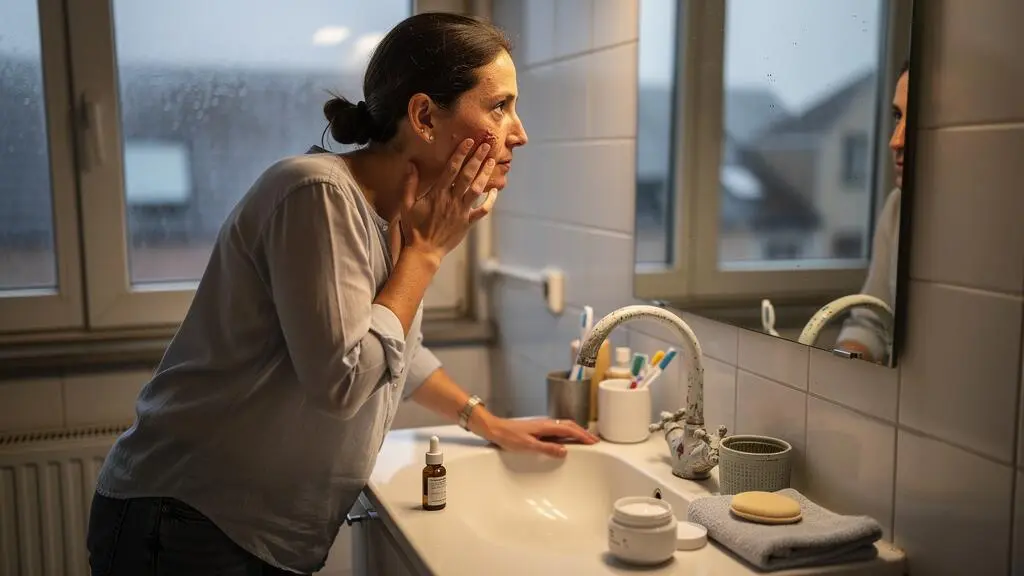
Smoother skin does not necessarily require more frequent exfoliation. Skin cells naturally renew themselves, while the outermost layer provides essential protection against moisture loss and environmental irritation. Exfoliating too aggressively can disrupt that protective layer, leaving skin looking dull, feeling tight or reacting to products it previously tolerated.
For people living in Belgium, the challenge can become more noticeable during autumn and winter. Cold outdoor conditions, coastal wind, indoor heating and changing humidity can coincide with increased dryness and sensitivity. The solution is not necessarily to abandon exfoliation, but to adjust its intensity and frequency according to how the skin responds.
A cautious approach combines gentle exfoliating ingredients, consistent moisturising, careful spacing between potentially irritating treatments and temporary breaks whenever the skin shows signs of stress. The aim is to achieve a smoother-looking complexion without sacrificing the barrier that keeps it comfortable.
Gentle Cell Renewal: What Matters Most
- Exfoliate according to skin tolerance, not a fixed schedule. Tightness, stinging and persistent redness suggest that the barrier needs recovery rather than more exfoliation.
- Start with one mild exfoliating product, avoid combining multiple acids or introducing them alongside retinoids, and moisturise immediately afterwards.
- In Belgium’s colder or windier conditions, simplify your routine when skin feels vulnerable, and restart exfoliation only after comfort has returned.
- Why Does Exfoliating More Often Sometimes Make Your Skin Look Duller?
- How to Start Exfoliating Once a Week Without Triggering Red Patches?
- PHA or Lactic Acid: Which Is Safer if Your Skin Flushes Easily in Winter?
- The Acid-Stacking Mistake That Can Cause Peeling Around the Mouth in 7 Days
- When Should You Exfoliate If You Shave or Use Retinoids So You Don’t End Up Irritated?
- The Exfoliation Reflex That Can Turn Minor Flaking Into Persistent Redness
- When Should You Restart Exfoliants After Lipid Barrier Recovery Without Peeling Again?
- How Can You Prevent Skin Irritation When You Use Actives and Belgium’s Weather Keeps Changing?
Why Does Exfoliating More Often Sometimes Make Your Skin Look Duller?
Frequent exfoliation can make skin appear duller because it removes surface cells faster than the protective barrier can comfortably recover. This may increase moisture loss, irritation and uneven surface texture. Instead of looking smoother and brighter, the complexion can become tight, flaky and less radiant, particularly when already exposed to drying environmental conditions.
The stratum corneum, the skin’s outermost layer, contains flattened cells called corneocytes embedded in a lipid-rich structure. Together, these components help maintain hydration and protect against external stress. Chemical exfoliants loosen connections between surface cells, while mechanical methods physically remove them.
Used appropriately, exfoliation can improve the appearance of roughness. Used too aggressively, it can interfere with barrier integrity. A scientific review of hydroxy acids and the epidermal barrier discusses how aggressive exfoliation may alter epidermal lipids and increase transepidermal water loss.
This helps explain the paradox of a complexion that looks progressively less luminous despite more frequent exfoliation. Dehydration can emphasise fine lines and uneven texture, while irritation may introduce redness that makes the skin tone look less uniform. The precise effect on visible radiance varies between individuals.
Distinguishing buildup from barrier-related dullness is an important first decision. Skin with ordinary surface roughness may feel relatively comfortable after cleansing, whereas barrier-stressed skin often produces warning sensations.
- Possible surface buildup: Roughness without significant stinging, redness or post-cleansing tightness.
- Possible barrier disruption: Tightness shortly after washing, unexpected stinging from moisturiser, visible redness or newly persistent flaking.
- Uncertain cause: Temporarily avoid exfoliation, maintain gentle moisturising and observe whether comfort improves.
Belgium’s maritime environment adds another consideration. Wind exposure, cool temperatures and transitions between outdoor air and heated rooms can make already sensitive skin feel less comfortable. However, humidity, temperature and wind affect skin differently; coastal weather does not automatically cause higher moisture loss in everyone.
Another difficulty is the self-reinforcing cycle: skin looks dull, the person exfoliates again, irritation increases, and the resulting roughness is mistaken for additional dead-cell buildup. Breaking that cycle often requires fewer exfoliating steps, not stronger ones.
If skin is comfortable but genuinely rough, a gradual exfoliation trial may be reasonable. The next step is to introduce that trial without overwhelming the barrier.
How to Start Exfoliating Once a Week Without Triggering Red Patches?
To introduce exfoliation cautiously, begin with one mild product, test it on a small area and use it no more than once weekly as an initial experiment if your skin tolerates it. Apply according to the manufacturer’s instructions, follow with moisturiser and monitor redness, stinging or dryness before repeating. Once weekly is a starting option, not a universal requirement.
A low-strength polyhydroxy acid (PHA) or a suitably formulated gentle enzymatic exfoliant may be worth considering for sensitive skin. Avoid introducing several exfoliating products together, because doing so makes it difficult to identify the cause of irritation.
Before facial application, the American Academy of Dermatology instructions for testing skincare products recommend trying new products on a small area, such as the underside of the arm or the elbow crease, and observing for reactions over seven to ten days.
That general testing guidance must be adapted to the product’s directions. An exfoliating acid intended for occasional use should not be applied twice daily simply to reproduce a general patch-testing schedule. A negative home test also cannot guarantee that facial skin will tolerate the product.
For a first facial application, choose an evening when skin feels comfortable and is not already irritated by wind, shaving or other active treatments. Apply to cleansed skin that has dried, unless the instructions specify another method. Keep the exfoliant away from the eyes and other sensitive areas, and follow with a plain moisturiser.
A brief sensation of warmth is not automatically evidence of damage, but it should not be assumed harmless either. Burning, persistent stinging, swelling, marked flushing or irritation continuing into the following day are reasons to discontinue the product. Gently remove it if a reaction occurs.
A simple four-week observation period can help establish personal tolerance. This is a practical tracking method rather than a clinically validated introduction schedule: record any application and check how the skin looks and feels approximately 24 and 48 hours later. Do not proceed with another application while irritation remains.
Your Five-Step First Exfoliation Checklist
- Select one gentle product: Write down its exfoliating ingredient, application instructions and recommended frequency.
- Complete a small-area tolerance test: Record the test location, application dates and any visible or sensory reaction.
- Choose a suitable evening: Mark an exfoliation day that does not overlap with shaving, retinoid use or existing irritation.
- Prepare barrier support: Identify the plain moisturiser to apply immediately afterwards and note whether the skin feels comfortable.
- Track the response: Keep a short record of tightness, redness, stinging and dryness at roughly 24 and 48 hours, using the results to decide whether to repeat or pause.
After establishing tolerance to a single product, the next question is whether the acid itself suits skin that flushes in colder conditions.
PHA or Lactic Acid: Which Is Safer if Your Skin Flushes Easily in Winter?
A PHA such as gluconolactone may be a more cautious starting choice than lactic acid for some people with easily irritated winter skin, partly because its larger molecular structure is associated with slower penetration. However, neither ingredient is universally safer. Product concentration, acidity, exposure time and the current condition of the skin barrier all influence tolerability.
Both PHAs and lactic acid belong to the broader group of hydroxy acids used in cosmetic formulations. They can assist surface-cell shedding, but their molecular characteristics differ.
PHAs, including gluconolactone and lactobionic acid, generally have larger molecular structures than smaller alpha-hydroxy acids. Scientific discussions suggest this can slow penetration and potentially improve tolerability in certain formulations.
Lactic acid is an alpha-hydroxy acid that also has water-binding properties. Lactate is associated with the skin’s natural moisturising system, but this does not mean that every lactic acid exfoliant is hydrating or suitable for already irritated skin. Its exfoliating effect and potential for irritation still depend on how the product is formulated.
For Belgian readers experiencing winter redness, the most useful comparison considers the dominant skin problem rather than the ingredient name alone.
| Decision factor | PHA | Lactic acid |
|---|---|---|
| Molecular characteristics | Generally larger molecules, potentially slower penetration | Smaller AHA molecule with different penetration characteristics |
| Potential benefit | Gentle surface renewal in appropriately formulated products | Surface smoothing alongside humectant properties |
| Cold-weather flushing | May be a reasonable first option if the barrier is comfortable | Requires equal attention to concentration, acidity and tolerance |
| Flaking and roughness | May help when flaking is not caused by irritation | May suit some rough, dry-feeling skin, but not an actively damaged barrier |
| Key limitation | Not automatically non-irritating | Humectant properties do not guarantee gentleness |
Consider two hypothetical situations. Someone whose cheeks flush after exposure to cold North Sea wind may prefer to avoid exfoliation until the redness settles, then trial a mild PHA. Someone with comfortable but persistently rough skin may consider a gentle lactic acid formulation, provided small-area testing and gradual introduction are successful.
The finished formulation matters more than a simple acid ranking. Product pH, concentration, supporting ingredients and whether the treatment is rinsed off or left on all influence exposure. A short-contact product may be easier for some users to tolerate, but this is not guaranteed.
There is no evidence-based percentage that makes either acid universally safe for reactive winter skin. Likewise, the current evidence does not establish that lactic acid is necessarily superior for visible flaking.
Whichever ingredient is chosen, its effects must be considered alongside every other exfoliating treatment already present in the routine.
The Acid-Stacking Mistake That Can Cause Peeling Around the Mouth in 7 Days
Peeling around the mouth can develop when several exfoliating products repeatedly affect the same area, especially if retinoids or frequent cleansing add further irritation. In a hypothetical seven-day period, someone using an acid cleanser, exfoliating toner and acid serum may accumulate more exposure than expected. The seven-day timeframe is illustrative, not a predictable clinical outcome.
The area surrounding the mouth is exposed to repeated movement, saliva, wiping and contact with oral-care products. These influences can make irritation particularly noticeable, although sensitivity varies between individuals. Some persistent mouth-area eruptions may also have causes unrelated to exfoliation.
Consider a hypothetical evening routine involving an exfoliating cleanser followed by a glycolic acid toner, a lactic acid serum and a retinoid. Even if each product is marketed for routine use, combining them can increase the overall burden of potentially irritating treatments.
The error is counting products without considering overlapping ingredients, application areas or repeated exposure.
Audit your routine by skin zone. Review every cleanser, toner, serum, treatment and exfoliating mask that touches the mouth area. Record whether it contains an AHA, BHA, PHA or another potentially irritating active.
Then count how often that zone encounters those ingredients across a week. This does not generate a clinically validated exposure score, because products differ substantially in strength and contact time. It simply reveals combinations that are easy to overlook.
Early signs may include tightness when smiling, mild stinging after washing or fine flakes near the corners of the mouth. If these appear, discontinue exfoliating acids and retinoids on the irritated area and use a gentle cleanser with a plain moisturiser or suitable protective emollient.
Do not scrub off the flakes or apply additional acids to smooth the area. Continued chemical and mechanical exposure may prolong irritation rather than resolve it.
The American Academy of Dermatology advice on safe exfoliation cautions against excessive exfoliation and highlights the additional irritation risk associated with retinoids and other treatments that can cause peeling.
Seek medical assessment if the reaction is severe, painful, swollen, weeping, repeatedly recurring or not improving after irritating products are stopped. Persistent bumps around the mouth may require evaluation for conditions such as perioral dermatitis rather than further cosmetic exfoliation.
Once overlapping acids have been removed, attention should also turn to non-chemical sources of exfoliation, particularly shaving and retinoid-based routines.
When Should You Exfoliate If You Shave or Use Retinoids So You Don’t End Up Irritated?
If you shave or use retinoids, exfoliate only when the skin is comfortable and avoid combining these potentially irritating activities in the same routine. Shaving mechanically disturbs surface skin, while retinoids can increase dryness and peeling. Separating treatments across different days may improve tolerance, but no universal waiting interval has been established for everyone.
Retinoids influence epidermal cell differentiation and turnover, although they do not act in exactly the same way as chemical exfoliating acids. Their potential to cause irritation is one reason additional exfoliation deserves caution.
A practical approach is to use a retinoid on its established treatment evenings and reserve any optional exfoliation for a separate day. For people prone to irritation, avoiding consecutive treatment evenings may provide additional recovery time. Using an acid in the morning and a retinoid that evening is not necessarily a safer substitute for spacing them apart.
Prescription retinoid users should follow their clinician’s instructions, particularly when the medication is being used to manage acne or another skin condition.
Shaving requires similar attention. A razor can remove superficial skin cells while exposing the area to friction, especially when pressure is excessive or repeated passes are made. Applying a chemical exfoliant immediately before or after shaving may therefore create an unnecessary combination of stresses.
For facial or body care, choose a separate exfoliation day and wait until any post-shave burning, tightness or visible redness has resolved. This is particularly relevant for areas such as the neck, jawline and legs that may already develop razor irritation.
Someone who both shaves and uses retinoids can create a flexible weekly routine in which shaving, retinoid treatment and optional exfoliation are kept apart, with recovery days between potentially disruptive activities.
For example, a hypothetical routine could reserve Monday for shaving, Wednesday for an established retinoid treatment and Saturday for gentle exfoliation. This is a planning illustration, not a medically validated timetable or a guarantee against irritation.
If irritation develops and the cause is unclear, simplify the routine and allow the skin to recover. Once comfortable, reintroduce one optional product at a time while keeping the rest of the routine stable. Do not discontinue or alter prescribed medication without appropriate professional guidance.
However, even an otherwise well-spaced routine can become counterproductive if visible flaking automatically triggers another exfoliation session.
The Exfoliation Reflex That Can Turn Minor Flaking Into Persistent Redness
Exfoliating immediately whenever flakes appear can turn temporary dryness into prolonged irritation. Flaking does not always mean that excess dead cells need removing; it may indicate that the skin barrier is already stressed. Scrubbing or applying acids over pink, tight or stinging skin can worsen the problem and delay the return of comfort.
The reflex is understandable. Visible flakes create a rough surface, so removing them seems like the quickest route to smoothness. But the underlying cause matters more than the appearance alone.
When the outer barrier is disrupted, skin may lose moisture more readily and develop superficial peeling. Additional exfoliation can aggravate this process by removing more surface material before normal recovery has occurred.
This cycle may be particularly frustrating during Belgian autumn and winter, when colder conditions and indoor heating can coincide with increased skin dryness. The same flakes that someone might interpret as buildup during summer may instead accompany irritation after a windy day.
One simple way to assess the situation is to look at the skin beneath and around the flakes after normal, gentle cleansing. This is an observational guide, not a diagnostic test.
- Flakes without discomfort: If the skin looks normal beneath them and feels comfortable, surface buildup may be contributing. Exfoliation can be considered cautiously.
- Flakes with pinkness or tightness: Treat these as possible signs of irritation. Avoid exfoliation and prioritise gentle barrier care.
- Flakes with burning, marked redness or persistent itching: Stop irritating products and consider medical advice, especially if symptoms continue.
Trying to lift individual flakes with fingernails, washcloths or scrubs may create further friction. Instead, use lukewarm water, avoid harsh cleansing and apply a suitable moisturiser while the skin is still comfortable with gentle care.
Flaking can also accompany eczema, contact dermatitis, seborrhoeic dermatitis and other conditions. Its appearance alone cannot establish the cause, and recurrent symptoms should not be treated as a purely cosmetic problem without assessment.
Once discomfort has settled, the next decision is not how quickly to resume the previous routine, but whether the skin has recovered sufficiently to tolerate a cautious restart.
When Should You Restart Exfoliants After Lipid Barrier Recovery Without Peeling Again?
Restart exfoliation only after the skin feels consistently comfortable: ordinary moisturiser no longer stings, washing does not leave prolonged tightness and unusual reactive redness has settled. There is no universally established number of recovery days. A cautious restart uses a gentler application or lower frequency than before, followed by observation before any increase.
The skin barrier relies on an organised combination of surface cells and intercellular lipids. When irritation has disrupted this structure, a return to normal appearance does not necessarily mean that previously tolerated products can immediately be resumed at their former intensity.
Look for functional signs of recovery rather than relying on a fixed calendar:
- Routine gentle cleansing no longer causes unusual burning or prolonged tightness.
- A previously tolerated plain moisturiser can be applied without stinging.
- Persistent irritation-related flakes and unusual flushing have subsided.
- Skin remains comfortable for several hours after basic care.
These observations do not clinically prove complete restoration of the lipid barrier, but they provide useful practical checkpoints. Persistent symptoms or repeated relapses deserve assessment by a dermatologist.
When recovery appears stable, introduce the mildest suitable exfoliant as a single variable. Follow the manufacturer’s instructions and consider less frequent use than before. For example, once every two weeks may serve as a cautious initial trial for some people, but it is not an evidence-based universal interval.
If using a rinse-off product, a shorter contact time may be an option only when compatible with its instructions. Do not dilute an acid formulation by mixing products unless the manufacturer explicitly recommends it, because doing so can alter how the product performs.
Monitor the skin after the first application, and do not increase frequency after just one comfortable evening. Two consecutive well-tolerated sessions can be a practical checkpoint before considering further use, although this is a conservative self-monitoring approach rather than a clinically validated threshold.
Avoid restarting the entire previous routine at once. Returning immediately to multiple acids, previous application frequencies and simultaneous retinoid use makes recurrence more likely and prevents identification of the offending step.
Weather also deserves consideration. If the skin has just recovered during a mild period, a forecast of colder, windier conditions may be a reasonable reason to delay optional exfoliation, particularly if those conditions have previously coincided with irritation.
Maintaining that comfort over the longer term requires adapting the routine to changing skin conditions instead of treating every week as identical.
Key Takeaways Before Building Your Seasonal Routine
- Skin comfort is the primary decision signal: when stinging, unusual tightness or reactive redness appears, postpone optional exfoliation.
- Track exposure by skin area, including acids, retinoids and shaving, rather than assuming that each product operates independently.
- Use weather and recent skin reactions as reasons to reconsider treatment intensity, without treating a particular forecast as a universal medical threshold.
How Can You Prevent Skin Irritation When You Use Actives and Belgium’s Weather Keeps Changing?
Prevent irritation by using a flexible skincare routine that becomes simpler when the weather or your skin’s condition changes. Keep gentle cleansing, moisturising and appropriate sun protection consistent, but reduce or defer exfoliating acids and other potentially irritating treatments when skin is dry, tight or reactive. Product tolerance should determine adjustments more than the calendar alone.
Belgium’s maritime climate creates varied exposure conditions. Residents of coastal areas such as Ostend may encounter frequent wind, while people in Brussels, Ghent or Liège can experience transitions between cool outdoor conditions and heated indoor spaces.
These environmental changes can coincide with shifts in skin comfort, but they do not affect everyone identically. A scientific review of humidity, temperature and skin barrier function links low temperatures and low humidity with reduced barrier function and greater susceptibility to certain irritants.
This supports taking additional care during drying conditions, but does not establish a Belgian wind-speed or temperature threshold at which exfoliation must stop. Nor does it show that every episode of irritation following a weather change is caused by the weather rather than a cosmetic product.
A practical alternative to a rigid daily regimen is to maintain three routine variants.
| Routine | When to consider it | Practical approach |
|---|---|---|
| Comfortable-skin baseline | Skin feels hydrated, calm and responsive to usual products | Gentle cleansing, moisturising, appropriate SPF and carefully spaced optional actives |
| Windy or cold-weather adjustment | Skin becomes tight or sensitive during colder, drying conditions | Maintain barrier care and sun protection; postpone optional exfoliation or increases in active-treatment intensity |
| Irritation recovery | Stinging, persistent redness or noticeable irritation-related peeling develops | Stop optional irritating actives, use a simple tolerated routine and seek advice if symptoms persist |
In the baseline routine, use a mild cleanser that does not leave the skin stripped, followed by moisturiser. During daylight exposure, apply suitable broad-spectrum sunscreen according to its directions. Exfoliation, if desired and tolerated, should remain an optional addition rather than the centre of the routine.
When cold wind, indoor heating or repeated outdoor-to-indoor transitions coincide with tightness, focus on maintaining moisture and minimising unnecessary exposure to irritating products. A richer moisturiser may be useful for some skin types, provided its ingredients are tolerated.
When symptoms progress beyond ordinary dryness, switch to recovery mode. Avoid scrubs, exfoliating acids and unnecessary treatment experiments until the skin is comfortable again. Prescribed treatments may require individual advice rather than automatic discontinuation.
The central principle is to adjust according to the combined picture: current skin comfort, recent treatment exposure, shaving or retinoid use, and environmental conditions. Weather alone should not determine the routine, but neither should it be ignored when the skin repeatedly reacts during colder or drier periods.
For people who want to identify reliable patterns, a short routine journal can record exfoliation days, weather exposure and subsequent skin reactions. Over time, this may clarify which combinations are poorly tolerated without assuming every correlation proves a cause.
Start by reviewing your current products, removing unnecessary overlapping exfoliants and choosing a simple routine your skin already tolerates. Add optional treatments only when the skin remains comfortable, and seek professional advice when redness, peeling or burning persists.
Do you need to exfoliate to maintain healthy skin cell renewal?
No. The epidermis naturally renews itself and sheds surface cells without cosmetic exfoliation. Exfoliating products can improve the appearance of certain types of roughness, but they are optional. If skin is already comfortable and smooth, there is no need to add acids simply to support its normal renewal process.
Does Belgium’s humid maritime climate mean skin cannot become dehydrated?
No. Skin hydration depends on barrier condition and several environmental factors, not outdoor humidity alone. Cold temperatures, exposure to drying conditions and indoor heating may contribute to discomfort. Maritime humidity does not guarantee that the skin barrier will remain adequately hydrated.
Can you use a hydrating serum instead of an exfoliating acid?
Yes, especially when dullness is accompanied by tightness or dehydration-related roughness. A well-tolerated hydrating serum and moisturiser may improve the skin’s appearance without additional exfoliation. However, hydration products do not necessarily produce the same surface-cell shedding effect as exfoliating acids.
Should you wear sunscreen on cloudy days after exfoliating?
Yes, appropriate sun protection remains important during daylight exposure, including on cloudy days. Certain exfoliating acids can increase sensitivity to ultraviolet radiation. A broad-spectrum sunscreen, protective clothing and sensible exposure habits are relevant throughout the year, including in Belgium’s cooler seasons.
When should persistent redness after exfoliation be assessed by a dermatologist?
Seek professional advice if redness is persistent, worsening, repeatedly recurring or accompanied by significant burning, swelling, blistering or pronounced peeling. Severe reactions deserve prompt assessment. A dermatologist can help distinguish irritation from allergic contact dermatitis or another skin condition that may require specific treatment.