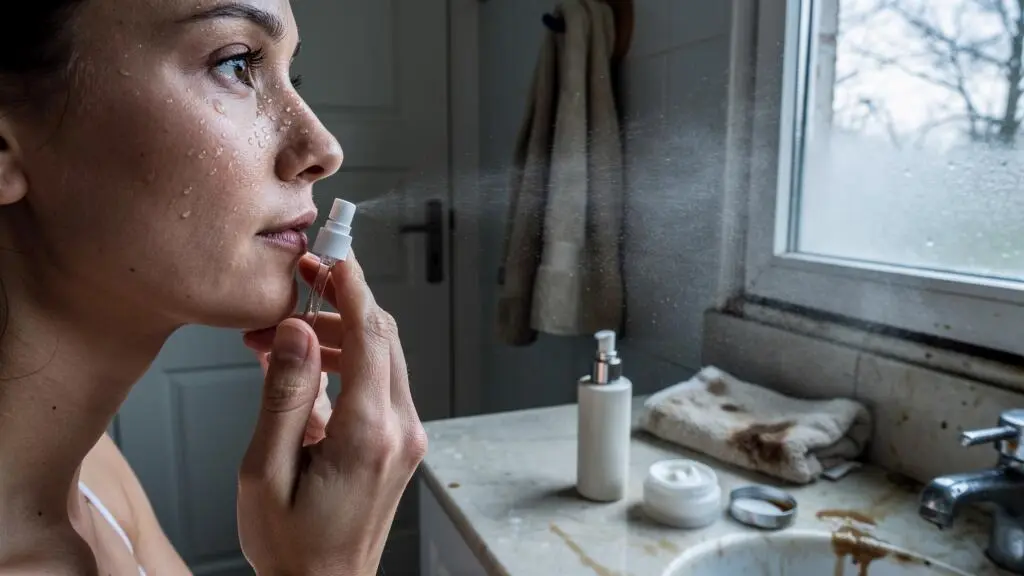
Hyaluronic acid is supposed to make skin feel hydrated, supple and comfortable. Yet after applying an HA serum before a windy commute in Brussels, Antwerp or Ostend, you might notice the opposite: cheeks that feel stretched, fine lines that seem more visible or a slightly sticky surface that turns uncomfortable a few hours later.
Hyaluronic acid does not automatically dehydrate skin in windy weather. The uncomfortable sensation is more plausibly related to a combination of environmental exposure, insufficient moisturizing, the serum’s formulation and the condition of your skin barrier. Wind can make exposed skin uncomfortable, while indoor heating can lower relative humidity and contribute to dryness.
The practical solution is usually straightforward: apply your hydrating product to slightly damp skin, follow with an appropriate moisturizer and adjust your protective layer to the day’s conditions. If the serum causes persistent stinging, redness or tightness despite these changes, replacing it may be more sensible than applying more.
Hyaluronic acid in Belgian weather: the essentials
- HA attracts and binds water, but comfortable hydration also depends on the surrounding formula and the skin barrier.
- Apply a modest amount to slightly damp skin, then use a fragrance-free moisturizer rather than relying on serum alone.
- For windy commutes, prioritize barrier protection; for pilling under sunscreen, adjust product combinations and application technique without reducing SPF coverage.
- Why Can Hyaluronic Acid Feel Drying After a Few Hours Instead of Hydrating ?
- How to Apply Hyaluronic Acid So It Stays Comfortable Through a Windy Commute ?
- Low or High Molecular Weight HA: Which Is Better if You Flush Easily ?
- The HA Layering Mistake That Causes Pilling Under Sunscreen — and How to Avoid It
- When Should You Skip Hyaluronic Acid and Use a Different Hydrator Instead ?
- Ceramides or Panthenol: Which One Makes More Sense for Flaking Around the Nose ?
- How to Layer Hydration and Protection Without Feeling Greasy in Coastal Wind ?
- How Should You Change Skincare for Belgium’s Climate — Humid but Windy, With Cold Spells and Indoor Heating ?
Why Can Hyaluronic Acid Feel Drying After a Few Hours Instead of Hydrating ?
Hyaluronic acid can feel hydrating immediately but leave your skin tight later if the serum does not provide enough lasting moisture protection. The ingredient itself is not proven to pull water destructively from deeper skin layers in dry air. More commonly, an incomplete routine, environmental dryness or an irritated skin barrier explains the change in comfort.
Hyaluronic acid is a humectant: it binds water and contributes to hydration. Different molecular sizes behave differently. Larger HA molecules primarily remain near the surface, while smaller versions may penetrate parts of the outer skin barrier. A scientific review of topical hyaluronic acid and skin hydration describes these molecular-weight differences and their relevance to skin hydration.
The popular explanation that HA causes « reverse osmosis » and sucks moisture out of deeper skin layers during dry weather is too simplistic. Water movement through skin involves multiple processes, including barrier permeability and evaporation. The available evidence does not establish that an ordinary HA serum predictably causes net dehydration simply because the surrounding air is dry.
However, the distinction between temporary surface plumping and lasting comfort matters. A water-based serum may initially feel refreshing without supplying enough emollient or occlusive ingredients to keep dry skin comfortable throughout the day.
Consider a typical Belgian winter morning: you apply HA in a heated apartment, walk through chilly wind and spend the afternoon in another heated building. Your skin experiences changing environmental conditions, and an already compromised barrier may struggle to retain water.
A simple personal comparison can help assess your routine. On one cheek, use your usual HA serum; on the other, use the same serum followed by a moisturizer. Observe comfort over several hours, keeping other products consistent. This is an informal product comparison, not a diagnostic test of humidity or skin water movement.
The more useful question is not whether HA is stealing water, but whether the complete routine provides enough hydration and barrier support for your skin’s current environment.
How to Apply Hyaluronic Acid So It Stays Comfortable Through a Windy Commute ?
For a comfortable windy commute, apply a small amount of hyaluronic acid serum to slightly damp skin, follow with a moisturizer and finish your morning skincare with adequate sunscreen. If your cheeks or nose are particularly vulnerable to wind, add targeted protection where needed without creating an unnecessarily heavy layer across your entire face.
Start after a gentle cleanse or rinse. Pat away excess water but leave the skin slightly damp. Spread the serum in a thin layer, then apply moisturizer before the skin feels completely dry. There is no established requirement to apply HA within exactly 60 seconds; the important principle is moisturizing while the skin is still damp.
The American Academy of Dermatology‘s dry-skin recommendations support applying moisturizer promptly after washing, selecting suitable cream or ointment textures and using a humidifier when indoor air is dry.
Think of the routine as three complementary functions rather than three compulsory products:
- Hydrate: use HA serum or another water-binding moisturizer on slightly damp skin.
- Soften and retain: apply an emollient cream containing ingredients such as glycerin, ceramides or dimethicone.
- Protect: use broad-spectrum SPF 30 or higher during daytime exposure, with additional targeted balm if necessary and compatible with your sunscreen.
Not every person needs a separate HA serum, cream and balm. A well-formulated moisturizer may already contain humectants, emollients and occlusive ingredients.
For particularly dry cheeks, a small amount of protective balm may improve comfort. If you use it in the morning, ensure it does not disrupt the sunscreen film. Avoid vigorously rubbing balm over already-applied SPF. A scarf can also reduce direct wind exposure, although friction from rough fabric may irritate sensitive skin.
In the evening, cleanse gently and use a more substantial moisturizer if necessary. A humidifier may help in a dry heated room, provided it is maintained and cleaned appropriately. Facial mist alone is unlikely to solve persistent dryness unless followed by moisturizing protection.
Your five-step windy-morning skincare check
- Check your skin: note whether your cheeks feel comfortable or tight after cleansing; record the starting condition.
- Apply a thin HA layer: use it on slightly damp skin and check for stinging; record whether the formula feels comfortable.
- Add moisturizer: cover the face evenly, adjusting richness to dry areas; confirm that no patches remain visibly unmoisturized.
- Apply sunscreen: use the recommended amount of broad-spectrum SPF 30 or higher; check that the finished layer is even and not visibly pilling.
- Review after commuting: note tightness, redness or residue in the same areas; use those observations to adjust the next morning’s routine.
When the basic routine is comfortable but your skin still reacts easily, the particular HA formulation may deserve closer attention.
Low or High Molecular Weight HA: Which Is Better if You Flush Easily ?
If your skin flushes easily, a simple, fragrance-free hyaluronic acid formula is generally a sensible starting point. High-molecular-weight HA mainly acts at the skin surface, whereas smaller HA molecules can penetrate further into the outer skin. Nevertheless, molecular weight alone cannot predict whether a product will cause redness, irritation or improved comfort.
High-molecular-weight hyaluronic acid, often abbreviated HMW-HA, has relatively limited skin penetration and can contribute to a surface film that supports hydration. Low-molecular-weight HA, or LMW-HA, is composed of smaller molecules and may interact with skin differently.
Some experimental research raises questions about inflammatory signaling associated with certain HA fragments. This does not establish that every cosmetic serum containing LMW-HA causes inflammation or flushing. Molecular size, concentration, manufacturing characteristics and the complete formulation all matter.
For people whose cheeks become red during a windy walk or when entering a heated café, irritation may have several explanations. Temperature changes, wind, fragrance exposure, compromised skin barrier function and underlying conditions such as rosacea can all be relevant.
Use the following comparison as a formulation guide rather than a universal ranking.
| Consideration | Higher-molecular-weight HA | Lower-molecular-weight HA |
|---|---|---|
| Predominant behavior | Primarily surface-oriented hydration | Greater potential to penetrate the outer skin layers |
| Potential advantage | Surface film and moisturizing support | Different hydration properties depending on formulation |
| Sensitive skin | A reasonable option to trial | Not automatically unsuitable, but individual tolerance matters |
| Main limitation | Cannot replace a complete moisturizer when additional barrier support is needed | Smaller molecular size does not guarantee better results or greater irritation |
Before introducing a new serum, test a small area according to the product’s directions over several days. Avoid testing on actively irritated or broken skin. If you notice persistent burning, swelling or worsening redness, stop using it.
Also inspect the ingredient list for fragrance and other ingredients you already know you react to. A multi-weight HA serum with a well-tolerated formula may be preferable to a supposedly gentler HMW-only product containing irritating additives.
If flushing persists independently of skincare products, a dermatologist can help determine whether the issue involves a skin condition rather than hyaluronic acid itself.
The HA Layering Mistake That Causes Pilling Under Sunscreen — and How to Avoid It
Hyaluronic acid serum may contribute to pilling under sunscreen when the combination of product films, application quantities and rubbing creates visible residue. However, HA is not necessarily the offending ingredient. To reduce pilling, use a thinner serum layer, let products settle appropriately and apply sunscreen gently without compromising the required amount or coverage.
Pilling describes the little rolls, flakes or granules that appear when products are spread over skin. It often becomes noticeable while applying SPF because sunscreen is commonly layered over moisturizer or serum and needs to be distributed across the entire face.
A clinical study on skincare product pilling examined 528 female volunteers aged 20–49 in Guangzhou, China. Of these participants, 217, or 41%, experienced pilling. The researchers observed associations with application techniques, formulation and skin characteristics, but did not identify hyaluronic acid as a singular cause.
41%
217 of 528 participants experienced product pilling in the reported clinical study. This is a finding from the studied population, not an estimate of how common pilling is among Belgian sunscreen users.
Skin Research and Technology, 2024; original skincare pilling study.
Rubbing movements were associated with more pilling events than some other evaluated application methods. This supports experimenting with gentler spreading or light pressing, although the best technique still depends on the sunscreen’s texture and application instructions.
A practical troubleshooting sequence is:
- Reduce excessive HA serum to a thin, even application.
- Allow the serum and moisturizer to settle until they no longer feel excessively tacky.
- Apply sunscreen evenly using gentle movements rather than repeated vigorous rubbing.
- Maintain the sunscreen’s recommended application quantity.
- If pilling continues, test a different moisturizer-serum pairing or omit the separate HA serum.
There is no universal one-minute or three-minute waiting rule. Some lightweight formulas settle quickly; others remain tacky longer. The number of layers alone does not reliably predict pilling, either.
As an informal compatibility check, you can reproduce the product combination on a small area of skin and observe whether visible particles form. Such a test cannot guarantee how the routine will perform on your face, but it may help identify an inconvenient combination.
Never solve pilling by deliberately applying too little sunscreen. If a combination prevents even SPF application, simplify or change the preceding skincare products instead.
Persistent rolling or residue is often a reason to simplify the routine, especially when a separate hydrating serum provides little additional comfort.
When Should You Skip Hyaluronic Acid and Use a Different Hydrator Instead ?
Skip a separate hyaluronic acid serum when it consistently stings, pills or leaves your skin uncomfortable despite appropriate moisturizing. You may also find it unnecessary if your daily cream already hydrates effectively. Alternatives such as glycerin, panthenol, ceramides or squalane can be more suitable depending on whether you need additional water-binding, soothing or barrier support.
Hyaluronic acid is not essential to every effective skincare routine. A moisturizer can contain several complementary ingredients that address different aspects of skin comfort.
Glycerin is another humectant with a long history of use in moisturizers. It attracts water and works well in formulations designed for dry skin. However, it is not scientifically accurate to describe glycerin as completely independent of surrounding humidity while portraying HA as uniquely dependent on it.
Urea is both a moisturizing ingredient and, at certain concentrations, a keratolytic agent that helps loosen thickened surface skin. Higher-strength products may sting sensitive or damaged facial areas, so concentration and product instructions are important.
Ceramides help support the lipid structures of the skin barrier. Squalane acts primarily as an emollient, improving softness and reducing the uncomfortable feel of dry skin. These ingredients serve a different function from simply adding more water-binding molecules.
| Skin concern | Ingredients to consider | Practical approach |
|---|---|---|
| Tightness without obvious irritation | Glycerin, HA or a balanced moisturizer | Prioritize a complete moisturizing formula |
| Roughness and flaking | Ceramides, squalane, petrolatum | Support and protect the barrier |
| Redness with dryness | Panthenol, fragrance-free moisturizer | Minimize irritating ingredients and simplify the routine |
| Persistent serum pilling | Moisturizer with built-in humectants | Remove an unnecessary layering step |
These are practical starting points, not diagnostic categories. Shiny skin can still be irritated, and visible flakes can result from several conditions rather than a simple lack of lipids.
If the barrier is already compromised, focus on a gentle cleanser and well-tolerated moisturizer, temporarily reducing potentially irritating actives. Once comfort improves, reintroduce products individually if you still need them.
Persistent flaking, painful cracking or irritation that does not improve with gentle care may require a dermatological assessment rather than another cosmetic ingredient.
Ceramides or Panthenol: Which One Makes More Sense for Flaking Around the Nose ?
For flaking around the nose, ceramides and panthenol address complementary needs. Ceramides support the skin’s protective lipid barrier, while panthenol, also called provitamin B5, can improve hydration and help soothe irritation. When the area is both red and flaky, a gentle panthenol-containing product followed by a suitable barrier-supporting moisturizer may be useful.
The skin around the nostrils is exposed to several everyday stressors. During colder Belgian weather, repeated nose blowing, rough tissues, wind exposure and movement between heated interiors and colder streets may contribute to dryness and irritation.
Ceramides are naturally occurring components of the intercellular lipids in the stratum corneum. A ceramide-containing moisturizer can help supplement a barrier-supporting skincare routine, particularly when formulated with complementary lipids and emollients.
Panthenol offers a different form of support. In a randomized, double-blind, placebo-controlled human study, seven days of topical dexpanthenol treatment improved stratum corneum hydration and reduced transepidermal water loss compared with the vehicle control. The controlled study of dexpanthenol and skin barrier function supports its usefulness in the specific formulations studied, but does not establish superiority over ceramides for irritation around the nose.
For a mildly irritated area, try a fragrance-free moisturizer containing panthenol, ceramides or both. Apply gently without scrubbing the flakes away. A thin protective ointment may help where tissues repeatedly rub the skin, provided the product is well tolerated.
Before adding another treatment, check whether retinoids, exfoliating acids or harsh cleansers are being applied too close to the nostrils. Reducing irritating exposure may be more useful than introducing several new creams.
Not all nasal flaking is ordinary dryness. Persistent redness and scaling around the sides of the nose can also occur with seborrhoeic dermatitis or other skin conditions. Yellowish or greasy scales, recurrence, cracking or inflammation warrant more specific assessment.
Once the irritated area is more comfortable, the next challenge is protecting hydration outdoors without leaving the entire face greasy.
How to Layer Hydration and Protection Without Feeling Greasy in Coastal Wind ?
In Belgium’s coastal wind, keep skincare comfortable by choosing products that perform different functions without unnecessarily duplicating textures. A lightweight hydrating product, a modest amount of barrier-supporting moisturizer and a suitable sunscreen may be enough. Use richer protection mainly on exposed, dry-prone areas rather than automatically applying thick balm over the entire face.
Along the Belgian coast, including Ostend and Knokke-Heist, maritime conditions can feel damp while wind still makes exposed skin uncomfortable. Moisture in the outdoor air does not guarantee that skin will feel hydrated, particularly when cold weather, friction and pre-existing barrier dryness are involved.
Rather than stacking several similar moisturizers, identify which product already covers each function. For example, a cream containing glycerin and ceramides may provide both humectant and emollient support, eliminating the need for a separate HA serum on many days.
The final sunscreen should be selected for appropriate UV protection and skin tolerance, not solely its matte or satin appearance. A lightweight fluid may feel more comfortable than a rich cream, but cosmetic finish is not a reliable measure of protection.
For an illustrative coastal-morning routine, consider a gentle cleanser, a ceramide moisturizer and a broad-spectrum SPF 30 or higher. Add HA only if it improves comfort. If the cheeks become dry during prolonged outdoor exposure, a compatible protective product can be targeted to those areas.
Be cautious with thick balm immediately underneath sunscreen if it causes sliding, uneven application or visible residue. Equally, sunscreen should not automatically be treated as a complete substitute for a moisturizer or protective ointment: formulations differ significantly.
Review the finish after about an hour as an individual adjustment exercise. If your skin feels excessively greasy, reduce an unnecessary moisturizing layer rather than cutting down sunscreen. If your cheeks remain tight, consider a more substantial moisturizer in those areas.
The same reasoning applies beyond the coastline: daily exposure and indoor conditions should guide adjustments more than a fixed winter-versus-summer product list.
Key takeaways before adapting your routine
- Respond to the conditions your skin actually encounters: heated indoor air, sustained outdoor wind and rapid temperature transitions may require different adjustments.
- Keep a stable foundation of gentle cleansing, moisturizing and appropriate daytime sun protection before experimenting with additional serums.
- Change one practical variable at a time, such as moisturizer richness or whether you use HA, so improvements and irritation are easier to identify.
How Should You Change Skincare for Belgium’s Climate — Humid but Windy, With Cold Spells and Indoor Heating ?
For Belgium’s variable maritime climate, adjust skincare according to wind exposure, indoor humidity and skin comfort rather than changing every product with the season. Maintain a gentle cleanser, suitable moisturizer and daytime sunscreen. Use a richer protective texture when skin becomes dry in cold wind, and address excessively dry heated indoor air where practical.
Belgian weather brings varied combinations of damp outdoor conditions, windy periods, cold spells and indoor heating. Indoor relative humidity may become low when cold outdoor air is heated without adding moisture. The exact effect depends on the building, ventilation and indoor conditions, so outdoor humidity alone cannot predict how your skin will behave.
For a winter commute in Brussels, prioritize a moisturizer that keeps cheeks comfortable and consider physical protection from the wind. During a mild, humid day in Ghent, you may find the same cream unnecessarily rich. Both situations can be handled by adjusting the amount and texture of moisturizer rather than replacing the entire routine.
Heating also changes the experience of returning indoors. Someone with reactive skin may notice flushing after moving from a cold street into a warm building. Such reactions do not prove that HA is harmful; the environmental transition itself may contribute, and persistent flushing can have other causes.
When indoor air feels dry, consider a properly maintained humidifier and check humidity with a hygrometer rather than assuming that more facial mist will solve the problem. If using a water mist, apply moisturizer afterward to help maintain comfort.
A simple environment-based framework is useful:
- Cold and windy outdoors: choose a comfortable, barrier-supporting moisturizer and protect exposed areas from unnecessary friction.
- Warm and dry indoors: avoid aggressive cleansing and consider improving indoor humidity where appropriate.
- Mild, humid conditions: favor lighter textures if your skin remains comfortable without richer products.
- Periods of irritation: pause unnecessary actives, minimize fragrance and prioritize products you already tolerate.
Whether HA remains part of the routine depends on its individual benefit. If your moisturizer works perfectly well without a serum, omitting HA is not a skincare failure. If HA makes the skin feel more comfortable without irritation or pilling, there is no evidence-based reason to stop using it simply because the forecast is windy.
The most useful next step is to keep your routine consistent for several days, record when tightness occurs and adjust only the product or environmental factor most closely associated with discomfort. Seek professional advice if redness, burning or flaking persists despite gentle skincare.
Can I use hyaluronic acid every day during a Belgian winter?
Yes, if your skin tolerates the product and it improves comfort. There is no general requirement to stop using hyaluronic acid during winter. Pair it with an appropriate moisturizer, and reduce or discontinue the serum if it repeatedly causes irritation or uncomfortable residue.
Should I put hyaluronic acid on wet or completely dry skin?
Slightly damp skin is a practical starting point, followed by moisturizer. Your face does not need to be dripping wet, and there is no scientifically established 60-second deadline. Follow the individual product’s instructions if they specify a different application method.
Does Belgian humidity mean I can skip moisturizer after an HA serum?
Not necessarily. Outdoor humidity does not tell you whether the serum supplies adequate emollient or barrier protection. If your skin feels tight after serum alone, use a suitable moisturizer. A well-formulated all-in-one hydrating product may also be sufficient without separate layers.
Does an HA serum make sunscreen less effective if it pills?
Pilling does not automatically prove that sunscreen protection has failed. However, visible product rolling, uneven distribution or accidental removal can make coverage less reliable. Simplify the layers beneath your SPF and follow its application and reapplication instructions rather than using less sunscreen.
When should tightness or redness be checked by a dermatologist?
Arrange an assessment if symptoms persist despite gentle skincare, repeatedly flare, or involve painful cracking, significant redness or ongoing burning. Sudden substantial swelling or a severe reaction requires prompt medical attention. Tightness alone cannot establish whether the cause is dehydration, contact irritation, eczema or another skin condition.