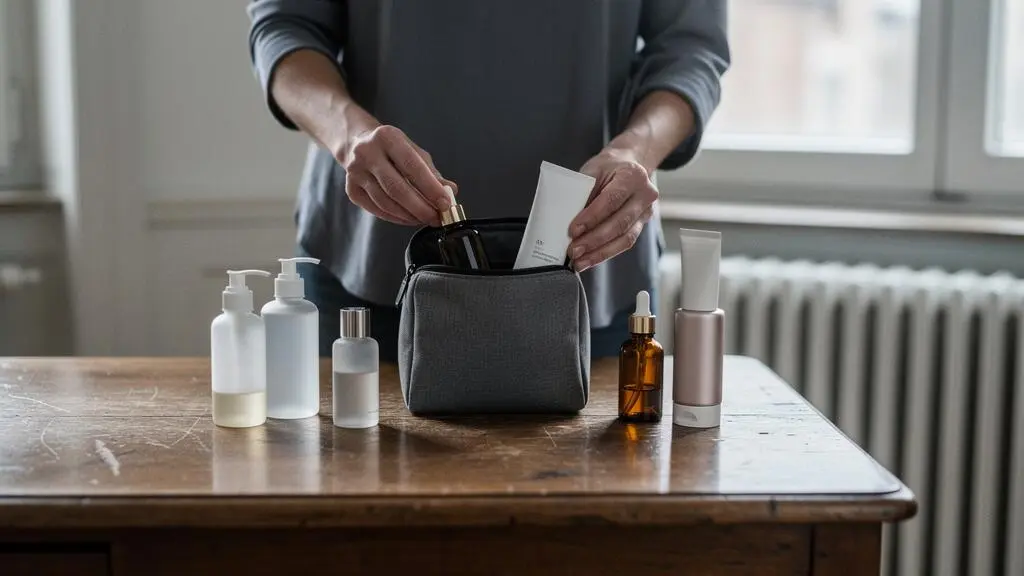
A sunscreen tube in a backpack, a vitamin C serum in a handbag or a retinoid bottle beside a bathroom radiator may face conditions very different from those intended by its manufacturer. In Belgium, commuting between heated homes, trains, offices and outdoor environments makes storage consistency particularly relevant.
Keeping sensitive skincare chemically intact means controlling three main exposures: excessive heat, light and repeated contact with air. It also means protecting the formulation from contamination when transferring or refilling products. A bottle can retain its familiar appearance even when the concentration of a sensitive ingredient has changed.
The practical solution is not necessarily refrigeration or expensive equipment. Keeping products in suitable original packaging, using a simple insulating pouch when helpful, avoiding prolonged exposure in parked cars and replacing products after questionable storage are more useful starting points. The right precautions depend on the formula, its packaging and the manufacturer’s instructions.
Essential skincare stability rules for Belgian commuters
- Protect SPF and sensitive serums from excessive heat, direct sunlight and unnecessary temperature changes.
- Prefer original or factory-sealed packaging for vulnerable formulas; avoid repeatedly topping up partly used travel bottles.
- Check expiry information, the period-after-opening symbol and storage history together. Normal appearance cannot guarantee chemical stability.
- Why Can a Product Lose Effectiveness Without Smelling Bad or Looking Different?
- How to Carry SPF in Your Bag Without Heat Damage Using a €10 Storage Hack?
- Decanting or Travel-Size: Which Keeps Formulas More Stable Over 30 Days?
- The « Top Up the Travel Bottle » Mistake That Can Destabilise Preservatives
- When Should You Replace the SPF You Keep in Your Car or Work Bag?
- Dark Glass or Airless Pump: Which Packaging Protects Unstable Ingredients Better?
- In-Store Refill Station or Sealed Refill Pod: Which Is Safer for Skincare?
- Is Refillable Packaging Actually More Hygienic and Sustainable for Beauty Products in Belgium?
Why Can a Product Lose Effectiveness Without Smelling Bad or Looking Different?
A skincare product can lose some of its chemical activity without developing an unpleasant smell, changing colour or separating. Sensitive ingredients may undergo oxidation, photodegradation or other reactions before the changes become apparent to the consumer. Appearance and odour are useful warning signs when something is visibly wrong, but they cannot verify that an active ingredient remains effective.
Different formulas deteriorate in different ways. Some vitamin C preparations darken as oxidation progresses, while changes in certain retinoids require laboratory analysis to measure accurately. Emulsions may separate when physically unstable, whereas the loss of an ingredient’s concentration may be less obvious.
A laboratory investigation of 12 commercial cosmetic products containing retinoids illustrates this distinction. Researchers measured losses ranging from 0% to 80% after six months at 25°C and 40% to 100% after six months at 40°C. Light-induced degradation was particularly important under the investigated conditions. These results are specific to the studied products, not universal degradation rates for skincare.
0–80%
Range of measured retinoid losses after six months at 25°C across the commercial products investigated. The wide range highlights formulation-dependent stability rather than a predictable loss in every retinoid serum.
Daily exposure can be cumulative. A product may spend the morning beside a radiator, several hours inside a warm bag and the evening in a steamy bathroom. Each exposure may be modest individually, yet the total storage history matters. An amber or frosted container does not automatically eliminate these risks.
Belgium’s generally temperate climate does not remove the problem. Indoor heating during winter, direct sunshine through windows and enclosed cars can create local conditions warmer than the surrounding outdoor air.
Check both the expiry or minimum-durability information, where applicable, and the period-after-opening (PAO) symbol, often shown as an open jar with a number of months. Under EU cosmetic labelling rules, these indications have different meanings and conditions of application. PAO concerns the period during which a product remains safe after opening; it is not a guarantee of unchanged ingredient potency after unsuitable storage.
When storage conditions have been poor, neither an unchanged texture nor an unexpired PAO symbol establishes that a formula is still performing as intended. Prevention is more dependable than attempting to recognise deterioration afterwards.
How to Carry SPF in Your Bag Without Heat Damage Using a €10 Storage Hack?
A small insulated pouch can help protect sunscreen from rapid temperature changes during a Belgian commute. A neoprene sleeve or thermal lunch-style pouch costing around 10 € is a practical option, although its protective effect depends on its construction, exposure duration and surroundings. It slows heat transfer; it does not guarantee that sunscreen stays below a particular temperature or retains its labelled SPF.
Sunscreen stability depends on the complete formulation, including UV filters, solvents, emulsifiers and packaging. Some filters have specific photochemical stability characteristics, but it would be inaccurate to assume that avobenzone, octocrylene or all organic UV filters deteriorate at the same rate whenever temperatures rise above room temperature.
The immediate objective is to reduce excessive heat and direct sunlight. This is consistent with public-health storage advice from the FDA sunscreen storage and expiry guidance. Its practical recommendations are useful internationally, although United States sunscreen expiry legislation should not be treated as Belgian law.
For a train journey between Brussels and Antwerp, for example, a commuter could place sunscreen inside an insulated pouch in the central compartment of a backpack. The pouch should remain out of direct sunlight and away from heating outlets.
Avoid using frozen ice packs as a default solution. They may introduce moisture, condensation or unnecessarily low temperatures, and their suitability has not been established for every cosmetic formulation. The aim is a relatively stable environment rather than refrigeration.
At work, move the sunscreen to a shaded cupboard or drawer instead of leaving the pouch on a sunny desk. Insulation only delays warming: an insulated bag left long enough in a hot car will eventually become hot too.
Five checks for a safer daily SPF commute
- Read the manufacturer’s storage directions and record any specific restrictions on your phone.
- Choose a clean, dry insulated pouch large enough to hold the original sunscreen container; confirm the cap closes securely.
- Identify the warmest point of your journey and write down the main exposure risk, such as a parked vehicle or sunny train window.
- Choose a shaded storage position at work and confirm that the product is not beside heating equipment.
- Review the sunscreen’s expiry, PAO and exposure history once a month, keeping a short note of any unusual storage incident.
If a commute involves prolonged exposure to excessive heat, changing where the product is kept is more important than buying a more expensive pouch. The same principle applies when deciding whether to carry a full-size original bottle or transfer its contents.
Decanting or Travel-Size: Which Keeps Formulas More Stable Over 30 Days?
A factory-packaged travel-size skincare product is generally the lower-risk choice for a sensitive formula, provided the manufacturer has validated that packaging and its intended use. Decanting exposes the contents to air, handling and a potentially incompatible container. However, no universal scientific rule establishes that every factory travel size remains stable for 30 days or that every decanted product fails within that period.
Transferring a formula changes its storage environment. Opening a container introduces an opportunity for oxidation and contamination, while the new bottle may have different light transmission, sealing performance and material compatibility.
The original formulation may have been evaluated in contact with a particular container. Switching to an inexpensive translucent plastic bottle means that the same packaging compatibility cannot simply be assumed.
International technical guidance in ISO guidelines on cosmetic stability testing emphasises that stability assessment depends on the formulation and relevant conditions. There is no single universal method that can establish stability for every cosmetic product.
For commuters choosing between formats, the most useful comparison is therefore based on exposure risk, rather than bottle size alone.
| Criterion | Factory-packaged travel size | Decanted product |
|---|---|---|
| Transfer contamination | No consumer transfer needed before first use | Additional handling and container-cleanliness risks |
| Air exposure | Depends on the original dispensing design | Additional exposure during transfer and later opening |
| Material compatibility | Packaging selected by the manufacturer | Not necessarily established for the chosen container |
| Light protection | Depends on the supplied packaging | Depends on the replacement bottle |
| Suitable product categories | Preferable for sensitive actives and SPF | May be considered for suitable lower-risk products |
For a simple rinse-off cleanser or body wash, transferring a small amount into a suitable clean container may be reasonable when manufacturer instructions permit it. For water-sensitive vitamin C formulas, retinoids and SPF, keeping the original packaging is a more conservative choice.
A 30-day trip or commuting period is useful as a planning horizon, not a scientifically established deterioration test. Visible changes can justify discarding a product, but an unchanged product after 30 days has not thereby passed a chemical or microbiological stability assessment.
Once a product has been transferred, hygienic handling becomes an additional responsibility. Reusing a partly filled bottle without removing old residue introduces a different category of risk.
The « Top Up the Travel Bottle » Mistake That Can Destabilise Preservatives
Topping up a partly used travel bottle combines fresh skincare with older residue that may have experienced air exposure, repeated handling or microbial contamination. This can increase uncertainty about preservative performance and product safety. Preservatives are designed for particular formulations and expected conditions of use, not for unlimited cycles of mixing contents with different storage histories.
A preservative system is part of the complete cosmetic formulation. Its effectiveness depends on factors such as ingredients, concentration, pH, packaging and potential microbial exposure.
When a used bottle is topped up repeatedly, any residual contamination can be carried into the fresh product. That does not mean contamination or preservative failure will inevitably occur, but it creates avoidable uncertainty.
There is also an age-tracking problem: the contents no longer share one identifiable opening or filling date. A consumer cannot reliably apply the fresh product’s PAO as though the entire mixture were newly opened.
If transferring a product is appropriate and permitted by its instructions, use a container intended for that purpose. Empty it completely before reuse. Follow the manufacturer’s cleaning and drying procedure, and ensure that no water or old product remains. A quick rinse is not a validated disinfection method, and visibly clean packaging is not necessarily microbiologically clean.
Where suitable, refill with a small quantity from an original package handled hygienically, without touching the dispensing opening. A factory-sealed refill or travel size remains preferable when hygiene or formula stability is particularly important.
Never add water to dilute a cosmetic product unless the manufacturer explicitly instructs users to do so. Dilution can alter preservative concentrations and other formulation properties.
Another important limitation is that microbial contamination may not produce an immediate smell or colour change. The absence of unpleasant sensory signs is not a microbiological safety test.
For SPF and especially sensitive leave-on formulations, avoid improvised transfer altogether unless the manufacturer supplies a compatible refill system and relevant instructions.
Good refill hygiene protects against avoidable handling risks, but it cannot reverse damage from prior overheating. Sunscreen stored for extended periods in cars or bags therefore requires a separate replacement decision.
When Should You Replace the SPF You Keep in Your Car or Work Bag?
Replace commuting sunscreen when it reaches its applicable expiry or PAO limit, develops changes suggesting deterioration, or has experienced storage conditions that make its integrity doubtful. A tube exposed to prolonged excessive heat in a parked car deserves particular caution, even if it still looks normal. No universal rule establishes a safe number of days in a car or mandatory replacement after one Belgian summer.
A parked vehicle presents a different exposure environment from an ordinary handbag. Direct sunlight can heat enclosed interiors, while repeated seasonal temperature changes can place additional stress on cosmetic packaging and emulsions.
Winter storage is not automatically harmless either. Some products may be affected by freezing or repeated extreme temperature changes, depending on their formulation.
A useful replacement decision follows the product’s actual condition and history:
- Past expiry or applicable PAO: replace according to the product’s labelling and instructions.
- Visible separation, unusual texture or unexpected odour: stop using the product and replace it.
- Prolonged exposure to excessive heat or direct sunlight: use a conservative replacement decision, especially when the extent of exposure is unknown.
- Routine storage in a shaded work bag: continue following the manufacturer’s stated storage conditions, expiry and PAO rather than applying an arbitrary shortened lifespan.
Keeping a separate commuting SPF may be practical for someone who frequently needs reapplication. However, designating one as disposable does not make extreme storage acceptable. A cheaper sunscreen is not inherently more heat-resistant, and mineral-filter formulations cannot automatically be assumed to withstand heat better than organic-filter products.
For Belgian drivers, the safer routine is to take the sunscreen out of the vehicle when arriving at home or work. Store it in a suitable indoor location, rather than relying on a glovebox or dashboard compartment.
For train and bicycle commuters, a shaded interior bag compartment is usually a more sensible storage choice than an exposed outer pocket.
Questionable storage is particularly important because a product that spreads normally has not necessarily retained its original tested protection performance. Sunscreen efficacy cannot be confirmed through appearance or a home experiment.
Replacing a compromised product is useful, but preventing repeated exposure is more economical. Choosing packaging suited to a sensitive formula can further reduce avoidable contact with light, oxygen and handling.
Dark Glass or Airless Pump: Which Packaging Protects Unstable Ingredients Better?
Neither dark glass nor an airless pump is universally superior for unstable skincare ingredients. Dark glass primarily reduces light exposure, while a properly designed airless dispenser can limit contact with ambient air and repeated handling. The better choice depends on the formula’s chemical sensitivities, the dispenser’s actual performance and the manufacturer’s packaging compatibility testing.
Three separate mechanisms matter: light-induced reactions, oxygen exposure and contamination during use. A package may address one effectively without protecting equally well against the others.
Amber glass can be useful for ingredients sensitive to certain wavelengths of light. Glass also provides a chemically resistant barrier for many formulations, although the closure, seal and other packaging components still influence compatibility and oxygen exposure.
An airless pump typically dispenses product without requiring the consumer to open the main reservoir during ordinary use. Depending on its design, it can reduce air exchange and opportunities for direct contact.
Airless packaging is not necessarily oxygen-free or fully impermeable. Product contact with plastic components, closure integrity and material compatibility still matter. Similarly, an amber glass bottle fitted with a frequently opened dropper can expose its contents to repeated air exchange.
For retinoid products, protecting against light is especially relevant, as demonstrated by the experimental study discussed earlier. The optimal packaging for vitamin C depends on whether the formula contains ascorbic acid or a particular derivative, along with its overall composition.
| Exposure risk | Dark glass bottle | Airless pump |
|---|---|---|
| Light | Reduces transmission of certain wavelengths; protection varies by colour and thickness | Opaque models can provide substantial light shielding |
| Air during dispensing | Depends heavily on cap, pump or dropper design | Can limit air exchange when properly designed |
| Repeated handling | Higher exposure with open bottles or droppers | Usually avoids direct access to the main reservoir |
| Material compatibility | Glass is compatible with many formulas, but seals still matter | Requires compatibility of product-contact components |
When shopping at Belgian pharmacies, Di, Kruidvat or other beauty retailers, look beyond the visual impression of premium packaging. Check whether the dispenser opens fully, whether the bottle is opaque and whether the manufacturer provides clear storage instructions.
Open jars generally involve more direct handling and repeated access than closed dispensers. That makes them less attractive for some sensitive formulas, although a properly preserved jar product is not automatically unsafe or unstable.
Once packaging is selected, the same questions become important when considering refills: will the formula remain in a controlled container, or will transferring it introduce new hygiene and compatibility concerns?
In-Store Refill Station or Sealed Refill Pod: Which Is Safer for Skincare?
A manufacturer-designed sealed refill pod is generally the more controlled option for sensitive skincare because the formula remains enclosed until the intended refill procedure. An in-store refill station can also be operated hygienically, but safety depends on equipment maintenance, dispensing controls, container preparation and product-specific validation. Neither format can be declared universally safe or unsafe based on its appearance alone.
The difference lies in how many opportunities exist for uncontrolled exposure.
At a refill station, the product may pass through shared dispensing equipment before reaching a customer’s container. Depending on the system, hygiene therefore depends on cleaning, maintenance, environmental controls and the suitability of the receiving container.
A sealed pod can reduce some transfer opportunities by using a predefined package and a controlled connection or replacement process. Nevertheless, opening, installing or manipulating the pod still requires following the manufacturer’s directions.
For leave-on skincare, several questions deserve attention before choosing a refill system:
- Is the refill specifically designed for the original product and container?
- Does the manufacturer give clear cleaning or cartridge-replacement instructions?
- Will the formula contact surfaces that may retain old product or water?
- Is the refill protected from unnecessary handling before use?
- Can the consumer identify the relevant product information and applicable usage period?
Low-complexity, quickly consumed rinse-off products such as certain shampoos or body washes may be practical candidates for established in-store refill systems. Their suitability still depends on the product’s preservation and the refill operator’s hygiene controls.
Leave-on serums and sunscreens deserve greater caution because their formulations and packaging may require more specific compatibility or stability controls. A sealed refill system designed and validated for the product is preferable to an improvised transfer.
Consumers should not assume that washing a reusable container under hot water makes it suitable for every formula. Complete drying helps avoid introducing water, but it is not equivalent to validated sanitisation. Follow the refill provider’s specified container-preparation process.
European cosmetic safety obligations apply to cosmetics supplied in Belgium, including products distributed through refill arrangements. The precise responsibilities depend on the parties involved and how the product is supplied.
A well-operated refill system can be a legitimate option. Its environmental value, however, must be assessed separately from the question of whether it keeps the product safe and chemically stable.
Key takeaways before choosing refillable skincare
- Choose refill systems designed and validated for the specific formula rather than assuming any reusable bottle is compatible.
- Consider the complete hygiene process, including dispensing equipment, container preparation and handling after purchase.
- Assess environmental savings alongside product waste: a refill that leads to premature disposal may undermine the intended benefit.
Is Refillable Packaging Actually More Hygienic and Sustainable for Beauty Products in Belgium?
Refillable beauty packaging can reduce packaging waste, but it is not automatically more hygienic or environmentally beneficial. Its performance depends on the materials used, the number of successful reuse cycles, the refill method and the quantity of product discarded. For sensitive skincare, a sustainable choice must also preserve formulation safety and stability throughout normal use.
A refill system can avoid manufacturing and discarding some packaging components with each purchase. However, its actual environmental impact depends on more than the visible amount of plastic.
Transport, manufacturing processes, cleaning requirements, refill materials and product wastage can all affect the result. A heavy reusable container used only once or twice may deliver less benefit than expected, while a lighter refill repeatedly used with a durable compatible container may offer advantages.
No universal number of reuse cycles establishes that every cosmetic refill becomes environmentally preferable. A meaningful comparison requires information about the specific packaging systems.
Hygiene presents a separate question. A closed refill cartridge can help reduce handling exposure, whereas systems involving an open customer container require an appropriate cleaning and dispensing procedure. Both can be suitable when designed, validated and used correctly.
In Belgium, the EU Cosmetics Regulation 1223/2009 establishes the principal framework for cosmetic product safety, responsible-person obligations, safety assessment and labelling. This framework applies to cosmetics supplied on the Belgian market, including products sold through refill arrangements.
The linked consolidated legal text is dated 4 April 2024; subsequent amendments and their applicability must be considered when determining the complete legal position in October 2026. The regulation does not itself establish that all refill stations are less hygienic than sealed pods.
For a Belgian consumer choosing a lower-waste skincare routine, a practical hierarchy is to use existing suitable containers correctly, purchase refill formats designed for them and avoid buying more product than can reasonably be used within its intended lifetime.
Simple, frequently used rinse-off products may be good candidates for convenient refill routines. For unstable leave-on products and SPF, a manufacturer-controlled refill arrangement provides greater reassurance than improvised decanting, although product-specific evidence remains decisive.
The whole routine matters: suitable storage at home, protection during commuting, minimal unnecessary opening, hygienic dispensing and timely replacement. Environmental benefits are strongest when products can be used fully without compromising safety.
Start with the sunscreen or sensitive serum you carry most often. Check its storage instructions, packaging, expiry or PAO information and the warmest location it encounters during the day. Then change the highest-risk habit first, whether that means moving the bottle away from a radiator, taking it out of the car or choosing a manufacturer-approved refill.
Should you refrigerate vitamin C or retinol skincare in Belgium?
Only refrigerate a product when its manufacturer recommends or permits it. Some sensitive ingredients may benefit from controlled cooler storage, but refrigerators introduce conditions that are not suitable for every emulsion or container. Keeping a product away from excessive heat and light is a useful general precaution; refrigeration is a product-specific decision.
Does an insulated pouch keep sunscreen safe all day?
No. An insulated pouch slows heat transfer but does not actively control temperature. Its performance depends on construction, surrounding conditions and exposure duration. Move sunscreen to an appropriate shaded indoor location when possible, and do not leave an insulated pouch inside a hot parked car.
Can sunscreen be tested at home to confirm that its SPF still works?
No reliable household appearance, smell or texture check can confirm that a sunscreen still provides its labelled SPF. SPF performance requires appropriate validated testing. If the product has exceeded its applicable usage period or experienced questionable heat exposure, follow manufacturer advice and replace it when its integrity cannot reasonably be assured.
Does the PAO symbol start again when a skincare bottle is refilled?
Refilling a container does not automatically reset the safe-use period of residual product or establish a new validated shelf life for mixed contents. Manufacturer-designed refill systems may have specific instructions for the refill and reusable container. Follow those directions rather than assuming the original PAO can be restarted after each transfer.
Are skincare products sold through Belgian refill stations subject to cosmetic safety requirements?
Yes. Cosmetics supplied on the Belgian market fall under the relevant EU cosmetic safety framework, including applicable safety assessment, manufacturing and labelling requirements. The obligations of a particular refill operator depend on its role and the refill arrangement. Consumers should follow the provider’s specified hygiene procedure and choose systems intended for their product and container.