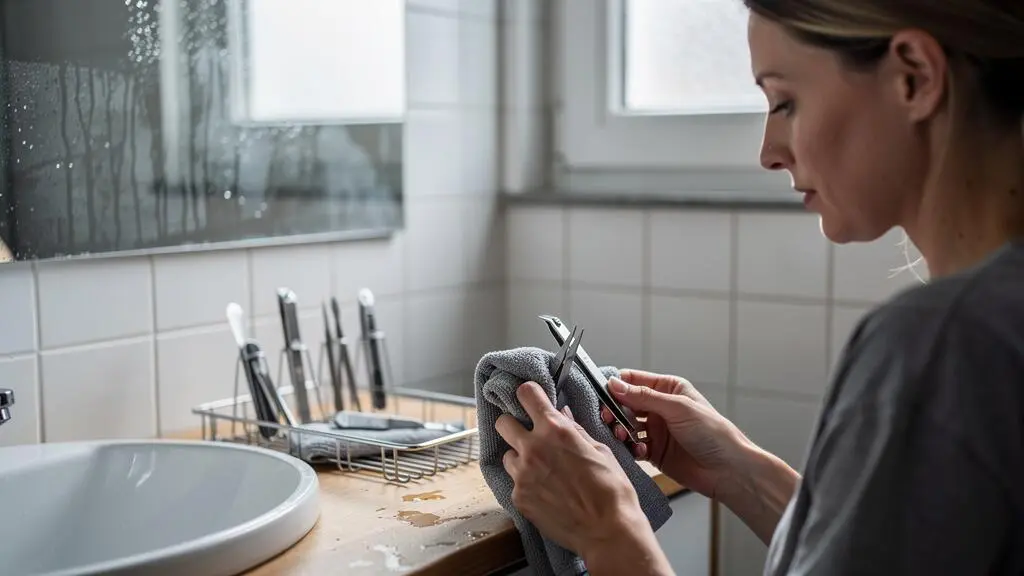
A pair of tweezers can look immaculate when purchased and develop orange spots after weeks beside a bathroom sink. Another pair may remain in excellent condition for years. The difference is rarely explained by the words « stainless steel » printed on the packaging alone.
For Belgian households, the practical question is how metal quality, shower condensation, cleaning habits and storage conditions interact. A compact bathroom without effective ventilation can expose grooming instruments to repeated cycles of moisture. Residues from skincare products, tap water and handling add another variable.
Well-made, corrosion-resistant stainless steel tools with smooth, accessible surfaces are generally a sensible choice for regular home grooming. Grade 304 is a useful benchmark when its composition is genuinely documented, while grade 316 offers additional resistance to certain chloride-related corrosion conditions. Neither grade is completely rust-proof.
The better purchase is therefore not necessarily the most expensive or the one labelled « professional ». It is the tool whose material, construction, grip and maintenance requirements match the bathroom where it will actually be used.
What matters most when choosing stainless steel beauty tools
- Prioritise clearly identified stainless steel grades, precise tip alignment and surfaces that can be cleaned and dried without difficulty.
- Remove residues, rinse and dry immediately after use; never assume a closed bathroom drawer is dry after a hot shower.
- Keep personal grooming tools separate, distinguish disinfection from sterilisation, and replace instruments that develop damaged tips or corrosion in critical areas.
- Why Can « Stainless Steel » Tools Still Rust After a Few Steamy Showers?
- How to Clean and Dry Stainless Tools in 3 Minutes So They Don’t Rust in the Bathroom?
- Stainless Steel or Disposable Tools: Which Is More Hygienic for At-Home Grooming?
- The Shared-Tool Mistake That Can Spread Nail and Skin Infections at Home
- When Should You Replace Tweezers or Nail Tools if They Start Slipping Instead of Gripping?
- Why Can Bathroom Storage Make Products Go Bad Faster Even Before the Expiry Date?
- How to Tweeze Brows With Less Hand Strain Using a 2-Minute Setup Change?
- Which Ergonomic Tweezers Actually Improve Precision if Your Hands Cramp Easily?
Why Can « Stainless Steel » Tools Still Rust After a Few Steamy Showers?
Stainless steel beauty tools can rust because their protective chromium-rich surface film is resistant to corrosion, not immune to it. Persistent moisture, deposits and chloride-containing residues can encourage localised damage. Steel composition also matters: two tools sold as stainless steel may behave differently in the same poorly ventilated bathroom.
The corrosion resistance of stainless steel comes from a remarkably thin passive oxide film that forms naturally on its surface. Under suitable conditions, this protective layer can repair itself when exposed to oxygen.
According to the British Stainless Steel Association technical overview of corrosion mechanisms, chloride exposure and crevice conditions can undermine that protection, contributing to pitting and other forms of localised corrosion.
A steamy bathroom does not automatically cause corrosion. The risk increases when surfaces remain damp, residues accumulate or droplets become trapped in hinges and tight contact areas. A tweezer left beside a shower may face different conditions from an identical tool dried carefully and stored in a ventilated bedroom.
Steel grade is one useful buying signal, but not a complete guarantee.
- 304 stainless steel: a widely used chromium-nickel alloy, often described as 18/8 or 18/10 stainless steel. It offers useful general corrosion resistance for normal household conditions.
- 316 stainless steel: contains molybdenum, which improves resistance to certain chloride-related forms of corrosion. Its advantages do not eliminate the need for cleaning and drying.
- 200-series stainless steel: a family of alloys with varying compositions and corrosion performance. The series designation alone is insufficient to predict how a particular beauty tool will perform.
- Unspecified stainless steel: may be entirely serviceable, but the consumer cannot verify an alloy grade from the label alone.
When shopping online in Belgium, examine the technical specifications rather than relying on terms such as « premium », « medical grade » or « surgical steel ». The latter is not a single alloy specification and does not, by itself, establish a product’s corrosion resistance or suitability for a particular hygiene procedure.
A precise grade declaration from the manufacturer is more informative than an unsupported marketing adjective. Conversely, missing alloy information is a reason to investigate further, not proof that a tool will rust.
Decorative finishes deserve similar scrutiny. Gold-coloured, black-coated and plated tools can have different base metals and coating systems. If a coating wears through, the exposed material may behave differently from the original surface. However, colour alone cannot establish whether a tool is more corrosion-prone than uncoated stainless steel.
Look particularly closely at hinges, serrations, engraving and gripping edges. These areas can retain deposits or moisture that are less obvious on polished handles.
In practical terms, a documented corrosion-resistant grade, uncomplicated construction and consistent drying offer a more defensible combination than any rust-free claim standing alone. The next priority is making that care routine easy enough to repeat.
How to Clean and Dry Stainless Tools in 3 Minutes So They Don’t Rust in the Bathroom?
For routine care of compatible stainless steel beauty tools, remove visible residue, wash with mild soap, rinse thoroughly and dry every accessible surface immediately. A three-minute routine is a practical target for uncomplicated instruments, not a validated cleaning duration. Hinges, joints and damp storage spaces deserve particular attention.
The essential principle is that cleaning removes contaminants while thorough drying limits the moisture left in contact with the steel. Neither step should be skipped simply because the metal looks clean.
The Australian Stainless Steel Development Association recommendations on tea staining describe removing deposits with mild detergent and water, rinsing and avoiding abrasive or chlorine-containing cleaning products.
Although that guidance addresses stainless steel more broadly, the underlying maintenance principles are relevant to accessible metal surfaces on grooming instruments.
A straightforward routine can follow this sequence:
- Remove residues: check for cosmetic product, skin debris or visible deposits, taking care around sharp working edges.
- Wash gently: use mild soap or a compatible detergent and water, following the tool manufacturer’s cleaning instructions.
- Rinse: remove detergent and loosened deposits with clean water where the instrument permits rinsing.
- Dry immediately: wipe the surfaces using a clean, absorbent, lint-free cloth, paying attention to joins and gripping ends.
- Store only when dry: allow any inaccessible moisture to dissipate in a clean, ventilated area before placing the instrument inside its storage container.
Cleaning and drying should not be confused with disinfection. Tools that contact broken skin or potentially infectious material require additional infection-control precautions; a quick wash alone is not an adequate substitute.
Storage is where an otherwise sensible routine can fail. Closing damp tweezers inside a drawer immediately after a shower may leave residual moisture with little opportunity to evaporate. A closed cabinet is useful only when both its contents and internal environment are sufficiently dry.
For a compact Belgian bathroom, choose a location away from direct shower spray and repeated condensation. If the bathroom remains humid, consider storing clean, fully dry tools in another room rather than leaving them permanently beside the sink.
Avoid wet metal trays, abrasive scouring pads and rubber attachments that retain moisture against steel. If a protective tip cover is supplied, allow both the cover and tweezers to dry completely before reassembly.
Your five-step stainless steel tool maintenance check
- Check the manufacturer’s care instructions and identify which tools can safely be washed; keep a clear separation between washable and non-washable items.
- Clean and rinse each compatible tool after use; confirm that no visible cosmetic residue remains.
- Dry the metal, joints and removable accessories; check that no visible water droplets remain before storage.
- Choose a clean, dry storage position away from shower spray; verify that the selected container is dry before closing it.
- Inspect the tips, hinges and engraved areas each month as a practical reminder; record or set aside any tool showing spots, roughness or misalignment.
Monthly inspection is a convenient household habit rather than a scientifically established optimal interval. More frequent checks may be sensible for tools used regularly or exposed repeatedly to moisture.
Once the instrument is clean and dry, the next question is whether reusing it is appropriate at all. That decision depends on its design, how it is used and whether adequate hygiene can be maintained between sessions.
Stainless Steel or Disposable Tools: Which Is More Hygienic for At-Home Grooming?
Reusable stainless steel tools can be a hygienic choice when they are designed for repeated use and cleaned appropriately between sessions. Disposable tools are preferable when reliable reprocessing is impractical or the item is specifically intended for single use. Neither category is automatically safer: hygiene depends on design, contamination risk and correct handling.
A smooth, accessible stainless steel surface is generally easier to clean than a tool with inaccessible joints, absorbent sections or damaged coatings. Reusability, however, does not mean an instrument can be fully sterilised at home.
Three different processes matter:
- Cleaning physically removes dirt, cosmetic residue and other contaminants.
- Disinfection reduces or inactivates relevant microorganisms when an appropriate product and validated application procedure are used.
- Sterilisation is a more demanding process intended to eliminate viable microorganisms, including bacterial spores, under validated conditions.
The CDC guidance on chemical disinfectants identifies antimicrobial activity for ethyl and isopropyl alcohol, while explaining important limitations. Alcohol does not reliably destroy bacterial spores and must not be treated as a universal sterilisation method.
A compatible 70% isopropyl alcohol disinfectant may be appropriate for some previously cleaned, non-critical instruments when the product label authorises that use. Effective contact time, surface coverage and material compatibility matter. A quick wipe is not automatically adequate, and alcohol can damage certain rubber or plastic components.
For instruments that penetrate skin or pose a significant exposure risk, casual household alcohol disinfection is not an adequate substitute for appropriate sterile equipment or professional reprocessing.
For ordinary at-home grooming, the comparison is more useful when based on the actual circumstances.
| Decision factor | Reusable stainless steel | Single-use disposable |
|---|---|---|
| Regular weekly use | Practical when cleaning and drying become routine | Creates repeated purchases and discarded items |
| Occasional use or travel | Suitable with clean, dry transport and maintenance | Convenient when appropriate reprocessing is difficult |
| Several household users | Prefer a separately assigned set for each person | Individual single-use items can reduce sharing |
| Maintenance requirements | Requires inspection, cleaning and suitable storage | Requires correct single-use handling and disposal |
| Long-term spending | Potentially lower over repeated use, depending on quality and upkeep | Costs accumulate with continued replacement |
| Material waste | May reduce discarded items over a long service life | Produces waste after each use |
This comparison is qualitative, not a measured life-cycle assessment or a claim about relative infection rates. The environmental and financial outcome depends on product construction, frequency of use and how long reusable tools remain functional.
In a humid bathroom, stainless steel’s durability advantage can diminish if instruments are constantly stored wet. Disposables do not solve poor hygiene either: a single-use item must not be saved for repeated use simply because it still looks clean.
For frequent personal grooming, a quality reusable set is usually a practical starting point. In a household where tools are regularly borrowed, however, controlling who uses each instrument becomes just as important as choosing the material.
The Shared-Tool Mistake That Can Spread Nail and Skin Infections at Home
Sharing nail nippers, cuticle tools or skin extractors without appropriate cleaning and disinfection can transfer contaminated material between people. The concern is greater when instruments contact broken skin, inflamed cuticles or visibly infected nails. Removing visible debris does not necessarily remove the microorganisms capable of contributing to infection.
A household grooming kit often looks harmless because it is used by familiar people. Yet a tool may collect biological material at its cutting edge or inside a joint even when no obvious residue remains.
Contamination can involve bacteria or fungi, and susceptibility depends on the condition of the skin, the microorganism involved and the nature of the contact. An exact infection probability cannot be inferred simply from the act of sharing an instrument.
Riskier situations include using the same cuticle nippers on several people, manipulating an inflamed nail fold, or passing an extractor between users after it has contacted damaged skin.
Intact skin provides an important protective barrier. Breaking that barrier through cutting, puncturing or aggressive grooming introduces an avoidable risk.
The CDC nail hygiene and infection-prevention recommendations advise cleaning nail-grooming tools before use and avoiding cutting cuticles because they help protect against infection. The same guidance identifies symptoms that may require medical attention.
At home, the simplest precaution is to assign each household member their own nail and grooming instruments, particularly those capable of causing small cuts.
If shared use cannot be avoided, clean the instrument thoroughly and apply an appropriate disinfectant according to its instructions before and after use. For a compatible instrument, a properly labelled 70% isopropyl alcohol product may be one option, but sufficient contact time and full surface coverage are essential.
Do not describe an alcohol-wiped instrument as sterile. Where a procedure requires a sterile tool, use an appropriate sterile instrument rather than improvising a household replacement.
Tools that have contacted visibly infected tissue should be removed from routine shared use. Do not resume sharing them merely because the infection appears to have improved. They should be appropriately reprocessed, replaced where reprocessing is uncertain, or assessed by a qualified professional if the instrument is intended for a specialised procedure.
Watch for persistent redness, swelling, pain, discharge, irritation or changes in nail colour or thickness. These symptoms have several possible causes and should not be diagnosed from appearance alone. Persistent or worsening symptoms merit medical evaluation, particularly for people with diabetes, impaired circulation or compromised immunity.
Routine cuticle cutting and attempts to drain an inflamed area at home are especially difficult to justify when simpler, less invasive grooming is available.
Even a tool used by only one person must remain mechanically sound. Bent gripping edges, slipping tips and corroded surfaces can turn an ordinary grooming task into a source of irritation or injury.
When Should You Replace Tweezers or Nail Tools if They Start Slipping Instead of Gripping?
Replace or professionally repair tweezers and nail tools when their gripping or cutting surfaces no longer align, repeatedly slip, or show damage that cannot be cleaned away. Visible pitting, deformed tips and uneven jaws are more informative than the tool’s age. Continued use can increase the force needed and reduce control near delicate skin.
Tweezers depend on accurate contact between their opposing tips. If the ends meet unevenly, a fine hair may slide away even when the handles are squeezed firmly. Nail nippers similarly depend on correctly aligned cutting edges for controlled operation.
Before blaming the tool, check that the gripping surface is clean and completely dry. Skincare residue can make an otherwise serviceable tweezer slip.
Look for the following observable warning signs:
- The two tweezer tips do not meet evenly when closed.
- Fine hairs repeatedly escape at the extreme tip despite clean, dry surfaces.
- One arm is visibly bent or twisted relative to the other.
- The gripping zone contains pits, persistent roughness or corrosion.
- Nail nipper jaws no longer meet consistently or produce an uneven cut.
Minor misalignment may sometimes be corrected, ideally by someone qualified to service the instrument. Attempting to bend hardened tips or sharpen nipper blades without appropriate expertise can worsen alignment or create hazardous edges.
Deep corrosion damage and severely worn gripping surfaces are different. These defects may make continued use unreliable even after visible rust has been removed.
A practical pre-use check is to grip one fine, loose hair at the very tip of clean, dry tweezers. If the hair repeatedly slides out, examine the alignment and working surface. This informal check does not establish a laboratory performance standard, but it can reveal a problem before grooming begins.
A slipping tweezer can encourage a person to squeeze harder, pull repeatedly or move the gripping edge closer to the skin. These compensations may increase irritation, accidentally pinch the skin or break the hair rather than remove it cleanly.
Near the eye area, precision is particularly important. Stop if the instrument unexpectedly slips or requires excessive pressure. Do not attempt to rescue severely damaged tips with aggressive abrasion or improvised sharpening.
Replacement does not need to follow a fixed calendar. A carefully maintained instrument may remain functional far longer than one exposed to repeated impacts, bending or moisture.
Once tool condition is under control, the same attention to the bathroom environment can help protect the cosmetics stored beside those instruments.
Why Can Bathroom Storage Make Products Go Bad Faster Even Before the Expiry Date?
Bathroom storage can shorten the useful life of some cosmetics because repeated heat, moisture and temperature changes may affect their stability. Certain active ingredients can degrade, emulsions may become unstable and powders may absorb moisture. An expiry date or period-after-opening indication does not guarantee product quality under unsuitable storage conditions.
The problem is not unique to Belgian homes, and there is no basis for assuming every Belgian bathroom is unusually humid. The relevant factor is the actual environment inside the room, particularly repeated hot showers without sufficient ventilation.
Some skincare formulas are more vulnerable to heat, light or oxygen than others. Vitamin C products and retinoid formulations, for example, can have stability requirements that depend strongly on their specific formulation and packaging.
Powder-based products may also be affected by moisture, while repeated warming and cooling can alter the texture or behaviour of certain emulsions.
Two packaging indications deserve particular attention. A printed minimum-durability date indicates the period for which an unopened cosmetic is expected to remain suitable under appropriate conditions. A period-after-opening symbol, commonly shown as an open jar with a duration such as 6M or 12M, indicates the recommended period of use after opening where applicable.
The PAO period does not literally count down faster in a humid room. Rather, unsuitable storage can compromise a product before its indicated period has elapsed. The manufacturer’s specific storage instructions remain the appropriate reference.
Organise bathroom storage according to the exposure each product receives:
| Product category | Preferred approach | Reason |
|---|---|---|
| Shower gels and everyday cleansers | Keep in the bathroom as directed, away from excessive heat | Typically designed for bathroom use, subject to packaging instructions |
| Vitamin C and retinoid serums | Follow the manufacturer’s storage guidance; favour a cool, stable location when advised | Stability varies with formulation, packaging and exposure |
| Sunscreen | Avoid prolonged heat and direct sunlight | Excessive heat may compromise product quality |
| Mascara and pressed powders | Store closed in a clean, dry location | Reduces unnecessary moisture exposure and contamination |
| Perfume | Prefer a cool location away from direct light and major temperature swings | Helps limit avoidable changes in fragrance quality |
Refrigeration is not universally recommended. Some formulas tolerate refrigeration, others do not, and condensation during temperature changes can introduce additional problems. Use a refrigerator only when the manufacturer recommends or permits it.
Airtight containers can help protect already dry contents from ambient humidity, but sealing damp objects or contaminated products inside them is counterproductive.
One practical arrangement is to reserve the immediate shower area for products designed to be used there, place regularly used items in a dry cupboard only once surfaces are free of condensation, and move particularly storage-sensitive products to a more stable room.
This approach also benefits metal beauty tools, provided they are completely dry before enclosed storage. Ventilation reduces excessive moisture accumulation, while careful placement limits exposure to splashes and steam.
After separating humidity-sensitive products from shower essentials, it becomes easier to create a comfortable grooming space with good lighting and enough room to work without straining the hands.
How to Tweeze Brows With Less Hand Strain Using a 2-Minute Setup Change?
A two-minute eyebrow-tweezing setup can reduce unnecessary hand strain by improving posture, lighting and arm support before grooming begins. Sit comfortably, position the mirror near face height and support your elbow or forearm. Better visibility and a relaxed wrist can reduce compensatory gripping, although persistent pain may require a different tool or professional advice.
Many people focus on the shape of their tweezers while overlooking their working position. Holding an arm in the air, leaning close to a poorly positioned mirror or repeatedly twisting the wrist can make a small grooming task unnecessarily tiring.
Start by selecting a stable chair and placing a mirror where the eyebrow is visible without stretching the neck. Support the forearm on a table or suitable armrest, keeping the wrist as close as comfortably possible to a neutral position.
Next, adjust the light. Bright, even illumination makes individual hairs easier to distinguish and reduces the temptation to lean forward or repeatedly reposition the hand. Avoid lighting that creates glare directly in the eyes.
Once the setup is comfortable, hold the tweezer lightly rather than squeezing continuously. A pencil-like hold may work well for conventional tweezers, while a broader or alternative grip may be preferable for someone with limited finger mobility.
Pluck in the direction of hair growth using controlled movements. Work in short sessions, release the handles between hairs and avoid repeated attempts when a hair cannot be gripped cleanly.
Warm water or a shower may make skin and hairs easier to manage for some people, but the effect varies. If tweezing immediately after a shower, dry the skin and fingers first so the tool does not slip. Avoid grooming irritated or damaged skin.
Grip force is an important feedback signal. If the same hair requires several increasingly forceful attempts, investigate the tool’s cleanliness and tip alignment instead of simply squeezing harder.
A heavy handle, stiff spring or narrow gripping area can make these difficulties more noticeable. Changing the mirror position will not correct a mechanically defective tweezer.
Likewise, persistent joint pain, numbness or significant cramping should not be treated as an ordinary inconvenience to push through. Reduce or stop the activity and seek appropriate healthcare advice if symptoms continue.
If supporting the arm and improving visibility still leave the fingers fatigued, the next buying decision should focus on handle shape, spring tension and actual gripping performance rather than appearance alone.
Key takeaways before choosing ergonomic tweezers
- Good grip begins at the tips: accurate alignment can matter more than a wide handle or decorative finish.
- Comfort is personal: test handle width, balance and spring resistance rather than trusting an ergonomic label.
- For humid bathrooms, select a documented corrosion-resistant material with surfaces that remain easy to clean and dry.
Which Ergonomic Tweezers Actually Improve Precision if Your Hands Cramp Easily?
Ergonomic tweezers may improve precision for cramp-prone hands when they combine accurately aligned tips, manageable spring resistance, comfortable handle dimensions and balanced weight. A wider grip or softer spring can reduce the effort some users experience, but no single design suits everyone. Corrosion resistance and cleanability remain essential for long-term use in a humid bathroom.
The most useful starting point is the task itself. Broad slant-tip tweezers are versatile for shaping eyebrows, while pointed designs can access individual hairs with greater localisation but demand especially careful handling near the skin.
For someone whose hands cramp easily, a well-aligned slant tip is often a reasonable first option for general eyebrow grooming. It provides a relatively accessible working edge without requiring the extreme precision associated with a very fine point.
Handle geometry is equally relevant. Narrow, slippery arms may encourage excessive finger pressure. Slightly wider or textured gripping areas can feel more secure, while an excessively bulky design may reduce control for smaller hands.
Spring tension determines how much force is needed to bring the gripping edges together. Lower resistance can feel more comfortable, but a very soft spring does not compensate for poor alignment or an unstable hold.
Balance and weight should also be evaluated together. A lightweight instrument is not automatically ergonomic if its handles flex unevenly, while a heavier tool may feel stable to one person and tiring to another.
Soft grip coatings can improve comfort, but introduce another maintenance question. Rubberised sleeves, adhesives and textured joints may retain moisture or become harder to clean. Check whether the material tolerates the intended cleaning procedure and can dry thoroughly.
When comparing candidates, use a short practical assessment rather than relying entirely on product descriptions:
- Inspect the stated stainless steel grade and whether the manufacturer provides meaningful material information.
- Close the tool gently against a plain, light-coloured sheet of paper to visually examine tip alignment without damaging the edges.
- Check whether the extreme tip securely holds a single loose fine hair.
- Simulate a short grooming session without plucking, noticing pressure, wrist position and fatigue.
- Examine the gripping areas, joints and any coating for surfaces that may be difficult to clean or dry.
The paper and hair checks are informal consumer evaluations, not standardised performance tests. Perform them carefully and respect any retailer policies governing product handling and returns.
For substantial joint pain or limited dexterity, wider cushioned handles or scissor-style tweezer grips may be worth evaluating. Their suitability depends on the user’s range of movement and control; a different handle format is not automatically safer or more precise.
When comfortable independent grooming remains difficult, professional eyebrow shaping may be a more appropriate option than repeatedly forcing a hand tool to work.
Finally, confirm that the tool’s precision is sustainable. A tweezer that grips beautifully when new but develops corrosion around its tips or trapped moisture beneath its handle coating may become less dependable with time.
In a Belgian bathroom subject to regular condensation, prefer a verified stainless steel composition, durable accessible surfaces and a shape that can be dried completely. The strongest purchase decision combines personal comfort, mechanical accuracy and realistic maintenance habits.
Choose the design that grips a fine hair cleanly without excess pressure, feels stable during a short trial and can be maintained under your actual storage conditions. A modest, well-constructed tool that passes those checks is more useful than an expensive one whose ergonomic or rust-free claims cannot be verified.
Is 316 stainless steel always better than 304 for bathroom tweezers?
Not necessarily. Grade 316 offers improved resistance to certain chloride-related corrosion conditions, but well-made 304 stainless steel can be suitable for ordinary household grooming. Construction, finishing, exposure to moisture and maintenance also influence performance. Neither grade guarantees rust-free use.
Can a magnet tell whether beauty tweezers are genuine stainless steel?
No. Magnetic response varies across stainless steel families and can also be affected by manufacturing processes. A magnet cannot reliably establish whether a tool is genuine stainless steel, identify its precise grade or predict its corrosion resistance. Manufacturer specifications are more informative.
Should stainless steel tools be stored with silica gel packets?
Silica gel may help control moisture inside a suitably closed storage container, but it should not replace cleaning and complete drying. Use only appropriate, intact desiccant packets, keep them away from children and pets, and follow their handling instructions. A clean, dry storage location remains the first priority.
Can small rust spots on tweezers be removed safely?
Some superficial staining on accessible steel surfaces may be removable using an approved non-abrasive cleaning method. However, corrosion at the gripping edge, persistent roughness or visible pitting may compromise precision and cleanability. Avoid abrasive restoration or unapproved chemicals; replacement is preferable when the working surface is damaged.
Does a stainless steel beauty tool need to be disinfected after every use?
The appropriate hygiene procedure depends on the tool, its intended use and the possibility of contamination. Cleaning is fundamental for reusable instruments, while disinfection may be needed where indicated by the product instructions or exposure risk. Instruments used on broken or infected skin require greater precautions. Household alcohol treatment must not be confused with sterilisation.