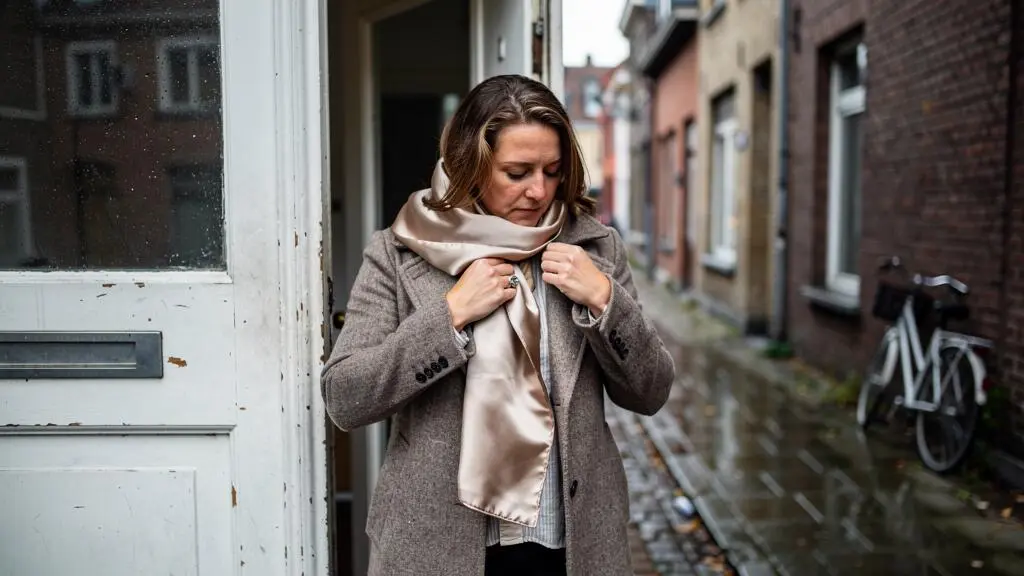
When scarves, coats and hoods become everyday clothing in Belgium, hair can experience repeated friction long before visible split ends appear. Strands catch against wool, move across coat collars and become tangled during windy commutes. Over time, that mechanical stress may contribute to breakage around the shoulders and mid-lengths, even when the hair looks healthy near the roots.
Protecting the hair shaft starts with reducing repeated rubbing, keeping vulnerable lengths away from clothing and handling damp hair gently. A smoother contact layer, a comfortable protective hairstyle and sensible drying habits can be more useful than repeatedly trimming hair without identifying what damages it.
The challenge is not simply Belgium’s changeable weather. It is the combination of wind, rain, indoor heating, commuting accessories and everyday grooming. These factors affect hair differently depending on its texture, length and previous chemical or heat exposure.
A practical winter routine should therefore protect the places where hair contacts fabric, minimise unnecessary manipulation and preserve access to the scalp without creating new tension.
How to reduce seasonal hair breakage in Belgium
- Keep mid-lengths and ends away from rough scarves, coat collars, helmet straps and backpack straps wherever practical.
- Use gentle detangling, conditioning and low-temperature drying appropriate to your hair texture.
- Choose loose protective styles, inspect recurring breakage points and trim damaged ends when necessary rather than relying on cutting alone.
- Why Does Hair Break in the Middle of the Shaft Instead of at the Ends After a Windy Week?
- How to Reduce Hair Friction With One Fabric Change and a 2-Minute Morning Habit?
- Silk Pillowcase or Loose Braid: Which Protects Hair Better Overnight?
- The Wet-Hair Brushing Mistake That Can Double Breakage in 30 Days
- When Should You Trim Hair Versus Change Your Routine if You See Constant Breakage?
- How to Maintain a Protective Style With a Weekly 15-Minute Routine Without Frizz Explosion?
- How to Dry Hair So the Cuticle Lies Flatter Without Using High Heat?
- Which Protective Style Helps You Retain Length Without Itching or Build-Up in Belgium?
Why Does Hair Break in the Middle of the Shaft Instead of at the Ends After a Windy Week?
Hair can break in the middle because repeated bending, tangling and friction weaken sections of the shaft that regularly encounter mechanical stress. During windy Belgian weather, strands may rub against scarves, coat collars or one another. Unlike split ends, which begin at the tips, mid-shaft breakage can appear wherever accumulated damage makes a fibre vulnerable.
A hair strand is protected by overlapping cuticle cells and a surface lipid layer. These structures influence friction and help the fibre withstand everyday handling. As hair becomes weathered through brushing, styling and environmental exposure, the surface can become rougher and more prone to catching on neighbouring strands.
A scientific review of human hair friction explains how cuticle structure, surface lipids, conditioning and environmental factors influence interactions between hair fibres. It supports understanding cumulative friction, although it does not establish that winter scarves inevitably cause breakage at shoulder height.
Consider a typical hypothetical commute in Brussels. Someone wears loose shoulder-length hair beneath a wool scarf while walking to public transport. Gusts of wind move the exposed strands, while the scarf and collar repeatedly contact approximately the same area. After several weeks, short broken hairs may become particularly noticeable around that height.
The important distinction is between a plausible wear pattern and a confirmed diagnosis. Wind, moisture fluctuations, bleaching, tight hairstyles and heat exposure may contribute simultaneously. A single windy week does not necessarily create all the damage noticed afterwards.
Look at the location and shape of the damage. Split or frayed tips suggest deterioration near the ends. Numerous shorter strands emerging around a recurring clothing-contact zone may suggest breakage higher up. Full-length hairs with a visible root bulb are more consistent with shedding than snapping.
Gently examining a detached strand may reveal brittleness, but a home stretch test cannot reliably distinguish mechanical trauma from protein deficiency. Hair elasticity varies with moisture, texture and previous treatments. Avoid interpreting one snapped strand as a diagnosis.
The collar line deserves particular attention. Hair worn loose beneath wool or textured synthetic fabric may experience repeated rubbing there even when heat styling is minimal.
Once the recurring stress zone is identified, the next priority is reducing contact at that location rather than assuming the entire length needs cutting.
How to Reduce Hair Friction With One Fabric Change and a 2-Minute Morning Habit?
Start by replacing the rough surface touching your hair with a smoother contact layer, such as a satin-lined scarf or collar insert. Then spend approximately two minutes gently separating tangles, applying a small amount of suitable leave-in conditioner and positioning the lengths away from clothing. The aim is to reduce repeated friction without changing your entire winter wardrobe.
Fabric choice matters because the surface touching the strands determines how readily hair may catch or move during everyday wear. However, textile names alone do not predict hair damage: weave, finish, seam placement, moisture and the condition of the hair also influence contact.
| Fabric or contact layer | Potential concern | Practical adjustment |
|---|---|---|
| Textured wool | Raised fibres can catch loose strands. | Use a smooth lining where hair touches the scarf. |
| Acrylic knit | Texture and static may complicate detangling. | Keep lengths away from the knit surface. |
| Cotton collar | Repeated rubbing may contribute to tangles. | Reduce contact or add a smooth removable layer. |
| Satin-finished lining | Its smooth surface may reduce snagging, but results depend on construction. | Check seams, fit and whether the lining remains smooth during movement. |
This comparison is practical material-selection guidance, not a laboratory ranking. The available evidence does not establish a precise breakage reduction for switching between these fabrics.
A simple morning routine can be organised into three actions:
- First 40 seconds: gently separate visible tangles, beginning at the ends and working upward without pulling.
- Next 40 seconds: distribute a small amount of leave-in conditioner along the mid-lengths and ends. Add a little oil only if your hair tolerates it without becoming greasy.
- Final 40 seconds: arrange the hair in a loose bun, braid or tucked style above the roughest collar contact area.
The two-minute timing is a practical target, not an experimentally validated treatment duration. Thick, tightly curled or heavily tangled hair may need considerably more time and a different detangling approach.
Protecting the contact zone can be more convenient than replacing an expensive coat. A removable smooth scarf lining or carefully secured satin strip may help prevent direct rubbing at the nape. Avoid pins or exposed fasteners that could catch hair, and check that the added fabric does not slip into an uncomfortable position.
Commuters should also examine pressure points created by cycling helmets, hoods and backpack straps. A helmet must remain correctly fitted; never compromise its positioning or straps for a hairstyle. Instead, gather loose lengths away from strap junctions and make sure they do not become trapped beneath backpack straps.
Consistent friction reduction is more valuable than applying large amounts of product. Once the daytime contact points are controlled, overnight movement becomes the next practical consideration.
Silk Pillowcase or Loose Braid: Which Protects Hair Better Overnight?
A silk pillowcase and a loose braid address different potential causes of overnight tangling. A smooth pillowcase aims to reduce friction against bedding, while a relaxed braid limits how freely longer strands move and intertwine. Neither has been established as universally superior. Hair length, texture, sleeping habits and sensitivity to tension determine which approach is more practical.
For shorter or heavily layered hair, a smooth pillowcase may be the easier option because short sections can escape a braid. For long hair, loosely gathering the lengths can make morning detangling easier by limiting uncontrolled movement during sleep.
| Hair situation | Practical starting option | Important limitation |
|---|---|---|
| Short or layered hair | Smooth pillowcase | Cannot prevent all movement or tangling. |
| Long, easily tangled hair | Loose braid with a soft tie | Tight braiding can create tension and localised damage. |
| Long hair with substantial bedding friction | Smooth pillowcase plus relaxed braid | The combination has not been proven superior for every texture. |
| Very curly or coily hair | Loose twists, an appropriate bonnet or another comfortable low-tension arrangement | The choice must respect texture, scalp comfort and existing styling needs. |
Silk is a fibre, whereas satin describes a weave that can be made from several materials. A well-finished satin pillowcase may offer a smooth surface without requiring natural silk. There is insufficient evidence in the supplied research to promise a specific percentage reduction in breakage from either option.
Loose is the essential condition for a protective braid. If the hairstyle pulls at the temples, causes scalp tenderness or leaves strands tightly stretched around the hairline, it may introduce a more consequential problem than the friction it was intended to reduce.
Winter heating adds another consideration. Hair exposed to changes in indoor humidity may feel different and become harder to manage, although dry indoor air does not establish a fixed amount of overnight damage. A small amount of conditioner on dry lengths may improve manageability. Avoid making a braid unnecessarily wet before bed or assuming that adding water or oil always reduces friction.
In practice, test one comfortable option for several nights and evaluate morning tangles, scalp comfort and visible snapping. These observations are more useful than treating the choice as a competition between expensive accessories.
A successful overnight routine should leave the hair easy to handle in the morning, particularly before washing or detangling when the fibres may be more vulnerable.
The Wet-Hair Brushing Mistake That Can Double Breakage in 30 Days
Aggressively brushing wet hair can contribute to breakage, especially when tangles are pulled from the roots toward the ends. However, there is no reliable evidence in the supplied sources that this habit doubles breakage within 30 days. Safer detangling depends on hair texture: partially dry straight hair and damp, conditioned tightly curled hair generally require different handling.
Hair changes mechanically when it absorbs water. Wet fibres become more extensible, and repeated pulling can still produce damage. The practical problem is not moisture alone but the combination of tension, snagging, forceful brushing and existing fibre weakness.
The American Academy of Dermatology hair-damage prevention recommendations advise gentle handling, conditioning and wide-tooth combs. They recommend allowing straight hair to dry somewhat before detangling while recognising that tightly curled or textured hair may be easier to detangle while damp.
Two habits are particularly worth changing: using force on heavily tangled hair and dragging a brush from the roots down through knots. Even a suitable comb can cause unnecessary pulling when the starting point and technique are wrong.
Use a gentle sequence after washing. Blot excess moisture with a microfiber towel or soft cotton T-shirt rather than rubbing vigorously. Apply conditioner or a compatible detangling product to provide slip. Separate the ends into manageable sections, release knots with minimal force and work gradually upward.
For tightly curled hair, detangling while damp and conditioned may be preferable to waiting until the hair is dry. For straight hair, allow some drying time first. Stop when resistance increases instead of repeatedly pulling through the same knot.
Belgian commuting conditions make wash timing relevant. Leaving home with damp hair trapped inside a scarf or hood may prolong contact between vulnerable strands and fabric. Washing earlier, drying indoors or completing a gentle low-heat finish can reduce that exposure.
Five checks for a gentler wash-day routine
- Blot freshly washed hair without scrubbing it; check that the towel has absorbed excess water without creating new tangles.
- Apply a suitable conditioner or detangler; confirm that your fingers or comb move more easily through a small section.
- Divide the hair into manageable sections; identify one section that can be detangled without force.
- Start at the tips and move upward; check that knots release without repeated hard pulling.
- Before putting on a coat or scarf, check whether the hair is sufficiently dry or positioned away from rough fabric.
To evaluate your results, observe visible short broken fragments and recurring knot locations over comparable wash days. Simply counting hairs on a brush is unreliable because naturally shed hairs and broken fibres are not the same measurement.
Improved handling may prevent additional damage, but it cannot restore a fibre that has already fractured. That distinction matters when deciding whether a trim is necessary.
When Should You Trim Hair Versus Change Your Routine if You See Constant Breakage?
Trim hair when the ends are visibly split, frayed or difficult to detangle because of localised damage. Change the routine when snapping repeatedly occurs higher along the shaft, particularly near collars, hair ties or other contact points. Both approaches may be necessary, but removing damaged hair without correcting ongoing mechanical stress does not prevent new breakage.
Trimming removes the compromised ends of individual fibres. It cannot change the friction, tension or grooming practices that affected them. Conversely, changing a routine may reduce future wear, but it does not permanently reconnect split cuticles or repair a snapped strand.
The most useful decision starts with the location of the problem.
| Observed pattern | First response | Reason |
|---|---|---|
| Splitting or fraying concentrated near the tips | Discuss a targeted trim. | Damaged ends cannot be permanently repaired with conditioning. |
| Short broken sections around collar height | Review fabric contact and daily styling. | Repeated mechanical contact may be contributing to localised damage. |
| Breakage concentrated around a tight hair tie | Reduce tension and change the fastening method. | A repeated pressure point can aggravate weakened fibres. |
| Widespread fragility after bleaching or frequent heating | Review chemical and thermal exposure; obtain professional advice. | Multiple forms of fibre damage may coexist. |
| Visible thinning, scalp symptoms or persistent unexplained loss | Seek dermatological assessment. | Hair loss from the follicle requires a different assessment from shaft breakage. |
Frequent micro-trims are not automatically the answer to poor length retention. If a scarf continues to rub the same section every day, the hair may keep breaking even when the ends are regularly refreshed.
Before visiting a hairdresser, record three observations: where the short pieces appear, whether the damage is concentrated or widespread, and when it became noticeable. Bring information about recent colouring, heat styling and changes in winter clothing.
A useful consultation might describe repeated snapping near the shoulders since returning to daily scarf use, while asking whether the ends also need trimming. This provides a clearer basis for assessment than requesting a substantial cut without discussing the pattern.
If several changes fail to improve the situation or hair thinning becomes noticeable, professional evaluation is appropriate. Breakage and shedding can overlap, and visual inspection at home cannot establish every underlying cause.
Once existing damage has been assessed, ongoing protection depends on a hairstyle that can be maintained without excessive pulling or constant restyling.
How to Maintain a Protective Style With a Weekly 15-Minute Routine Without Frizz Explosion?
A weekly 15-minute maintenance session can help keep a protective hairstyle comfortable and functional by checking the scalp, refreshing exposed lengths, adjusting pressure points and inspecting clothing contact. The goal is not to eliminate every flyaway strand. It is to preserve protection without adding excessive product, repeated manipulation or tension.
Frizz can arise from several causes, including humidity, natural texture, shorter new growth and mechanical wear. It should not automatically be interpreted as evidence that a hairstyle has failed or that the hair needs stronger products.
For a simple bun, loose twists or an accessible braided style, the following schedule provides a manageable starting framework. The timings are organisational estimates rather than a scientifically validated maintenance protocol.
- Minutes 0–4: Scalp check and refresh. Inspect the scalp for visible residue, tenderness or irritation. Refresh or cleanse as appropriate for the hairstyle and your usual washing schedule. A quick refresh does not replace a thorough wash when cleansing is needed.
- Minutes 4–8: Mid-length care. Apply a modest amount of suitable leave-in conditioner to accessible lengths, concentrating on areas exposed to rubbing. Avoid repeatedly layering heavy products.
- Minutes 8–12: Pressure-point adjustment. Check whether ties, clips or braids have shifted. Loosen uncomfortable sections and reposition the style without pulling at the roots.
- Minutes 12–15: Fabric inspection. Put on the usual scarf, hood or coat and check that the lengths remain away from the roughest contact areas.
A protective style that has become slightly untidy may still be doing its job. Resetting it every time a few hairs escape can increase manipulation. On the other hand, a style that pulls, traps hair beneath a strap or produces persistent discomfort should be adjusted or removed rather than maintained for appearance alone.
Belgian weather creates practical reasons to vary the maintenance schedule. After a windy cycling commute or several rainy days, examine the exposed sections sooner. During mostly indoor weeks, there may be less need to disturb a comfortable style.
Use less product when build-up is the problem. Repeatedly applying thick creams to control flyaways can leave residue without correcting the rubbing that produces tangles. A smoother lining or a better-positioned hairstyle may be the more appropriate response.
Styles that remain installed for multiple weeks require maintenance suited to the individual’s scalp, hair texture and construction of the style. The 15-minute framework is not a substitute for washing, drying or professional care when those activities require more time.
A comfortable style should make ordinary grooming easier. Drying technique is another important part of that process, especially before cold-weather commuting.
How to Dry Hair So the Cuticle Lies Flatter Without Using High Heat?
Gentle drying reduces unnecessary mechanical and thermal stress by combining blotting, controlled airflow and moderate temperatures. Start by absorbing excess water without rubbing, then use a low-heat dryer if needed while keeping it moving and away from the hair. Conditioning and careful handling help reduce tangling, although a cool shot does not permanently seal the cuticle.
The cuticle consists of overlapping cells that protect the inner structure of the hair. Its condition is influenced by chemical treatments, weathering, grooming and heat. Drying does not simply open or close these cells like a mechanical switch, and no single technique guarantees perfectly flat cuticles.
An experimental study on hair-dryer temperature and hair-shaft damage compared repeated drying conditions on human hair tresses. Higher temperatures generally produced greater hair-surface damage. Under the study’s controlled conditions, a continuously moving dryer held approximately 15 cm away produced favourable results compared with natural drying on some structural measures.
The experiment does not prove that blow-drying is universally safer than air-drying. Hair texture, equipment, prior damage and actual temperatures remain important variables.
For everyday drying, a practical sequence is:
- Gently squeeze out excess water after washing, avoiding twisting or pulling the lengths.
- Blot with a microfiber towel or soft cotton T-shirt instead of rubbing the hair vigorously.
- Use an absorbent wrap briefly if suitable, removing it before it becomes uncomfortable or creates additional tangles.
- Allow some indoor drying, then finish with cool or low-temperature airflow if necessary. Keep the dryer moving and avoid holding it close to one section.
- Direct airflow gently along the lengths when useful for your texture, or use a diffuser for curls. A cool finish may improve comfort and styling control, but should not be presented as a permanent cuticle-sealing treatment.
Consider when the hair will meet winter clothing. On mornings when a scarf, hood or coat will cover the lengths immediately, spending additional time drying indoors can limit prolonged damp contact with fabric.
Air-drying is not inherently damaging, and many people prefer it successfully. The concern is leaving hair damp for extended periods while it is repeatedly rubbed, compressed or manipulated. In that situation, a gentle drying finish may be a sensible alternative to going outside with wet lengths.
High heat remains avoidable. Repeated close exposure should not be considered necessary merely because the weather is cold or the morning is rushed.
Once the hair is prepared for outdoor contact, the remaining decision is how to arrange it comfortably throughout the colder months.
Key takeaways before choosing a protective style
- Prioritise a hairstyle that keeps fragile ends away from collars and scarves without pulling at the hairline.
- Choose a construction that allows realistic scalp cleansing and access to areas where product residue accumulates.
- Reassess the hairstyle after changes in commuting habits, weather exposure or breakage patterns rather than keeping an uncomfortable arrangement.
Which Protective Style Helps You Retain Length Without Itching or Build-Up in Belgium?
A loose tucked updo or low-tension bun is often a practical starting point for protecting medium to long hair beneath Belgian winter clothing. Braids and twists can also reduce loose-end exposure when installed comfortably. The best choice keeps vulnerable lengths away from rough fabric, permits regular scalp care and does not create persistent pulling, irritation or excessive product build-up.
No protective hairstyle guarantees length retention. Its value depends on the balance between reduced daily manipulation and any tension or rubbing introduced by the style itself.
The American Academy of Dermatology advice on traction-related hair loss warns that tightly pulled hairstyles and repeated rubbing from hair coverings can contribute to hair-loss problems. Traction alopecia affects hair follicles and should not be confused with isolated mid-shaft fibre breakage, although the same routine may expose hair to several kinds of stress.
The following comparison uses practical selection criteria rather than clinical performance scores. Actual results depend on styling technique, hair texture and how long each arrangement is worn.
| Style | End protection | Tension considerations | Scalp and build-up considerations |
|---|---|---|---|
| Loose low bun | Can enclose ends, provided the bun sits clear of the coat collar. | Use soft fastening and avoid tight pulling. | Usually easy to release for washing and inspection. |
| Loose braided style | Keeps lengths gathered but may leave the braid ends exposed. | Avoid tight roots and pressure from hair ties. | Accessibility depends on how the braids are arranged. |
| Twists | Can reduce loose-end movement when ends are tucked. | Installation should remain comfortable at the roots. | Cleaning access and residue depend on the construction and products used. |
| Tucked updo | Can keep ends away from scarves and collars. | Check that clips and pins do not create pressure points. | Typically practical to undo for regular cleansing. |
For someone commuting daily between Antwerp, Brussels or Ghent, a style that fits beneath a hood without shifting may be more useful than an elaborate arrangement that repeatedly catches against clothing.
Helmet wearers need an additional check. Hair must not interfere with the helmet’s proper fit, and no hairstyle should require loosening safety straps. A low-profile arrangement that works with the helmet is preferable to a bulky bun underneath it.
Scalp comfort should determine how long a style remains installed. Itching can reflect product residue, irritation, dandruff or other scalp conditions rather than the hairstyle alone. Heavy butters and repeated product layering may make cleansing more difficult, but persistent itching should not automatically be attributed to build-up.
If scalp discomfort persists despite appropriate cleansing, or if redness, scaling, pain or noticeable hair loss develops, seek dermatological advice. Increasing the frequency of styling or applying more oil may not address the underlying issue.
Build a repeatable winter cycle instead of keeping one style indefinitely. Wear a comfortable arrangement while it remains functional, remove or adjust it when tension develops, cleanse according to your scalp’s needs and inspect areas that contact clothing. Between styles, allow time for gentle detangling and assessment of damaged ends.
Rest periods can be useful for checking the hair and avoiding continuous tension, although a fixed number of rest days is not established by the supplied research. If the same collar-height breakage keeps appearing, reconsider the contact layer before committing to a more complicated hairstyle.
Start with one comfortable low-tension style and one smoother contact layer for the next series of commutes. Observe tangling, visible broken strands and scalp comfort, then make targeted adjustments. That creates a manageable winter hair-protection routine without unnecessary cutting, excessive products or complicated daily styling.
Can wearing a wool scarf every day damage otherwise healthy hair?
Repeated rubbing against a textured scarf may contribute to tangling and mechanical wear, particularly when hair is already weathered or chemically treated. However, wearing wool does not automatically cause breakage. A smooth contact layer and a hairstyle that limits rubbing are sensible preventive measures.
Does rain itself cause hair breakage during a Belgian commute?
Ordinary rain exposure does not automatically break healthy hair. The more relevant concern is how damp hair is handled, tangled or rubbed against clothing. Avoid forceful detangling and prolonged damp friction where practical, while following handling advice appropriate to your hair texture.
Should hair oil be applied every time a scarf is worn?
Not necessarily. A suitable conditioner or light leave-in product may help manage friction and tangling, but adding oil every day can be unnecessary and may contribute to residue. Product choice and quantity should reflect hair texture, existing conditioning and how the hair responds.
How can you tell whether short hairs are new growth or breakage?
Short hairs alone cannot establish the cause. Visible fractured or frayed ends, combined with a recurring stress location, may suggest breakage. Gradually emerging shorter hairs may represent new growth. If the distinction is unclear, especially alongside thinning or scalp symptoms, a dermatologist can provide a more reliable assessment.
Is a silk-lined bonnet necessary for healthy hair in winter?
No. A comfortable bonnet with a smooth lining may be useful for some people, but it is not an essential product or a guaranteed prevention method. A suitable pillowcase, loose overnight style and gentle morning detangling may be sufficient. The priority is reducing unnecessary friction without introducing scalp pressure or tension.