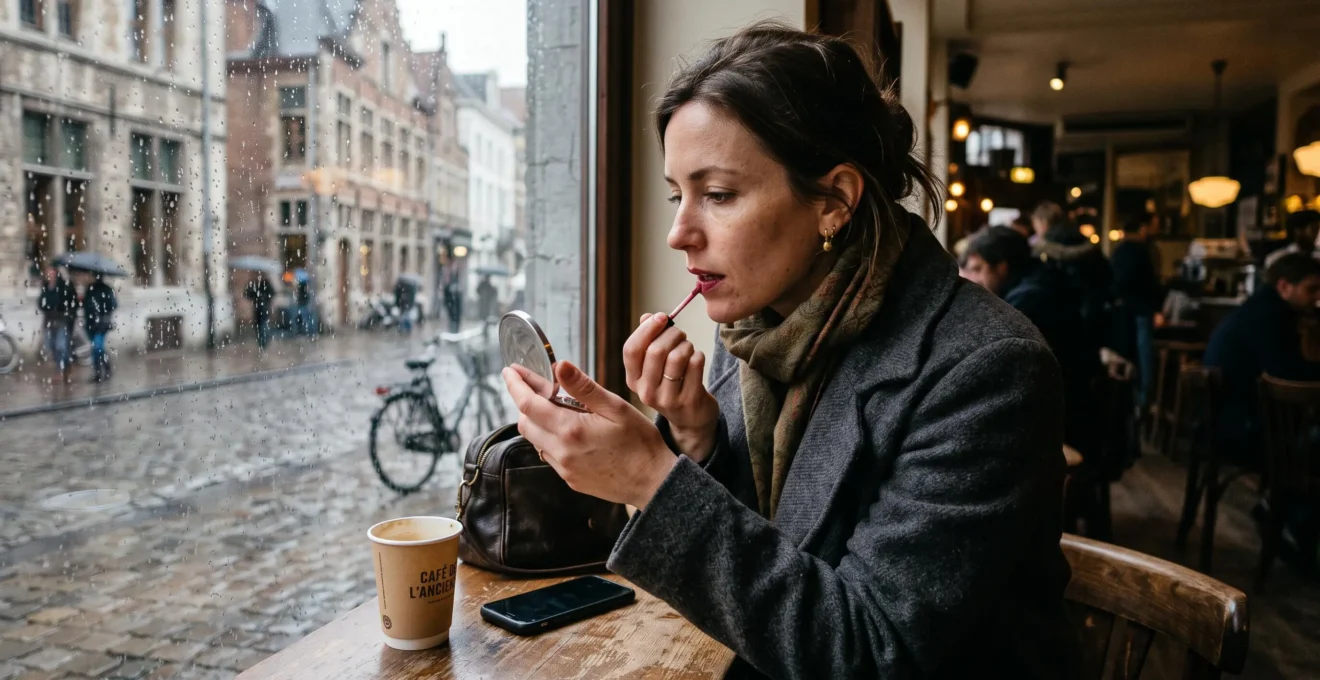
A lip stain that looks fresh on the train to Brussels but leaves uneven, tight-feeling lips by the afternoon is hardly low-maintenance. The challenge is finding colour that survives ordinary contact with coffee cups, lunch and occasional mask-wearing without making comfort an afterthought.
The best practical choice is a stain that fades evenly and remains comfortable after its initial glossy or watery layer has disappeared. A gel-style stain may be a sensible starting point for lips prone to dryness, while a lightweight water tint can suit someone who prioritises colour intensity and already has a smooth lip surface. Neither format guarantees six-hour wear.
For Belgian professionals and students, the most useful test is not how a stain looks immediately after application. It is how the colour and the lips themselves feel after commuting, drinking, eating and moving between outdoor weather and heated interiors. Formula, preparation and application all matter, and there are simple ways to assess them without buying an entire collection.
Hydrating lip stains: the practical verdict
- Prioritise even fading over maximum pigmentation. A stain that softens gradually usually needs less corrective makeup than one that leaves dark patches.
- Prepare lips in advance. Keep them conditioned, remove excess balm before application and avoid aggressive exfoliation.
- Test real-life comfort. Check the stain after coffee, at lunch and after six hours, paying attention to tightness as well as colour.
- Why Can a « Hydrating » Lip Stain Still Feel Dry After 90 Minutes?
- How to Apply Lip Stain Evenly So It Doesn’t Go Patchy After Your First Drink?
- Water Tint or Gel Stain: Which Leaves More Even Colour After 6 Hours?
- The Flaky-Lip Mistake That Makes Lip Stain Turn Dark in Random Patches
- When Should You Choose a Lip Stain Instead of Lipstick for a Low-Maintenance Day?
- How to Prep Skin for Foundation With Only 2 Products So It Lasts to 18:00 — and What It Teaches You About Prepping Lips for a Full-Day Stain
- How to Prep Lips Without Making the Colour Slip Off (What Matte Liquid Lipstick Teaches Us About Lip Stains)
- How Do You Wear Long-Wear Lip Colour Without Cracks After 2 Hours in Belgian Winter?
Why Can a « Hydrating » Lip Stain Still Feel Dry After 90 Minutes?
A hydrating lip stain can feel comfortable when first applied yet leave the lips tight after its liquid phase evaporates. Some long-wear formulas rely on volatile ingredients and film-forming materials that help colour resist transfer. The initial sensation of moisture does not necessarily mean the lips will remain comfortable once the colour has set.
The distinction is between comfort during application and comfort after drying. A watery or glossy texture may spread easily, but the remaining colour film has different properties. Some films remain flexible; others can feel stiff or uncomfortable, especially on lips that were already dry.
A 2022 study on long-lasting lipstick film-forming resins examined this problem in experimental lipstick formulations. Researchers found that a newly designed silicone resin improved film properties and reduced perceived dryness compared with the conventional formulation tested.
The research is relevant to understanding long-wear cosmetics, although it does not show that every commercial lip stain will dry out after 90 minutes. That time is better treated as a useful checkpoint than a scientifically established threshold.
Ingredient lists offer clues, but not a definitive comfort score. Look at the complete formulation rather than assuming that the word « hydrating » or the presence of a single moisturising ingredient guarantees results. Humectants such as glycerin can support moisture retention, while emollients and nonvolatile oils may influence how supple a formula feels. Their concentration, compatibility and interaction with the film matter.
Adding balm over a dried stain can improve comfort, although it may also change the finish or disturb some formulas. It is not correct to assume that every balm necessarily breaks every colour film.
In Belgium, a winter commute may involve wind outside and heating indoors. These changing conditions are relevant to lip comfort, but they do not establish that stains evaporate faster in Belgian weather than elsewhere.
Try a coffee-break comfort test: apply a tester according to hygiene rules, preferably using a disposable applicator, allow it to set and check how it feels after a drink. If store testing is impractical, repeat the test at home with a product you own. Assess tightness, stinging and colour transfer separately.
A stain that feels tight soon after setting is unlikely to become a pleasant all-day option simply because its colour remains visible. Once comfort is acceptable, application technique becomes the next factor to test.
How to Apply Lip Stain Evenly So It Doesn’t Go Patchy After Your First Drink?
Apply lip stain in thin, controlled layers on smooth lips without excess balm. Allow the first layer to set before adding colour only where necessary. This reduces the risk of uneven buildup, while gentle blotting after drinking avoids rubbing a partially worn finish into darker borders or irregular patches.
Patchiness can arise from two different problems. The stain may have been distributed unevenly while wet, or it may adhere differently across the lip surface because some areas are smoother, drier or more exposed to saliva.
The inner lip is particularly challenging because it is frequently exposed to moisture. A heavy application near that boundary may wear differently from the rest of the colour. However, the precise way a stain behaves depends on its formulation, so not every patch should be attributed to a film being pulled away by a drink.
A two-pass approach is worth testing:
- Start with a minimal amount. Remove obvious excess product from the applicator and distribute a thin layer across the lips.
- Let the first layer set. Follow the product’s drying instructions rather than repeatedly pressing the lips together while it remains wet.
- Inspect the colour. Check the corners, inner lip border and centre in natural light.
- Add a targeted second pass. Apply a little more colour only where needed, rather than covering the entire lip with another heavy coat.
- Finish with a gentle blot if necessary. Remove loose excess without scrubbing away the stain.
This is a practical application method, not a clinically validated technique that guarantees longer wear. Some water tints set quickly and work better with immediate blending, while others permit gradual layering. The instructions on the specific product should take precedence.
After coffee, press a tissue lightly against the lips if necessary. Avoid repeatedly rubbing the lips together, particularly when the finish is tacky. Constant friction can affect the appearance of products that leave a surface film.
Also inspect the inner edge after application. Removing obvious excess from the wet inner lip boundary can sometimes prevent an uneven line later, but avoid wiping away the colour aggressively once it has set.
For a typical Belgian morning involving a train journey and a takeaway coffee, this controlled approach is more useful than trying to achieve maximum intensity in one application.
Once the technique is consistent, comparing different stain formats becomes more meaningful: otherwise, differences in application may be mistaken for differences in formula performance.
Water Tint or Gel Stain: Which Leaves More Even Colour After 6 Hours?
Neither water tints nor gel stains can be declared universally better after six hours without testing the actual products. Water tints often feel lightweight and leave noticeable colour, while gel stains may offer more cushioning during application. For everyday wear, choose whichever formula fades more evenly on your lips without producing unacceptable tightness.
Water-based tints are often designed to spread thinly and set relatively quickly. Their colour may remain noticeable after the surface liquid disappears, but uneven distribution can become obvious on dry areas.
Gel stains usually have a thicker application texture, which may make controlled spreading easier. Some feel more comfortable initially, although the presence of a gel texture does not establish how much pigment remains after lunch or several drinks.
The table below describes useful shopping tendencies rather than verified six-hour results for every product in each category.
| Criterion | Water tint | Gel stain |
|---|---|---|
| Application feel | Usually thin and fluid | Usually thicker or more cushioned |
| Blending | May need quick, controlled spreading | Can offer more working time, depending on formula |
| Dry patches | Uneven pigment concentration may become obvious | Can also cling to dry areas |
| Colour intensity | Often suitable for a sheer but noticeable stain | Ranges from sheer to highly pigmented |
| Six-hour uniformity | Requires a product-specific test | Requires a product-specific test |
| Best starting point | Smooth lips and a preference for a light texture | Users seeking more controlled or comfortable application |
If your lips are frequently flaky or sensitive, a gel-style product may be worth testing first, but it should not replace proper lip care. If you want a stronger residual tint, a water-based formula might be appealing, provided it applies evenly.
For frequent coffee breaks and an irregular lunch schedule, uniform fading should matter more than the deepest remaining pigment.
A simple comparison can reveal more than online shade descriptions. Test one formula on one workday and the other on a similar day, keeping your lip preparation and application as consistent as possible. Take photographs at two, four and six hours under similar lighting.
Compare the lip edges, inner boundary, centre and corners. Record whether the colour faded smoothly, darkened in isolated areas or disappeared unevenly. Also note comfort and how many times you felt the need to reapply balm.
Your five-step lip stain wear-test checklist
- Choose two candidates. Record each product name, texture and shade in a comparison note.
- Standardise preparation. Use the same gentle lip-care routine and record any balm applied before either test.
- Photograph at set intervals. Save labelled photos at two, four and six hours under consistent lighting.
- Log everyday contact. Note drinks, meals, mask use and touch-ups so the comparison has context.
- Score colour and comfort separately. Give each product a simple evenness and comfort rating, then identify the one you would willingly wear again.
Six-hour results also depend on the starting condition of the lips. Before rejecting a promising stain as patchy, check whether dry flakes or leftover balm affected the test.
The Flaky-Lip Mistake That Makes Lip Stain Turn Dark in Random Patches
Applying lip stain over loose, flaky skin can produce uneven colour because pigment may collect around rough areas and visible edges. The mistake is trying to hide those flakes under more stain instead of addressing the underlying dryness. Gentle conditioning ahead of application is safer than aggressive scrubbing immediately before wearing colour.
When the lip surface is irregular, even a carefully distributed tint can appear darker around flakes or dry creases. As the colour fades elsewhere, those areas may become more noticeable.
However, not every dark patch is caused by dead skin absorbing extra pigment. Differences in application thickness, product chemistry, saliva exposure and individual lip texture can also contribute. A patchy result alone cannot identify the mechanism.
The important distinction is between genuinely dry lips and lips coated with too much balm. Dryness calls for conditioning; excess balm calls for removing the surplus before colour application. These are different problems and should not be treated with the same solution.
A sensible evening routine starts with a gentle, non-irritating balm. If there are loose flakes that come away easily, a soft damp cloth may help remove them without rubbing. Avoid peeling attached skin, using abrasive scrubs or forcing away flakes from cracked or sore lips.
For irritated or chapped lips, exfoliation may be inappropriate altogether. The priority is repairing and protecting the surface rather than preparing it for long-wear makeup.
The American Academy of Dermatology advice on dry, chapped lips recommends avoiding irritating products and using suitable moisturising ingredients. Examples include petrolatum, dimethicone, ceramides and shea butter. Its recommendations also discourage picking or biting the lips.
Those are lip-care recommendations, not proof that exfoliating the night before guarantees a smoother stain. If a product burns, stings or worsens dryness, discontinue it rather than trying to make it last longer.
On the morning of application, allow any lip treatment to settle and blot away excess grease. Do not repeatedly wipe an already tender surface simply to improve colour adhesion.
Once the lip surface is comfortable and relatively smooth, the remaining decision is whether a stain is actually the best product for the day’s activities.
When Should You Choose a Lip Stain Instead of Lipstick for a Low-Maintenance Day?
Choose a lip stain when you want a lightweight tint that may remain visible after drinks and requires fewer colour touch-ups than your usual lipstick. Choose a moisturising lipstick when comfort, an emollient texture and easy reapplication matter more. For long days, a stain paired with a compatible clear balm can be a useful compromise.
Consider a workday with an early train from Leuven to Brussels, a morning meeting, takeaway lunch and an afternoon presentation. A stain that fades evenly may be easier to manage than an opaque lipstick requiring precise reapplication after every meal.
On a quieter university day or a weekend with fewer commitments, the balance may change. Reapplying a creamy lipstick is not necessarily inconvenient, particularly when lips feel dry and a more nourishing finish is preferred.
The distinction is not simply stain equals durable and lipstick equals comfortable. Some lipsticks are designed for extended wear, while certain stains transfer or disappear quickly. The actual formulation and your tolerance for its finish determine the better choice.
| Daily priority | Lip stain | Moisturising lipstick |
|---|---|---|
| Frequent coffee breaks | Useful if it resists transfer and fades evenly | May need reapplication |
| Long meetings | Potentially fewer colour checks | Comfortable if frequent touch-ups are acceptable |
| Dry or sensitive lips | Choose cautiously; comfort varies | Often a more flexible starting point |
| Meals and snacks | May leave residual colour | Usually easier to refresh evenly |
| Occasional mask use | Transfer resistance may be advantageous | Some creamy finishes transfer more readily |
| Cold, windy weather | Consider a comfortable formula plus balm | Consider a protective, emollient formula |
A hybrid routine is straightforward: apply stain to clean, comfortable lips, let it set and add a small amount of clear balm if needed. Keep the balm available for later, but check whether it changes the wear of your particular stain.
For especially dry lips, the better hybrid may be no stain at all until the irritation settles. Colour longevity should not require enduring persistent discomfort.
In Belgian winter, cold outdoor conditions and heated interiors make practical lip care particularly relevant. The priority may shift towards more emollient products even when that means accepting an additional touch-up.
If a stain remains the preferred option, a minimal preparation routine can help make application more consistent without adding unnecessary products.
How to Prep Skin for Foundation With Only 2 Products So It Lasts to 18:00 — and What It Teaches You About Prepping Lips for a Full-Day Stain
The useful lesson from a simple foundation routine is to prepare the surface without leaving excess product underneath the makeup. For lips, apply a suitable moisturising balm early enough to absorb or settle, then remove the remaining slippery layer before stain application. Extra primers and multiple treatments are not essential to achieve a controlled finish.
Foundation preparation often involves balancing skin comfort with the texture of the makeup applied over it. A similar principle applies to lips: an uncomfortable surface is a poor starting point, but too much residual product can interfere with how some colour formulas adhere.
That does not mean skin and lips require identical products. Facial primers and setting products are not automatically suitable for lip use, and a two-product foundation method has not been shown to guarantee lip-stain wear until 18:00.
For a practical morning routine, start with balm when you wake up. Continue getting dressed, having breakfast or preparing your bag. Shortly before leaving, gently blot away excess balm and check whether the lips feel comfortable.
If they are smooth, proceed with the stain. If they are visibly flaky, do not treat forceful last-minute exfoliation as a necessary step. A little residual dryness is better addressed through ongoing care than aggressive rubbing before makeup.
Timing matters more than adding another product. Applying a thick balm immediately before a stain may make some formulas harder to distribute evenly. Allowing it to settle and removing the surplus makes it easier to assess the colour on its own.
A minimalist routine therefore needs only a suitable lip treatment and the chosen lip stain. A tissue is useful for blotting; it does not need to become another skincare product.
The exact waiting time will vary with the balm, the condition of the lips and the stain. No universal preparation interval is established by the available evidence.
For rushed mornings, applying balm the previous evening and again on waking may be more manageable than attempting to repair chapped lips minutes before a commute.
The same balance becomes particularly important when comparing lip stains with matte liquid lipsticks, since both can be affected by an uneven surface but do not necessarily respond to identical preparation.
How to Prep Lips Without Making the Colour Slip Off (What Matte Liquid Lipstick Teaches Us About Lip Stains)
Prepare lips for either matte liquid lipstick or lip stain by keeping the surface comfortable, smooth and free from excess grease. Blot leftover balm, avoid aggressive exfoliation and let each product set according to its instructions. The main difference is that some matte formulas benefit from carefully managed conditioning, while watery stains may be especially sensitive to slippery layers underneath.
Both formats can produce disappointing results when applied over loose flakes. But they do not behave identically: many matte liquid lipsticks form an opaque surface layer, whereas some stains leave colour with much less visible coating.
A matte liquid lipstick may crack or separate when its film is thick, rigid or disturbed. A stain may instead show uneven pigment distribution or an irregular fading pattern. These are possible outcomes, not universal rules for either category.
Formulation research helps explain why the distinction matters. Journal of Cosmetic Science research on long-wear makeup formulations discusses balancing harder formulation components with compatible softer components, including nonvolatile oils.
The authors identify compatibility and material properties as relevant to long-wear performance. The study concerns colour cosmetics generally; it does not establish an optimal lip-preparation routine or prove that a particular balm will increase wear time.
For daily use, the preparation requirements can be reduced to three practical checks:
- Surface: lips should feel comfortable and have no loose flakes that require picking.
- Residue: remove obvious excess balm or oily product before applying colour.
- Setting: allow the chosen formula to settle or dry as instructed before eating, drinking or layering another product.
Be cautious with creamy lip liner beneath a watery stain. A waxy layer may affect the application of some formulas, although it is not a problem with every product. If precise edges are important, test the liner-and-stain combination before depending on it for a full workday.
Similarly, it would be misleading to say that matte liquid lipstick always needs a protective barrier underneath. Some formulas perform well over fully absorbed balm, while others work best on clean, dry lips. Follow product directions and prioritise comfort.
For dry lips, protective care before bed and during makeup-free periods may be more useful than trying to compensate with a thick coating immediately under long-wear colour.
With formula and preparation addressed, the remaining challenge is maintaining comfort throughout a Belgian winter day without repeatedly disturbing the colour.
Key takeaways before your next long workday
- Do not accept stinging, cracking or persistent tightness as the price of long-lasting colour; lip comfort comes first.
- For an extended day, pack one familiar non-irritating balm and use your existing stain rather than automatically adding more products.
- When colour wears unevenly, decide whether the surface needs gentle care or a small targeted touch-up before applying another full layer.
How Do You Wear Long-Wear Lip Colour Without Cracks After 2 Hours in Belgian Winter?
To reduce cracking and discomfort during a Belgian winter workday, start with well-conditioned lips, apply colour sparingly and protect the lips from unnecessary irritation. Use a compatible balm when needed, avoid licking or picking and refresh uneven areas gently rather than repeatedly layering more product over a cracked finish. No technique guarantees crack-free wear.
Winter creates a particularly demanding routine for lip makeup. A morning might begin with cold wind at a tram stop, continue in a heated office and end with another outdoor commute. Both environmental exposure and the starting condition of the lips can influence comfort.
Belgium’s Royal Meteorological Institute reported a mean temperature of 5.8 °C at Uccle during winter 2026, compared with the 1991–2020 winter normal of 4.1°C. Its observations provide useful local context but do not measure lip hydration or cosmetic wear. Outdoor relative humidity should not be confused with moisture levels inside heated buildings.
Cold and dry conditions are recognised contributors to chapped lips. The American Academy of Dermatology also advises against repeatedly licking the lips, since saliva evaporation can worsen dryness.
These principles support a more protective winter routine, but they do not establish that a given lip stain will start cracking after exactly two hours.
Begin with a formula you already know is comfortable, rather than testing an unfamiliar long-wear product immediately before an important meeting. Apply a thin layer and let it set fully. Keep a non-irritating balm accessible for periods when the lips feel dry.
During the day, use gentle pressing motions if applying balm over remaining colour. This may preserve the appearance better than vigorous rubbing, although some stains will change finish or fade more quickly after balm application.
Drinking enough water supports general hydration, but there is no evidence in the supplied research that drinking water directly extends lip-stain wear. Avoid confusing bodily hydration with the performance of a cosmetic colour film.
If a dark patch appears after lunch, resist applying another thick layer across both lips. Instead, check whether the surface is comfortable and gently blot away loose residue. Add a small amount of stain only where needed, if the product allows targeted application without creating a hard edge.
If the lips are cracked, painful or irritated, prioritise a non-irritating balm over continued stain application. Persistent or worsening symptoms warrant professional advice rather than repeated cosmetic adjustments.
For a hypothetical workday ending at 18:00, a sensible maintenance plan is to assess the finish at the first coffee break, again after lunch and once more before heading home. These checks reveal whether colour is fading attractively and whether the lips still feel comfortable.
The best outcome is not necessarily the strongest remaining colour. It is a finish that still looks intentional without requiring frequent correction or causing discomfort.
For your next full Belgian workday, test a comfortable stain on an ordinary day, photograph its appearance after six hours and record whether you needed balm or colour touch-ups. Keep the product only if it performs acceptably on both evenness and comfort; that is a more useful decision than relying on a long-wear claim alone.
Can you wear lip stain every day without drying out your lips?
Daily use may be comfortable if the formula suits your lips and you maintain appropriate lip care. However, some long-wear products can feel drying, especially when the lips are already chapped. Stop using a product that causes persistent stinging, tightness or irritation, and do not rely on its hydrating label alone.
Does a lip stain always survive coffee and lunch?
No. Transfer resistance and residual colour vary between formulas, meals and application methods. A stain may survive drinking but fade unevenly after food, especially around the inner lip. Check the finish after a normal lunch before treating a product as genuinely low-maintenance.
Can you put clear lip balm over a lip stain?
Yes, provided the balm is suitable for your lips and the stain has had time to set. Balm can improve comfort, but it may alter the finish, increase transfer or affect colour retention. Test the specific combination rather than assuming all balms behave identically.
Should you remove lip stain before bed?
Removing makeup before bed is a sensible routine. Use a gentle remover suitable for lip products, avoid vigorous rubbing and follow with a non-irritating lip balm. If residual tint remains, repeated harsh cleansing may be more damaging than allowing the colour to fade naturally.
Is a more expensive hydrating lip stain necessarily better?
No reliable evidence in the available sources establishes a relationship between price and six-hour lip comfort or colour uniformity. Evaluate the formula on your own lips, including its fading pattern, irritation potential and need for touch-ups. A comfortable, evenly fading product is a better purchase than an expensive stain that requires constant correction.