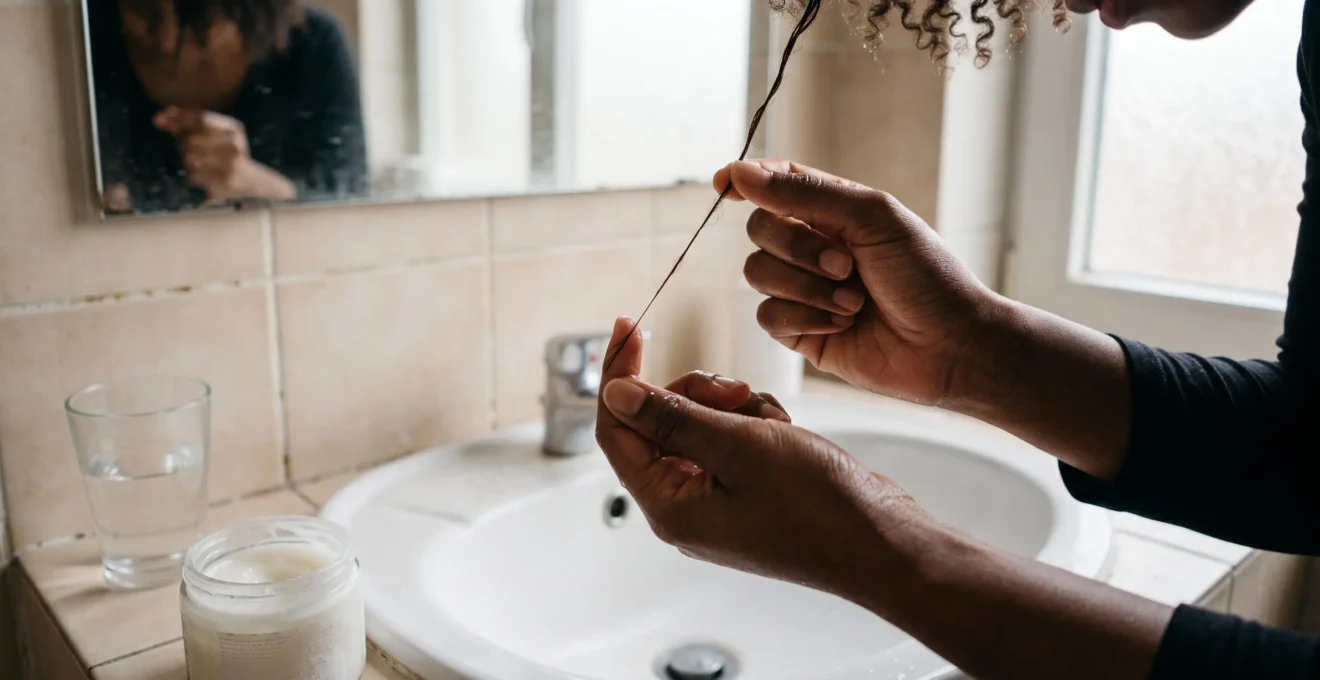
Hair that snaps during detangling, feels unusually stiff or refuses to hold a curl pattern does not automatically need more protein. In Belgium, tap-water minerals may contribute to changes in how hair feels and behaves, particularly when combined with bleaching, heat styling or frequent washing.
Protein treatments can improve certain mechanical properties of damaged hair, but they are not a universal remedy for dryness. Likewise, a deep conditioner may improve softness without addressing mineral deposits, existing structural damage or excessive friction.
The useful question is not simply whether your hair needs moisture or protein. It is whether the problem comes primarily from damage, surface deposits, product use or handling habits. These causes can overlap, and no single home test reliably separates them.
Before adding another strengthening mask, check your local water hardness, examine when your hair breaks and review the products already in your routine. A few controlled adjustments can reveal considerably more than applying several treatments at once.
Protein, moisture or hard water: the essentials
- Protein may help structurally damaged hair, especially after chemical processing, but its effects depend on the formulation and the condition of the fibres.
- Hard-water minerals can change hair stiffness. Check your Belgian water supplier’s hardness information before assuming mineral deposits explain every symptom.
- Start with a simple routine. Use gentle cleansing and conditioning, introduce protein cautiously and adjust based on how your hair responds over successive washes.
- Why Does Hair Break Even When You Deep Condition Every Week?
- How to Start Protein Treatments Once Every 14 Days Without Making Hair Feel Like Straw?
- Keratin or Rice Protein: Which Works Better if Your Curls Won’t Hold Definition?
- The Protein-Overload Mistake That Makes Hair Snap More After 3 Uses
- When Should You Do Protein Treatment If You Also Clarify for Hard Water Build-Up?
- How to Remove Hard-Water Minerals in 2 Washes Without Wrecking Your Hair Texture?
- How to Dry Hair So the Cuticle Lies Flatter Without Using High Heat?
- How Can You Remove Mineral Build-Up From Belgian Tap Water Without Buying 6 New Products?
Why Does Hair Break Even When You Deep Condition Every Week?
Hair can continue breaking despite weekly deep conditioning because softness and structural strength are not the same thing. Conditioning reduces friction and improves manageability, but it cannot fully reverse damage already present in the fibre. Hard-water minerals, chemical processing and rough detangling can also contribute to problems that conditioning alone cannot solve.
Hair consists largely of keratin, a structural protein. Chemical processing, repeated heating and mechanical wear can weaken the fibre. A conditioner may improve lubrication and reduce tangling, yet the underlying damaged areas can remain vulnerable when hair is stretched or manipulated.
Water hardness adds another consideration. Calcium and magnesium can interact with hair fibres. In experimental research on water-hardness metals and hair structure, researchers observed increased fibre stiffness after mineral uptake. Styling effects differed between virgin and bleached hair.
However, the study did not establish that hard water always causes breakage. A separate investigation reported no statistically significant difference in tensile strength or elasticity under its tested conditions. Mineral exposure is therefore a possible contributing factor, not a diagnosis.
To narrow down the problem, observe several characteristics rather than relying on a single sign:
- Short pieces without a root bulb: suggest breakage along the shaft, especially when accompanied by split ends or visible snapping.
- Long strands with a club-shaped root: may represent naturally shed hairs rather than broken fibres.
- Soft, overly stretchy hair: may be heavily conditioned or structurally weakened, particularly after bleaching.
- Rough, stiff or coated hair: may reflect mineral deposits, product residue, previous damage or a combination.
A wet-strand stretch test can be used as an informal observation: gently stretch an already shed strand and notice whether it extends, returns or snaps. Excessive stretching, immediate snapping or stiffness may help describe the problem, but these responses do not reliably diagnose protein deficiency, moisture deficiency or mineral build-up. Avoid pulling attached hairs to test them.
Belgian water hardness varies by supply area. Households served by Farys can consult the Farys municipality water-hardness lookup. Residents using other suppliers should check their own water-distribution company’s information.
Do not assume that all of Flanders, Wallonia or Brussels has the same water hardness. Local water composition matters more than broad regional labels.
Once the possible causes are separated, a cautious protein trial becomes more informative than repeatedly applying stronger masks without knowing what is wrong.
How to Start Protein Treatments Once Every 14 Days Without Making Hair Feel Like Straw?
Start with one mild protein-containing treatment, follow its label instructions and assess your hair over the next two weeks. A 14-day interval is a practical trial schedule, not a scientifically established requirement. If your hair becomes noticeably stiff, tangled or harder to manipulate, stop rather than automatically repeating the treatment.
For a first application, use a rinse-out product that lists a hydrolysed protein among its ingredients. Common examples include hydrolysed keratin, rice protein, wheat protein and silk protein.
Hydrolysis breaks proteins into smaller components, but the ingredient name alone does not reveal how deeply those components penetrate hair. Molecular-weight distribution, concentration and the complete formulation all influence performance.
A conservative beginner routine is:
- Wash with a shampoo appropriate for your scalp and any noticeable residue. Use a mineral-targeting cleanser only if there is a reason to suspect hard-water deposits.
- Apply the protein treatment to damp hair according to the manufacturer’s directions, using the minimum recommended processing time for your first trial when a range is provided.
- Rinse thoroughly and apply a moisturizing conditioner if the product instructions recommend it or your hair needs additional slip.
- Detangle gently, then dry without excessive heat.
- Record how your hair feels once dry and after the next wash before deciding whether to repeat the treatment.
Clarifying first may remove residues that interfere with the feel of a treatment, but there is no direct evidence in the supplied research that protein must always follow mineral removal or that applying it to unclarified hair is ineffective.
Hair that has been bleached, relaxed or repeatedly heat-styled may respond differently from untreated hair. Fine strands may also react differently from coarse strands. Porosity can influence product behaviour, but home porosity assessments are imperfect and should not determine treatment frequency on their own.
For example, a person with chemically processed curls might initially test a treatment every 14 days, while someone with untreated, low-damage hair may find additional protein unnecessary.
Avoid simultaneously introducing a protein shampoo, strengthening mask and protein-containing leave-in. If the hair becomes stiff, it will be difficult to determine which product or combination caused the change.
Your five-step protein trial checklist
- Check the water: save your supplier’s local hardness information or record that it is unavailable.
- Audit your products: write down the hydrolysed proteins listed in your shampoo, mask and leave-in.
- Choose one treatment: note its name, protein ingredients and label processing time.
- Record the first application: enter the date, duration and immediate hair feel in a simple journal.
- Review after the next wash: document softness, tangling, curl definition and breakage before choosing a repeat date.
The most useful treatment interval is the one that provides a noticeable benefit without increasing stiffness or manipulation-related damage. Choosing between specific protein ingredients requires a separate decision.
Keratin or Rice Protein: Which Works Better if Your Curls Won’t Hold Definition?
Hydrolysed keratin is a reasonable ingredient to investigate when curls have lost resilience after chemical damage. Rice protein may be worth trying in a lightweight formulation when hair feels overly soft or lacks body. However, there is insufficient direct comparative evidence to establish that rice protein consistently defines curls better than keratin.
Keratin is the main structural protein in human hair. Hydrolysed keratin treatments contain smaller fragments that may interact with damaged fibres, depending on their molecular characteristics.
A study on hydrolysed keratin penetration and hair strength examined chemically relaxed, tightly curled hair treated with keratin peptides of different molecular weights.
Smaller peptides penetrated more deeply into the hair cortex, while larger peptides were found mainly at or near the surface. Intermediate- and higher-molecular-weight fractions improved certain mechanical measurements related to stiffness and premature breakage under the tested conditions.
This does not mean that all keratin masks produce the same results. The experiment did not compare keratin directly with rice protein, and its findings cannot automatically be transferred to untreated curls or every commercial formulation.
The following comparison is therefore a practical trial framework rather than a scientifically validated ranking.
| Decision factor | Hydrolysed keratin | Hydrolysed rice protein |
|---|---|---|
| Main reason to consider it | Interest in strengthening damaged fibres, particularly chemically processed hair | Interest in experimenting with body or firmness in a lightweight formula |
| Evidence available in the supplied research | Laboratory evidence of mechanical benefits for particular keratin peptide sizes | No direct comparative curl-definition evidence supplied |
| What to monitor | Breakage during handling, flexibility and tangling | Body, curl definition, softness and stiffness |
| Important limitation | Results depend on molecular weight and formulation | Benefits and drying effects cannot be predicted from the ingredient name alone |
If curls feel mushy, stretch excessively and lose definition quickly, assess chemical damage and product buildup before assuming rice protein is the answer. If they are frizzy, rough and prone to snapping, consider whether conditioning, handling habits or existing damage deserve attention before adding keratin.
Hair can also feel simultaneously rough and limp. A mineral-coated surface, a heavily conditioned fibre and existing chemical damage may produce overlapping symptoms.
Where hard-water deposits are suspected, evaluate cleansing first. Then test only one protein formula so its effects are easier to observe.
For low-porosity or easily weighed-down hair, use a small section test before treating the entire head. If it becomes rougher, more tangled or less flexible, that particular formula may not suit your routine.
Neither ingredient should be treated as automatically superior. Product formulation and repeated observations provide a better basis for choosing than claims about protein names alone.
The Protein-Overload Mistake That Makes Hair Snap More After 3 Uses
Hair that becomes progressively stiff or difficult to detangle after several protein treatments may not tolerate the products or frequency being used. The sensible response is to pause additional protein and simplify the routine. However, three applications are not a proven overload threshold, and stiffness alone does not demonstrate that protein has damaged the hair.
The term protein overload is widely used in haircare to describe an undesirable combination of rigidity, roughness and reduced manageability after repeated protein-containing treatments.
It is not a standardized clinical diagnosis. Laboratory research shows that certain hydrolysed keratin fractions can increase fibre stiffness while improving resistance to premature breakage under specific conditions. Increased stiffness is therefore not inherently harmful.
Problems may arise when a treatment leaves hair difficult to manipulate, especially if detangling requires additional force. Mechanical handling can then contribute to breakage, regardless of whether protein is the underlying reason for the change in texture.
Look for a pattern rather than one disappointing wash:
- Hair becomes noticeably harder to detangle after successive treatments.
- Strands feel less flexible or unusually coarse compared with their previous condition.
- A treatment that initially improved manageability stops producing that benefit.
- Breakage increases during styling or detangling despite gentler handling.
These observations can develop after two or three uses, over several weeks or not at all. The number of applications does not identify the cause.
If the pattern appears, pause strengthening treatments and return temporarily to gentle cleansing and a conditioner that provides good slip. Avoid vigorous manipulation, aggressive brushing and unnecessary heat while assessing the change.
A comfortably warm towel over a conditioning treatment may improve the experience, but it is not a proven method for reversing protein overload. Follow the product’s temperature and processing instructions.
Review the whole routine. Hydrolysed proteins may appear in shampoos, sprays, leave-ins and masks. Some bond-building products use different chemical mechanisms and should not automatically be classified as protein treatments.
When several products were introduced together, remove the newest or most suspect products first. Reintroduce them individually only if the hair returns to a manageable state.
If hair continues snapping despite simplifying the routine, investigate chemical damage, friction and scalp-related concerns rather than assuming that more moisturizing masks will always solve the problem.
When Should You Do Protein Treatment If You Also Clarify for Hard Water Build-Up?
If you suspect significant mineral deposits, consider a mineral-targeting wash before assessing the effects of a protein treatment. This sequence may make product testing easier by reducing surface residue. It is not necessary to chelate before every protein application, and scientific evidence does not establish that mineral removal is required for protein ingredients to work.
The first distinction is between clarifying and chelating products.
A conventional clarifying shampoo is designed primarily to remove oils, styling products and other residues. A chelating formulation contains ingredients intended to bind certain metal ions, potentially helping remove mineral deposits associated with hard water.
Ingredients such as disodium EDTA or tetrasodium EDTA can serve chelating functions, although their presence alone does not prove that a finished shampoo will remove a particular amount of calcium or magnesium from hair.
Product concentration, formulation and usage instructions also matter.
| Hair concern | Reasonable cleansing approach | What to avoid assuming |
|---|---|---|
| Heavy styling-product residue | Consider a conventional clarifying shampoo | That ordinary clarifying necessarily removes hard-water metals |
| Suspected mineral deposits and confirmed hard water | Consider a chelating shampoo labelled for mineral removal | That every rough strand is caused by minerals |
| Dry, fragile hair without obvious residue | Prioritise a gentle cleanser and conditioner | That stronger cleansing is always necessary before protein |
For someone with heavily processed curls and suspected deposits, one possible sequence is a chelating wash, thorough rinsing and conditioning. If the hair remains comfortable, a protein trial can be performed during a later wash.
This staggered approach reduces the number of variables changing at once. It also avoids making a fragile fibre undergo several unfamiliar treatments in one session.
If a product specifically instructs users to follow chelation with a protein treatment, follow those directions provided the products are compatible and your hair tolerates them. Otherwise, there is no general requirement to combine them immediately.
A moisture-rich conditioner can improve slip and manageability after cleansing, but conditioning between chelation and protein is not an experimentally validated necessity.
For Belgian households, the frequency of mineral-targeting washes should depend on local water characteristics, visible or tactile buildup, product tolerance and washing habits rather than a fixed weekly rule.
When the mineral concern is substantial, a carefully planned cleansing trial is a more useful next step than immediately increasing protein frequency.
How to Remove Hard-Water Minerals in 2 Washes Without Wrecking Your Hair Texture?
A two-wash approach can separate mineral removal from routine maintenance: use a chelating shampoo when deposits are suspected, then return to a gentle cleansing and conditioning routine at the next wash. Two washes are not a guaranteed mineral-removal threshold. The aim is to reduce suspected deposits while preserving softness, manageability and the hair’s tolerance for cleansing.
A mineral-removing cleanser should be chosen based on its stated purpose, ingredient formulation and usage directions. The supplied research confirms that calcium and magnesium can interact with hair, but it does not establish the efficiency of a particular household chelating procedure.
For textured or chemically treated hair, the following approach limits unnecessary interventions.
- First wash: use a mineral-targeting shampoo as directed. Concentrate on cleansing without vigorously rubbing or piling the lengths together.
- Condition thoroughly: use a conditioner suited to your texture and detangle gently to limit friction.
- Observe the result: notice whether hair feels less coated, more manageable or unchanged once dry.
- Next routine wash: use a gentle shampoo appropriate for your scalp, followed by conditioner. A co-wash may be an option for some routines, although it may not adequately cleanse every scalp.
- Evaluate before repeating chelation: avoid repeated mineral-removing treatments without evidence of a continuing problem.
These are two separate cleansing sessions, not necessarily two shampoos applied consecutively during the same shower. If the chelating cleanser leaves hair particularly dry or tangled, adjust the approach rather than automatically proceeding to another cleansing step.
Some people use a pre-shampoo oil treatment to reduce friction or improve manageability. This may be worth evaluating separately, but it is not an established requirement for effective chelation.
Diluting shampoo with water can change the concentration and distribution of a formulation. It should not be assumed safe or equally effective for every chelating product. Similarly, shortening contact time below the manufacturer’s instructions may reduce performance.
Household vinegar and citric-acid rinses are sometimes suggested as inexpensive ways to manage mineral deposits. Their actual acidity depends on concentration, and the supplied evidence does not establish a safe or effective dilution for textured hair.
Avoid improvising concentrated acidic rinses, particularly on an irritated scalp or immediately after chemical processing. Commercial products designed for hair are easier to use according to established formulation instructions.
Be especially cautious with repeated chelating sessions, excessive processing times and forceful detangling after cleansing. These practices can make already fragile hair harder to manage.
Finally, measure success through practical observations rather than a promised transformation: less coating, easier detangling and improved styling behaviour are useful signs, but they do not prove that all mineral deposits have been removed.
If the hair feels more manageable after cleansing, preserve that improvement through gentle conditioning and drying instead of repeating an intensive wash unnecessarily.
How to Dry Hair So the Cuticle Lies Flatter Without Using High Heat?
To reduce drying-related damage, gently blot excess water, apply a suitable leave-in product and dry with minimal friction and controlled heat. Low or medium dryer settings are generally preferable to excessive heat. Smooth, directional airflow can improve the finished appearance, although a cool-air setting has not been proven to repair or permanently close damaged cuticles.
The cuticle is the outer protective layer of the hair fibre. Chemical treatments, mechanical wear and repeated heat exposure can damage this layer, increasing roughness and tangling.
Drying technique matters because wet hair can be vulnerable to unnecessary stretching and friction. Rubbing vigorously with a conventional terry towel may worsen tangling, especially for curls and coils.
The American Academy of Dermatology healthy-hair recommendations advise gentle towel or T-shirt drying, careful detangling and limiting excessive heat.
A practical low-heat drying sequence is:
- After rinsing, gently press out excess water instead of wringing the hair.
- Blot with a soft cotton T-shirt or microfiber towel without rough rubbing.
- Apply a leave-in conditioner to damp hair if it improves slip and styling.
- For curls, air-dry when practical or use a diffuser at a comfortable low or medium heat setting.
- For a smoother finish, use gentle directional airflow without repeatedly dragging a brush through fragile strands.
Finishing with cool air may help with styling comfort and the temporary feel of the hair, but it should not be described as a method that seals or repairs the cuticle.
Belgian hard-water exposure can remain relevant even after rinsing. When minerals accumulate, hair may feel different during drying and styling, but a rough finish does not establish mineral buildup as the cause.
Using a small amount of suitably treated low-mineral water for a final rinse is a possible personal experiment. However, ordinary boiling does not reliably eliminate every mineral responsible for hardness, and not all domestic filters soften water.
Assess the actual treatment technology before purchasing a filtration product.
For highly textured hair, avoid leaving it tightly compressed in a damp wrap for prolonged periods. Prolonged dampness may be uncomfortable and can complicate drying, while tight wrapping can create unnecessary tension. There is insufficient evidence to claim that sleeping with wet hair inevitably causes cuticle damage.
Once daily handling becomes gentler, it is easier to judge whether additional mineral-focused products are worth purchasing.
Key takeaways before buying another product
- Confirm whether your water supplier reports hard water before treating mineral deposits as the main explanation for breakage.
- Use a chelating cleanser for suspected mineral residue only when needed, and keep regular washing gentle.
- Test protein separately from other major routine changes so improvements or unwanted stiffness are easier to identify.
How Can You Remove Mineral Build-Up From Belgian Tap Water Without Buying 6 New Products?
Most people do not need six specialized products to investigate suspected hard-water buildup. Start by checking local water hardness, then consider one properly formulated chelating shampoo if mineral deposits appear plausible. Maintain a conditioner that already works for your hair and avoid purchasing additional protein masks, acidic rinses or filtration devices before assessing the results.
Belgium has multiple water-distribution networks, and hardness varies by location. The first investment should therefore be a few minutes checking your supplier’s published water-quality information rather than buying a product marketed for hard-water damage.
If your water is relatively soft and your hair is breaking, chemical history, styling habits, conditioning and mechanical friction may deserve more attention.
If your supplier confirms hard water and your hair consistently feels coated after washing, a targeted chelating cleanser may be a reasonable product to evaluate.
Three commonly discussed approaches have different practical limitations.
| Option | Potential benefit | Cost and limitations |
|---|---|---|
| Chelating shampoo | Designed to help manage mineral-related deposits when appropriately formulated | Recurring product expense; may feel drying; requires appropriate conditioning and careful frequency |
| Shower filter | May remove certain water contaminants depending on its technology | Initial purchase and cartridge costs; many conventional filters do not meaningfully soften calcium- and magnesium-rich water |
| Household acidic rinse | Low ingredient cost and commonly discussed as an alternative | Uncertain effectiveness for hair mineral removal; concentration-related irritation risk; no validated DIY dilution in the supplied evidence |
A typical shower filter should not be confused with a genuine water softener. If the goal is to reduce calcium and magnesium, verify that the device is specifically designed and tested for hardness reduction. A cartridge that targets chlorine or sediment does not necessarily address the same problem.
Similarly, vinegar or citric acid should not automatically become part of a minimal routine just because the ingredients are inexpensive. Without reliable formulation guidance, a homemade acidic rinse may add uncertainty rather than remove it.
For someone with textured, bleached or relaxed hair, preserving manageability can matter more than pursuing increasingly aggressive mineral removal. Keep the cleanser appropriate to the hair’s condition, and continue using a conditioner that provides sufficient slip.
Once suspected deposits have been addressed, reassess breakage and curl behaviour. Protein may be worth introducing if substantial damage remains, particularly after chemical processing, but it should be tested separately rather than layered into every wash.
The economical principle is simple: identify the likely cause, change one variable, observe the outcome and buy only what solves a demonstrated problem. No special hard-water routine is justified solely because a household is located in Belgium.
For your next wash, check your local water information, retain a gentle conditioner and change only the cleansing or strengthening step that appears justified. Record how your hair behaves afterward. If substantial breakage or hair loss continues, consult a dermatologist rather than repeatedly escalating home treatments.
Can hard water make curly hair feel as though it has too much protein?
Possibly. Calcium and magnesium can interact with hair fibres, and experimental research has observed increased stiffness after mineral uptake. However, stiffness can also arise from chemical damage, product residue or individual product formulations. The sensation alone cannot distinguish mineral buildup from an undesirable response to protein treatments.
Can protein treatments permanently repair bleached or relaxed hair?
No permanent restoration of chemically damaged hair has been established by the supplied studies. Certain hydrolysed keratin peptides improved mechanical measurements in laboratory experiments on relaxed textured hair, but those results do not mean that a treatment reverses every form of damage or restores the fibre to its original condition.
Does a standard shower filter remove the minerals responsible for Belgian water hardness?
Not necessarily. Many household shower filters focus on other water characteristics and should not be assumed to remove substantial amounts of calcium and magnesium. Check the product’s verified hardness-reduction capability and the water supplier’s local information before investing in a filtration system.
Should low-porosity hair avoid protein entirely?
No universal rule requires low-porosity hair to avoid every protein-containing product. Responses vary with the complete formulation, existing damage and individual hair characteristics. A limited section test and careful observation are more useful than relying exclusively on a porosity label.
When does hair breakage require professional assessment?
Seek medical advice if breakage is persistent or unexplained, or if it occurs alongside increased shedding, visible thinning, bald patches, scalp pain or inflammation. A dermatologist can help distinguish fibre damage from conditions affecting the scalp or hair growth. Protein treatments and chelating shampoos are not substitutes for evaluating these symptoms.