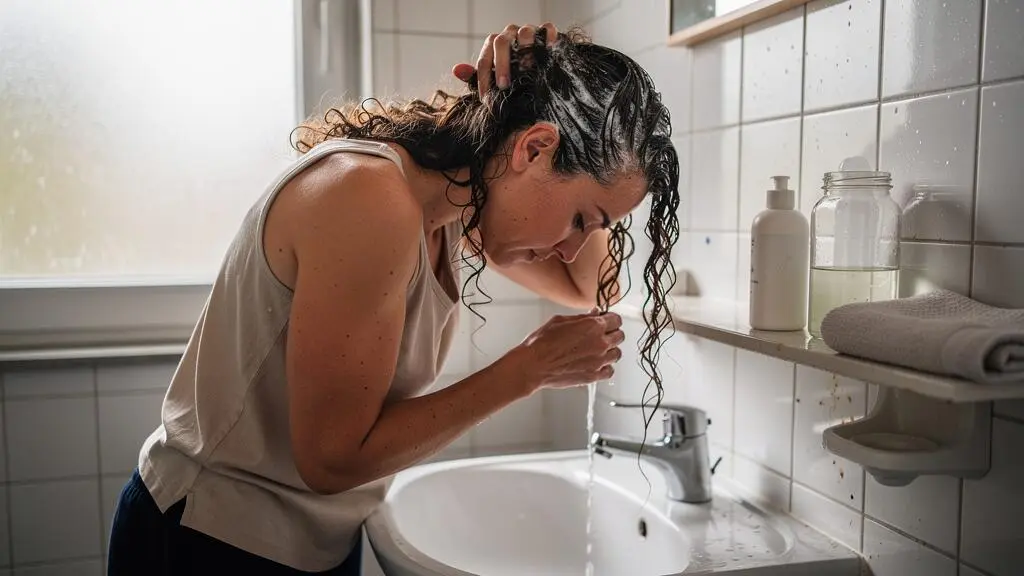
Your conditioner used to leave your hair soft. Now your curls feel rough, detangling takes longer, and even a generous mask seems to disappear without making much difference. Before replacing your entire routine, consider what comes out of your shower.
Belgian tap water can contain substantial amounts of dissolved calcium and magnesium. These minerals contribute to water hardness and can interact with hair fibres. However, hardness varies between supply areas, and rough hair alone does not prove that mineral accumulation is responsible.
The budget-conscious solution is to investigate before buying. Check your local water hardness, examine the ingredients of products already in your bathroom, and consider a targeted chelating shampoo if mineral deposits are a plausible problem. Follow with the conditioner you already own and assess the results.
You do not need six new products, an elaborate curl routine, or an expensive shower attachment to start. The aim is to distinguish deposits from other causes of dryness, remove them without unnecessarily stressing your hair, and develop a manageable maintenance routine.
Hard-water hair care: the essentials
- Check the water first: Belgian hardness levels depend on the supply address, so verify your local water report before blaming your products.
- Choose targeted removal: a chelating shampoo containing a suitable mineral-binding ingredient may be more relevant than an ordinary clarifying shampoo.
- Protect softness: condition after cleansing, reassess your results, and avoid automatic weekly chelation or unverified home remedies.
- Why Does Conditioner Stop Working When Mineral Build-Up Is the Real Problem?
- How to Remove Hard-Water Minerals in 2 Washes Without Wrecking Your Hair Texture?
- Shower Filter or Chelating Shampoo: Which Is More Effective in Hard-Water Belgian Cities?
- The Misdiagnosis Mistake: Treating Mineral Roughness Like Protein Overload
- When Should You Chelate Again if Your Hair Starts Feeling Rough After 3 Weeks?
- How to Identify Your Curl Pattern at Home Without Buying a « Curl Quiz » Product?
- How to Do a Clarifying Rinse Once a Month Without Losing All Your Softness?
- How Do You Clarify Hair in Belgium Without Turning It Dry and Frizzy?
Why Does Conditioner Stop Working When Mineral Build-Up Is the Real Problem?
Conditioner may seem less effective when mineral deposits, product residue, or changes to the hair surface interfere with its normal conditioning effect. Calcium and magnesium can accumulate on hair, but that does not establish that they physically block every conditioner from working. The useful response is to investigate build-up before assuming that your conditioner needs replacing.
Calcium and magnesium are the main dissolved minerals associated with hard water. Certain cleansing ingredients, particularly traditional soap-based surfactants, can react with hardness ions and produce poorly soluble residues. Conditioner formulations behave differently, however, and not every conditioning ingredient forms an insoluble film when exposed to these minerals.
Research reported in the Journal of Cosmetic Science examined mineral uptake by human hair. Its findings showed that hair can retain calcium and magnesium, while the condition of the fibre, including previous oxidative damage, plays a particularly important role in the amount retained.
This matters because two people showering with the same Belgian water may experience different results. Bleached or chemically treated lengths, naturally weathered ends, and relatively undamaged hair do not necessarily interact with minerals in the same way.
How can you tell whether build-up is plausible? Notice whether hair has become unusually difficult to detangle, feels coated after washing, or loses definition despite an otherwise unchanged routine. These are observations worth recording, not reliable diagnostic tests by themselves.
A practical wet-hair check is to gently slide your fingers along a strand after shampooing. Roughness, excessive friction, or a coated sensation can help you track changes between washes. A gummy or squeaking strand cannot confirm mineral deposits: those sensations can also reflect product residue, damage, or the way hair has been cleansed.
Belgium adds another variable. Municipal water supplies have different geological sources and treatment arrangements. Water hardness can also change when suppliers blend water from several sources. A routine that worked in another city may therefore behave differently after moving, without making the local water the only possible explanation.
Adding progressively richer masks is not necessarily the answer. If product accumulation is contributing to the problem, additional layers may make hair heavier without improving manageability.
Once mineral accumulation is a reasonable possibility, a controlled cleansing trial can provide more useful information than changing several products simultaneously.
How to Remove Hard-Water Minerals in 2 Washes Without Wrecking Your Hair Texture?
A two-wash approach separates targeted mineral removal from gentle follow-up cleansing. Start with a chelating shampoo formulated for hair, following its label instructions, then condition thoroughly. At your next scheduled wash, use a gentle shampoo and your usual conditioner. This gives you a manageable way to assess changes without repeatedly applying a stronger cleanser.
The important distinction is between clarifying and chelating. Clarifying products primarily address oily residue and styling-product accumulation. Chelating formulations contain ingredients capable of binding certain metal ions, such as disodium EDTA or phytic acid. Actual mineral removal depends on the complete formulation and how it is used, not merely the presence of an ingredient on the label.
Neither the supplied research nor a general ingredient list establishes that every chelating product will remove all deposits in one wash. Two washes are a practical assessment framework, not a guaranteed treatment duration.
- Wash one — targeted cleansing: wet hair thoroughly, apply the chelating shampoo as directed, and distribute it gently through the areas requiring treatment. Avoid vigorous scrubbing, especially on fragile ends.
- Rinse and condition: rinse completely and apply your existing conditioner. Detangle gently while the product provides slip, if that method suits your hair.
- Observe the result: compare wet detangling, softness after drying, and curl definition with the condition of your hair before cleansing.
- Wash two — gentle maintenance: at your next normal wash, use a mild shampoo and conditioner rather than automatically repeating chelation.
Fine, bleached, colour-treated, or chemically processed hair deserves particular caution. Select a formulation compatible with its condition and follow the manufacturer’s contact time. Diluting a concentrate or restricting application to the roots changes how a product works and is not automatically safer or more effective.
If your hair feels rough after the first wash, do not assume that more shampoo is needed. Roughness can reflect exposed pre-existing damage, insufficient conditioning, or a problem unrelated to minerals.
The finger-slip comparison is useful for monitoring the feel of your hair, but a slippery or squeaky sensation is not scientific confirmation that calcium has been removed. Judge the outcome using several observations across complete wash cycles, including how easily your hair detangles after conditioning.
Your five-step hard-water hair reset
- Check your water supplier: record your address-specific hardness result or note that the information is unavailable.
- Audit your bathroom shelf: write down your current shampoo, conditioner, and any chelating ingredients already listed.
- Document your starting point: record how your hair feels, detangles, and dries before changing the routine.
- Perform one targeted wash: follow the chelating product instructions, condition afterwards, and record the date.
- Compare the next wash: note whether softness and manageability improved and whether another intervention is actually justified.
If the results are promising but the problem returns, the next question is whether your household water needs treatment or whether occasional hair cleansing is sufficient.
Shower Filter or Chelating Shampoo: Which Is More Effective in Hard-Water Belgian Cities?
A chelating shampoo and a shower filter solve different problems. Chelating shampoo acts on hair during washing; water-treatment equipment acts on the incoming water. For dissolved calcium and magnesium, a conventional chlorine-reduction shower filter should not be assumed effective. If hard-water minerals are your concern, documented softening performance matters more than advertising claims.
Many showerhead attachments contain carbon, mesh, KDF media, or calcium sulfite. These materials may be marketed for particular filtration purposes, but their presence does not establish meaningful reduction of dissolved hardness minerals.
According to NSF water-treatment certification standards, NSF/ANSI 177 addresses free available chlorine reduction by shower filters. By contrast, NSF/ANSI 44 concerns water softeners that use ion exchange to address calcium and magnesium hardness.
Consequently, a product advertised as a certified shower filter is not necessarily a certified water softener. Checking exactly what the certification covers is essential.
The following comparison focuses on treatment mechanisms and purchasing considerations, rather than unverified Belgian retail prices.
| Criterion | Shower filter or softener | Chelating shampoo |
|---|---|---|
| Where treatment occurs | Before water reaches the hair | During cleansing, directly on the hair |
| Calcium and magnesium | Only equipment with demonstrated hardness reduction should be relied upon | Chelating ingredients are designed to bind certain metal ions; results vary by formula |
| Costs | Equipment and possible installation or cartridge expenses | Product purchase and subsequent replacement |
| Maintenance | Check replacement requirements, cartridge life, and performance claims | Use intermittently according to hair needs and product instructions |
| Curly or coloured hair | Effect depends on the actual water-treatment technology | Requires a suitable formulation and careful conditioning |
Before purchasing either option, find out what your tap water actually contains. The Walloon supplier SWDE provides information on limestone deposits and water quality, including access to address-specific water information and analysis reports.
Residents served by Vivaqua, CILE, or another regional distributor should consult their own supplier’s reporting system. Brussels, Flanders, and Wallonia should not be treated as three uniform hardness zones.
There is also a budget distinction. If your main problem is occasional roughness, purchasing a single suitable shampoo may be a simpler initial trial than installing new equipment. If water hardness is a broader household issue, documented water softening may offer benefits beyond hair care.
A hybrid approach can make sense when a household already has an effective softener: treated water limits exposure to hardness minerals, while occasional targeted cleansing remains an option. An ordinary shower filter should not be assigned that preventive role without supporting performance data.
Before buying either solution, consider another possibility: the roughness you are trying to remove may not be caused by minerals at all.
The Misdiagnosis Mistake: Treating Mineral Roughness Like Protein Overload
Mineral accumulation and problems associated with protein-heavy hair routines can produce overlapping complaints, including stiffness, tangling, and poor flexibility. Their appearance alone cannot distinguish them reliably. Instead of immediately adding moisture, protein, or another strong cleanser, review recent treatments, examine your water conditions, and change one part of your routine at a time.
The term « protein overload » is widely used in hair-care discussions, but it is not a precise clinical diagnosis. Products containing hydrolysed proteins can change how hair feels, depending on their overall formulation and the condition of the fibre. Stiffness after using such products does not necessarily indicate that hair contains too much protein.
Similarly, calcium and magnesium accumulation cannot be diagnosed by touch alone. A rough strand may reflect mechanical wear, chemical processing, residue from styling products, or insufficient lubrication during detangling.
Look at the sequence of events. Did your hair become difficult to manage after moving to another Belgian municipality? Did the problem begin after introducing a protein-rich mask? Have you recently bleached your lengths or increased heat styling?
These details are more useful than interpreting one sensation as a definitive diagnosis.
Consider a hypothetical example: someone moves to Brussels, continues using their previous conditioner, and notices rougher curls. At the same time, they begin a new strengthening treatment. Either change could be relevant, and the hair may also have accumulated damage from earlier colouring.
The sensible response is not to purchase another mask immediately. First, check local hardness information. Then review the treatment ingredients and simplify the routine enough to observe what changes.
If a suitable chelating wash improves detangling, mineral residue becomes a plausible contributing factor. It still does not prove that calcium alone caused the problem. If the wash makes no difference, avoid repeating it simply to force a result.
Likewise, a hair condition that improves after reducing heavy protein treatments does not establish a universal rule that such ingredients are harmful.
Avoid the cycle of treating every stiff strand with protein, every soft strand with stronger cleansing, and every disappointing wash with additional products. There is no established basis for assuming that chelation itself causes protein depletion or that moisture treatments must resolve suspected protein overload over a fixed number of weeks.
Once your routine is simpler and the hair responds more predictably, you can decide whether another chelating wash is needed without relying on an arbitrary timetable.
When Should You Chelate Again if Your Hair Starts Feeling Rough After 3 Weeks?
Three weeks is an observation point, not a universal chelation schedule. If your hair becomes rough again, compare its condition with your previous wash results and check for changes in products, water exposure, or damage. Repeat chelation only when mineral accumulation remains a reasonable explanation and the product instructions permit it.
The speed at which hair accumulates minerals may depend on several variables: the condition of the fibre, the water it encounters, washing habits, and other aspects of the care routine.
Scientific work on mineral uptake found that hair condition was particularly influential, while water hardness alone was a less dominant factor in the experimental conditions examined. Even exposure to relatively soft water did not necessarily eliminate accumulation.
That makes fixed statements such as « everyone in Belgium should chelate every three weeks » difficult to justify.
A simple maintenance record is more helpful. After your first treatment, write down the wash date, product used, general hair condition, and whether detangling became easier. Record the number of subsequent washes before the same complaint returns.
For example, if hair felt manageable after treatment but became rough after several ordinary washes, look for changes in the routine rather than automatically buying a stronger chelator.
If you use a water-treatment cartridge, verify whether it needs replacement and whether it was designed to reduce hardness in the first place. A cartridge that primarily targets chlorine does not become a water softener simply because it is new.
Maintenance and corrective cleansing should not be treated as identical. A maintenance approach means using the least intensive suitable intervention when evidence suggests it is needed. Corrective cleansing means addressing a more substantial, plausible accumulation problem while still following the product’s directions.
Repeatedly diluting shampoo or reducing its contact time should not be presented as a universally validated maintenance method. Both can alter product performance unpredictably.
It is also important not to assume that every build-up cycle permanently increases hair porosity. Hair damage can affect mineral uptake, but the supplied research does not establish that accumulated minerals inevitably create an accelerating cycle of porosity and deposition.
A record of your hair’s response will be more useful when paired with an understanding of its natural texture and how that texture behaves without heavy styling products.
How to Identify Your Curl Pattern at Home Without Buying a « Curl Quiz » Product?
You can estimate your curl pattern without purchasing a quiz, kit, or dedicated styling product. Wash your hair with a suitable gentle shampoo, use enough conditioning to avoid unnecessary tangling, and let it dry with minimal manipulation and minimal styling residue. Observe whether the natural strands form waves, spirals, or coils, while recognising that different patterns can coexist.
Curl typing commonly groups visible shapes into three broad categories:
- Type 2: predominantly S-shaped waves, ranging from loose bends to more defined waves.
- Type 3: spiral or ringlet-like curls of varying circumference.
- Type 4: tight coils, compact curls, or zigzag patterns.
These categories describe appearance rather than hair health. They do not measure calcium accumulation, fibre damage, or the effectiveness of a particular conditioner.
A practical home observation can be performed after a normal wash. Avoid heavy styling products that hold strands in an artificially defined shape. Let the hair settle naturally, then examine several sections from roots to ends.
Do not judge your entire head from one strand. Hair around the temples, crown, and nape may show different curl patterns, especially after chemical treatments or repeated heat styling.
If you suspect substantial mineral residue, address that possibility before deciding that a recent change in definition represents your permanent curl type. However, a chelating wash is not a requirement for identifying curls, and the available research does not prove that mineral deposits predictably transform one curl category into another.
Pattern and porosity answer different questions. Curl shape describes the geometry of the fibre. Porosity concerns how readily the hair interacts with and takes up water, influenced by structural and surface conditions.
Neither category alone determines how often you should chelate. Fine hair may show unwanted product weight quickly, while damaged hair may retain more minerals under some conditions. These tendencies should not be converted into fixed treatment schedules based on curl type.
Commercial curl quizzes may be useful as basic educational tools, but a quiz linked to a product range can also steer readers towards purchases. It cannot substitute for understanding hair condition, ingredient compatibility, and actual water quality.
With a clearer picture of your texture, the next decision is whether a mild rinse has any useful place between targeted cleansing treatments.
How to Do a Clarifying Rinse Once a Month Without Losing All Your Softness?
A gentle monthly rinse should not be treated as a guaranteed mineral-removal treatment. Diluted vinegar and citric acid are often suggested for hard-water hair, but the available evidence does not establish a safe, effective home dilution or prove that these mixtures remove accumulated calcium from hair. A formulated rinse used as directed is the more predictable option.
Acidity matters in hair care because product pH can influence the surface behaviour of hair fibres. A scientific review examining shampoo pH reported a relationship between alkaline conditions, increased surface charge, friction, and potential frizz.
The scientific review of shampoo pH and hair-fibre health examined 123 shampoos, with measured pH values ranging from 3.5 to 9.0. The authors also emphasised the need for further research into optimal pH conditions.
This helps explain interest in acidic hair products, but it does not demonstrate that homemade apple cider vinegar or citric acid rinses safely dissolve mineral deposits from hair.
The phrase « resealing the cuticle » is also an oversimplification. Hair is not a surface that can be permanently sealed by pouring an acidic liquid over it. Formulation pH may influence friction and surface behaviour, but the resulting effect depends on the product and hair condition.
If you already have a commercially formulated acidic rinse, follow its directions. Where the manufacturer specifies use after conditioning, apply it at that stage. Avoid undiluted household acids on your scalp and do not improvise stronger mixtures to remove stubborn deposits.
The familiar vinegar-rinse method is illustrated above, but the image is not evidence of its effectiveness or safety. In particular, advice to use household vinegar for removing limescale from bathroom fittings must not be transferred directly to hair or scalp care.
If a rinse stings, irritates your scalp, or leaves your hair noticeably rougher, discontinue it. Do not assume that a cooler final rinse neutralises an unsuitable acid concentration or removes dissolved calcium and magnesium.
When mineral accumulation is substantial, relying on repeated homemade acidic rinses may postpone a more appropriate assessment. Chelating formulations are designed for a different task and should not be considered interchangeable with kitchen ingredients.
If your current conditioner already leaves your hair manageable, there may be no reason to add a monthly rinse at all. A minimal routine should respond to an actual problem rather than a calendar reminder.
What to remember before your next wash
- Confirm the likely cause: roughness is not proof of calcium deposits, and water hardness varies locally.
- Match the treatment to the problem: chelating shampoo, ordinary clarifying shampoo, acidic rinses, and water softeners have different purposes.
- Keep successful products: if your existing conditioner works after appropriate cleansing, replacing it adds cost without a demonstrated benefit.
How Do You Clarify Hair in Belgium Without Turning It Dry and Frizzy?
To clarify hair without unnecessary dryness, choose a cleanser that matches the suspected residue, follow its instructions, and condition immediately afterwards. In Belgium, start by checking local water hardness rather than assuming every supply is hard. Keep the routine simple: one appropriate cleanser and your existing conditioner are often enough for an initial assessment.
The most important purchase decision is whether you need a clarifying shampoo or a chelating one. Ordinary clarifiers target styling-product residue, excess oils, and other removable deposits. Chelating formulations are more specifically relevant when metal ions are part of the suspected problem.
Read ingredient lists and product descriptions rather than relying solely on labels such as « detox », « purifying », or « hard-water rescue ». Disodium EDTA and phytic acid are examples of chelating ingredients, but their presence does not establish how effectively any particular shampoo will treat accumulated minerals.
Belgian consumers can look for suitable cleansing products through retailers and pharmacies, including chains such as Kruidvat and Di, parapharmacies, and specialist online stockists. Availability and formulation suitability should be confirmed for the specific product rather than assumed from the retailer’s name.
A realistic minimal routine consists of the following:
- Verify the water situation. Check your supplier’s hardness information for the relevant address before investing in water-treatment equipment.
- Select one suitable shampoo. Use a chelating formula when mineral accumulation is plausible, or an ordinary clarifier when styling residue is the more likely issue.
- Protect the lengths. Avoid unnecessary friction and repeated cleansing, especially on bleached, coloured, or already fragile hair.
- Condition after washing. Reuse your existing conditioner or mask, provided it suits your hair and is not contributing to unwanted residue.
- Review the outcome. Check softness, detangling, and curl definition over subsequent washes before making another purchase.
There is no reliable basis for assuming that a final rinse with cooled, previously boiled water removes hardness minerals. Boiling may affect some forms of temporary hardness, but the result depends on water composition and handling; it should not be presented as a controlled household softening method for hair.
Likewise, reducing wash frequency during winter is not automatically beneficial. Indoor heating, scalp needs, styling habits, and hair condition all matter. Wash at a frequency that keeps the scalp comfortable without unnecessarily stressing the lengths.
Avoid stacking strong cleansing, intensive protein treatments, and high-heat styling in one session when your hair already feels fragile. This is a practical way to limit additional stress, not proof that any particular combination inevitably causes damage.
For long-term maintenance, use a simple decision framework. Documented water softening may reduce mineral exposure if household hardness warrants it. A compatible rinse is optional, not an essential monthly step. Chelating shampoo remains a targeted intervention to reassess when appropriate symptoms return.
The financial benefit comes from buying fewer unnecessary products and retaining those that already work. No single shampoo, shower filter, or homemade rinse is guaranteed to restore every hair texture, especially when damage or scalp conditions are contributing factors.
For your next wash, check the hardness information for your address, choose one justified change, and record how your hair responds. That gives you a useful starting point for softer, more manageable curls without turning a water-quality concern into six new purchases.
Can hard water affect hair even if there is no visible limescale in the shower?
Yes. Calcium and magnesium can be present in tap water without obvious deposits on shower fittings. Visible limescale is not a reliable measure of how much mineral exposure your hair receives. Check the water analysis for your supply address rather than relying on bathroom appearance alone.
Does a shampoo containing EDTA automatically remove hard-water deposits?
No. EDTA is a chelating ingredient, but its presence does not guarantee that a shampoo will remove a particular quantity of calcium or magnesium from hair. Ingredient concentration, formulation, cleansing conditions, and the condition of the hair all matter. Look for a product intended for the relevant purpose and follow its directions.
Can you use a chelating shampoo on bleached or colour-treated hair?
Some products may be suitable, but chemically processed hair needs extra caution. Oxidative damage can influence mineral uptake, while strong cleansing may leave already fragile lengths feeling less manageable. Check compatibility with treated hair, follow the product instructions, and condition afterwards. Avoid assuming that all chelating formulas behave alike.
Can bottled or distilled water be used for a final hair rinse?
Water with a verified low mineral content can reduce exposure to hardness ions during that particular rinse. However, a final rinse does not necessarily remove minerals already retained by hair, and the available sources do not establish that it reliably restores softness or curl definition. Consider the expense, convenience, and environmental impact before making it a routine.
What if chelating shampoo does not improve roughness or curl definition?
Do not continue repeating strong cleansing treatments without a reason. Reassess product residue, chemical damage, heat exposure, conditioning habits, and other possible causes. If roughness persists alongside scalp irritation, unusual breakage, or increased shedding, seek advice from a qualified dermatologist or appropriate hair-care professional rather than assuming minerals are responsible.