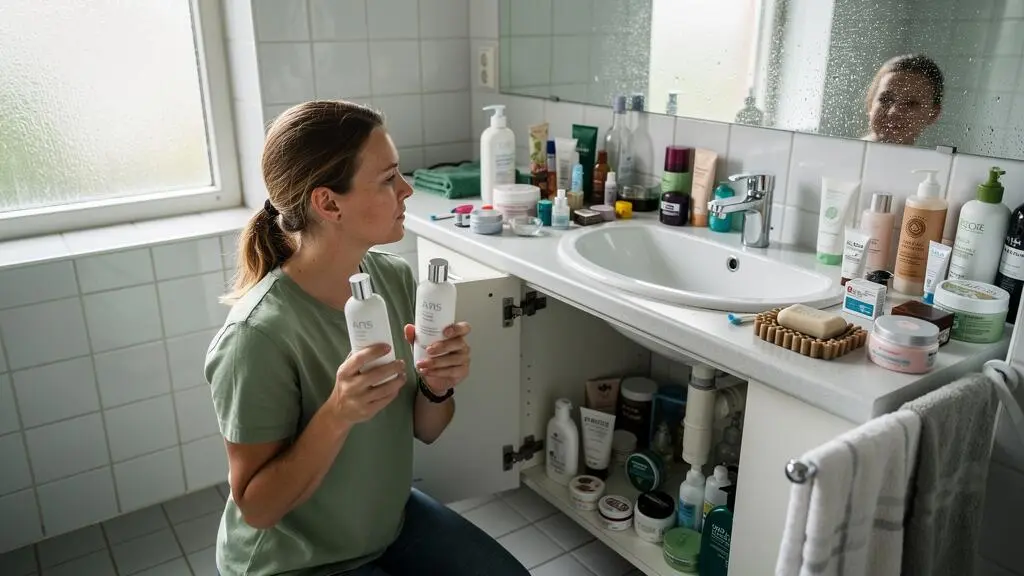
The most effective way to reduce the environmental footprint of a beauty routine is not necessarily to buy greener products. It is to buy fewer unnecessary products, finish what remains safe to use, reduce packaging waste and avoid preventable contamination. These changes can lower waste without compromising cleansing performance, skin comfort or everyday hygiene.
For consumers in Belgium, the practical challenge is choosing changes that survive normal shopping habits, bathroom storage conditions and the availability of local refill options. A solid shampoo that dissolves between showers, a refill poured into an unsuitable bottle or an expensive concentrate used too generously may create new problems instead of solving old ones.
The safest approach starts with the products already in the bathroom. Check how much is actually used, preserve existing formulas correctly and compare replacement formats by their real cost and usable lifespan. Keep effective essentials, particularly suitable sunscreen, toothpaste and products needed for sensitive skin, rather than treating minimal packaging as the only measure of sustainability.
Lower-Waste Beauty: The Essentials
- Use up safe, suitable products before buying replacements, and measure waste across your entire routine rather than judging individual eco labels.
- Choose solid bars, concentrates or refills according to actual usage, storage conditions and manufacturer instructions.
- Keep hygiene non-negotiable: protect formulas from contamination, respect durability information and introduce concentrated products cautiously.
- Why Does Buying « Eco » Products Still Create a Big Footprint if You Overbuy ?
- How to Reduce Beauty Waste With a One-In-One-Out Rule That Actually Works ?
- Solid Bars or Concentrates: Which Lowers Footprint More for Shower Routines ?
- The DIY Reuse Mistake That Creates More Waste When Products Spoil Early
- When Should You Change Your Routine in Stages So Eco Habits Stick Beyond 3 Months ?
- How to Refill Containers at Home Without Contaminating the Product Using a Simple 4-Step Routine ?
- Concentrate or Standard Bottle: Which Is Cheaper per Use Over 3 Months ?
- How Do You Use Concentrated Formulas Without Over-Applying and Irritating Your Skin ?
Why Does Buying « Eco » Products Still Create a Big Footprint if You Overbuy ?
Buying environmentally labelled beauty products can still create substantial waste when purchases exceed actual consumption. Each additional cleanser, cream or shampoo requires materials, packaging and distribution, even if its individual formulation meets environmental criteria. The meaningful question is whether a new purchase replaces something genuinely needed or simply expands a collection that may never be finished.
European certifications can help consumers evaluate specific product characteristics. For example, the European Commission decision establishing EU Ecolabel criteria for cosmetics covers eligible rinse-off and leave-on cosmetics. However, product-level certification is not evidence that purchasing additional products lowers a household’s overall environmental impact. EU Ecolabel, NATRUE and COSMOS also have different assessment frameworks and should not be treated as interchangeable.
The first useful measurement is total bathroom stock versus useful consumption. Count every full-size product, miniature, sample and duplicate, including unopened purchases stored outside the bathroom. Then identify which products are used regularly and which serve an overlapping purpose.
A product inventory can distinguish three categories:
- Active essentials: products used consistently and likely to be finished safely.
- Necessary reserves: unopened replacements for products that will realistically run out.
- Surplus stock: overlapping products, impulse purchases and items unlikely to be used within their applicable durability period.
Consider a hypothetical bathroom containing four similar facial cleansers. If one cleanser lasts several months, purchasing a fifth because it carries an environmental label increases inventory without reducing the existing need for packaging or product disposal.
Belgian shoppers may encounter discounts, loyalty promotions and multi-buy offers across supermarkets, pharmacies and beauty retailers. These incentives can make purchasing ahead appear economical. Yet a discount has little value when the product deteriorates or remains unused.
Before purchasing, ask: What specific product will this replace, and when? If neither question has a clear answer, postponing the purchase usually preserves more flexibility than creating another reserve.
Reducing overbuying establishes the foundation for the next step: managing replacements without accumulating duplicates or discarding useful products prematurely.
How to Reduce Beauty Waste With a One-In-One-Out Rule That Actually Works ?
A one-in-one-out rule reduces beauty waste when it means replacing a product after the existing one is finished or no longer safe to use, not merely moving an old bottle into another cupboard. Apply the rule by product category and consumption speed. Fast-moving essentials need a different replacement schedule from occasional masks, serums and treatments.
Begin by separating frequently consumed products, such as toothpaste and daily cleansers, from slow-moving items such as exfoliating masks or specialty treatments. A replacement for a daily cleanser may be practical before the last application, but purchasing several additional masks rarely solves an immediate need.
Make every product exit visible. Finish suitable formulas whenever possible, dispose of products that are unsafe or unusable, and sort empty packaging according to Belgian collection instructions. Unopened products may be suitable for donation if a receiving organisation accepts them, but opened cosmetics should not automatically be passed on because their storage and contamination history may be uncertain.
Belgian packaging collection also deserves attention. A January 2026 survey commissioned by Fost Plus and conducted among 2,612 Belgian adults found that one in three bathroom products was sorted incorrectly. The results were reported in Fost Plus research on bathroom waste sorting in Belgium.
42%
Of surveyed Belgian adults selected residual waste when uncertain how to sort bathroom packaging. This describes responses in a commissioned survey, not a measured national recycling rate.
Fost Plus, survey conducted by Dedicated, January 2026.
For Belgian households, empty household packaging should be sorted according to the applicable PMD, glass, paper and cardboard instructions. Packaging containing substantial product residues may require different handling. Fost Plus is a packaging collection organisation, not a universal collection service for partially used cosmetics.
The rule also needs safeguards. Count samples and travel sizes as real inventory, maintain one designated reserve only when justified, and avoid exceptions justified by temporary promotions. Track the date on which a replacement is actually needed rather than buying whenever an offer appears.
Product durability matters as much as inventory discipline. Under EU cosmetics rules, a product with a minimum durability exceeding 30 months generally displays a period-after-opening indication when that concept is relevant. The open-jar symbol indicates the relevant usage period after opening, not a universal expiry date for unopened products.
Record opening dates for products used infrequently. Never assume that a product remains safe merely because its indicated period has not elapsed: contamination, unsuitable storage or visible deterioration can justify earlier disposal.
Once unnecessary replacements are under control, the next decision is which product formats can genuinely reduce packaging and wasted material in everyday use.
Solid Bars or Concentrates: Which Lowers Footprint More for Shower Routines ?
Neither solid bars nor concentrated liquids automatically have the lowest environmental footprint. Solid products can reduce packaging and avoid transporting some water, while concentrates may deliver more uses from smaller containers. The better choice depends on formulation, packaging, accurate dosing, complete product use, storage conditions and whether the product remains suitable for your skin and hair.
A shampoo bar sold in minimal packaging may look preferable to a bottled concentrate. But if it softens in standing water, breaks apart or becomes difficult to use before it is finished, part of its potential material advantage disappears.
Concentrated shower products present a different trade-off. They can reduce the amount of product used per wash when dosed correctly, but dispensing too much can cancel the intended saving. Some refill systems also require a dedicated reusable container, introducing an additional material purchase.
The following comparison highlights the practical variables rather than presenting an unsupported universal environmental ranking.
| Decision factor | Solid bars | Concentrated liquids | Standard liquids |
|---|---|---|---|
| Packaging | Can use minimal wrapping | May use smaller bottles or refill packs | Often sold in conventional bottles |
| Water in product | Generally lower for anhydrous bars | Depends on concentration | Depends on formulation |
| Dosage | Controlled by rubbing or lathering | Requires accurate measuring | Often familiar to users |
| Main waste risk | Dissolving or breaking during storage | Over-dispensing or incorrect dilution | Excess packaging or overuse |
| Skin suitability | Depends on formulation and pH | Depends on formulation and dose | Depends on formulation |
| Practical advantage | Compact format with limited packaging | Potentially efficient transport and dispensing | Easy replacement and familiar handling |
For sensitive skin, distinguish traditional soap from solid synthetic-detergent cleansers. These products can have different pH characteristics and cleansing properties. A solid format is not automatically gentler, just as a liquid concentrate is not automatically harsher.
To preserve a bar, store it on a well-draining dish away from standing water and allow it to dry between uses. For concentrates, follow the manufacturer’s dispensing and dilution instructions, rather than copying the quantity previously used with a standard product.
Before switching formats in Belgium, consider local availability. A product available only through repeated individual deliveries may introduce costs and transport considerations absent from a readily available alternative. A refillable bottle should also be compatible with the product intended for it.
For travel, a well-protected solid bar may be convenient, while a correctly packaged concentrate can offer precise dosing. Neither format guarantees lower overall impact without considering how many applications the product actually delivers.
The same principle applies to reusable containers: reducing new packaging only helps when the reused container preserves the safety and usability of what goes inside.
The DIY Reuse Mistake That Creates More Waste When Products Spoil Early
The most consequential DIY reuse mistake is transferring cosmetics into unsuitable or insufficiently cleaned containers. Residual product, moisture, contaminated pumps and dirty tools can introduce microorganisms or interfere with preservation. If the contents become unsafe or unusable, the entire refill may be wasted, potentially outweighing the packaging saved by reusing the bottle.
Cosmetics containing water require particular care because microbial contamination and preservation are important formulation considerations. Products marketed as natural or formulated with different preservative systems are not automatically safe to transfer, mix or dilute at home.
An anhydrous oil or solid product may have a different microbial risk profile from a water-based lotion, but neither category is universally immune to contamination or deterioration. Compatibility with the container, exposure to water and the manufacturer’s instructions remain decisive.
Before reusing a container, assess three conditions:
- Container condition: Check the material, interior surfaces, lid and pump for residue, damage or places that cannot be adequately cleaned.
- Product condition: Look for unexpected changes in smell, colour, consistency or separation. These are warning signs, although contamination may also be invisible.
- Storage conditions: Consider humidity, heat, sunlight and exposure to shower water, especially when products are kept in bathrooms.
A previously used pump can be particularly problematic. Its narrow internal channels may retain old product or moisture even when the outside looks clean. Ordinary washing does not establish that a container is sterile or suitable for every formulation.
There is also a distinction between reusing a container as an object and refilling it with cosmetics. An empty jar repurposed for dry household storage avoids contact with a sensitive cosmetic formula. Pouring a preserved lotion into that same jar creates a different safety question.
Never add water to finished cosmetics merely to make the last portion easier to dispense unless the manufacturer explicitly instructs you to do so. Homemade dilution changes the product’s intended composition and may undermine its preservation system.
When contamination cannot reasonably be controlled, retaining the original package or choosing a manufacturer-designed refill system is more sensible than forcing a homemade solution.
When Should You Change Your Routine in Stages So Eco Habits Stick Beyond 3 Months ?
Change an eco-beauty routine gradually, preferably when each existing product naturally runs out. Begin with frequently used products that are straightforward to replace, then evaluate performance, cost and convenience before making another change. A three-month review is useful for checking whether the new habits are sustainable, but it is not a deadline for replacing every product.
Changing a whole routine at once introduces avoidable problems. It becomes difficult to identify which new formula causes discomfort, whether a reusable format saves money or which extra task makes the routine inconvenient.
A staged plan can follow actual consumption rather than rigid shopping dates:
- First replacement: Trial a straightforward daily-use product, such as a suitable body wash or facial cleanser, when the current supply is finished.
- Second replacement: Review another frequently used category only after the first change proves practical.
- Later replacements: Evaluate specialised treatments and skin-care products individually, with particular attention to tolerance and clinical purpose.
Toothpaste should continue meeting appropriate oral-care needs, including suitable fluoride protection where recommended. Sunscreen should maintain the required protection and be applied in adequate quantities. An environmentally preferable package is not a reason to compromise either function.
At the three-month checkpoint, measure completed products, new packaging items, money spent and products discarded before use. These observations are more actionable than a general impression that the routine feels greener.
Your Five-Action Beauty Waste Audit
- List every opened and unopened beauty product by category, producing a complete bathroom inventory.
- Mark duplicate products and record those approaching their relevant durability limits, producing a priority-use list.
- Select one frequently used product for a lower-waste replacement trial, recording the chosen product and expected replacement point.
- Record each empty package and how it was sorted, producing a simple packaging-waste log.
- Compare the first and third months for purchases, discarded product and spending, producing a short results summary.
A successful trial also needs reliable supply. Because availability can differ between Belgian cities, pharmacies, supermarkets and specialist shops, identify a convenient primary supplier and a suitable backup before committing to a difficult-to-find format.
Habits are more likely to remain practical when the alternative cleans effectively, fits ordinary routines and does not require repeated special trips or complicated preparation. If a switch proves uncomfortable or inefficient, returning to a suitable product is preferable to persisting with an unsuitable one.
Once replacement habits are stable, refill systems can be evaluated as an additional option, provided that product safety remains the deciding condition.
How to Refill Containers at Home Without Contaminating the Product Using a Simple 4-Step Routine ?
To refill a cosmetic container more safely at home, use only a product and container combination approved for refilling, then follow four checks: clean and dry the container as instructed, verify material compatibility, transfer the refill hygienically and record its identification and filling date. These steps reduce avoidable handling errors but cannot make an unsupported refill method automatically safe.
European industry guidance recognises the importance of container suitability, microbial contamination, cleaning residues and traceability. The Cosmetics Europe guidance on refillable cosmetic products addresses retail refill systems and the responsibilities involved in their safe operation. It does not certify that a four-step domestic procedure is sufficient for every cosmetic.
For consumers using a refill system that the manufacturer explicitly supports, the following routine provides a practical handling checklist.
- Clean and dry: Follow the brand’s instructions for preparing the reusable bottle. Where washing is specified, ensure that both the container and permitted removable components are fully dry. If the pump cannot be adequately cleaned, follow the manufacturer’s replacement or reuse instructions.
- Check compatibility: Confirm that the bottle, closure and pump are suitable for the exact refill. Do not assume that glass, plastic or metal can hold any cosmetic formula.
- Transfer hygienically: Wash your hands, use the authorised transfer method and avoid touching the refill opening or internal surfaces. Use a dedicated clean funnel only if the refill instructions permit one.
- Record and store: Retain the product identity, batch information and applicable durability instructions. Record the refill date for traceability and store the product under the conditions recommended by its manufacturer.
Dating the container helps track handling history, but refilling does not automatically restart the original product’s period after opening. Follow the instructions associated with the actual refill and packaging system rather than applying a new generic shelf-life period.
A manufacturer-designed replacement cartridge is different from an informal refill using a container brought to a bulk shop. The former can be developed for a specified dispenser and formula; the latter requires an independently suitable system with adequate hygiene, product compatibility and traceability safeguards.
At Belgian refill shops, ask whether a particular cosmetic is intended for customer-container refilling, who determines container suitability and what cleaning and labelling instructions apply. General household bulk-refill practices should not be assumed appropriate for facial care, eye-area products or other cosmetics.
The cap and pump deserve specific attention. Product can accumulate in threaded closures, dispensing tubes and narrow openings. A visibly clean bottle with contaminated internal components can still compromise its contents.
Cosmetic safety assessments and preservation systems are designed around particular formulations and intended conditions of use. Manufacturers may therefore restrict transferring or diluting products. Where instructions do not authorise home refilling, using the original packaging is the safer choice.
A refill is worthwhile when it reduces material use without causing spoilage, irritation or replacement purchases. Its financial value should also be evaluated using the number of safe, usable applications delivered.
Concentrate or Standard Bottle: Which Is Cheaper per Use Over 3 Months ?
A concentrate is cheaper over three months only when its actual cost per usable application is lower than that of a standard bottle. Purchase price alone cannot establish which option wins. Compare the quantity used per application, realistic product lifespan, delivery costs and any product discarded, while including the cost of a required reusable bottle where relevant.
The most useful calculation starts with applications rather than package volume:
Cost per application = total relevant product cost ÷ number of usable applications.
For a three-month comparison, calculate the total cost of products consumed during that period, allowing for any usable quantity remaining at the end. Distinguish cash spent on purchases from the value of product actually consumed. If a new reusable dispenser is required, include its initial cost separately so the comparison remains transparent.
Consider the following explicitly hypothetical example. It is not a claim about current Belgian retail prices or measured product performance.
Hypothetical comparison: 90 daily applications
Imagine a standard cleanser costing €9 and delivering 45 applications per bottle. A concentrated alternative costs €12 and delivers 90 applications when used at the instructed dose. Both products are assumed to meet the user’s skin-care needs.
Over 90 applications, two standard bottles cost €18, or €0.20 per application. One concentrate costs €12, approximately €0.13 per application. If the concentrate is applied at twice the intended quantity, however, it provides only 45 applications. Two bottles then cost €24, approximately €0.27 per application.
These figures illustrate how dose changes the result. They exclude shipping, dispensers, promotions and any remaining product.
Belgian shoppers should compare prices actually paid, including discounts that apply to regularly purchased products. A concentrate available only through separate deliveries might carry additional shipping expenses, while a standard formula bought locally could avoid them.
Unexpected leftovers complicate the comparison. If a product irritates the skin or cannot be finished within its applicable usable period, its effective cost rises. An economical format must therefore also be suitable and manageable.
| Usage situation | Concentrate | Standard bottle |
|---|---|---|
| Accurate dosing | May offer a lower cost per application | Can remain competitive |
| Frequent over-dispensing | Expected savings may disappear | May prove more economical |
| Special dispenser required | Additional initial cost | Often no new dispenser needed |
| Unreliable local availability | Potential delivery costs | May be easier to replace locally |
| Product unsuitable for skin | Poor value regardless of concentration | Poor value regardless of price |
There is no reliable universal rule that concentrates nearly always win. Their value depends on the relative prices, effective doses, packaging requirements and amount actually used.
Once the numbers justify a trial, correct dosing becomes essential not only for maintaining the expected savings but also for protecting skin comfort.
Key Takeaways Before Trying Concentrated Products
- Choose concentration based on the manufacturer’s intended dose and demonstrated suitability, not on an assumption that stronger always means better.
- Keep mixing, measuring and storage procedures separate from improvised refill experiments.
- Watch for discomfort and reassess both product quantity and formulation before continuing a new routine.
How Do You Use Concentrated Formulas Without Over-Applying and Irritating Your Skin ?
Use concentrated formulas according to their specific dispensing, dilution and application instructions, rather than applying the same volume as a standard product. Excessive use can increase exposure to cleansing agents or active ingredients and may contribute to irritation, dryness or redness. Introduce unfamiliar products individually, monitor skin tolerance and stop using a product that causes a concerning reaction.
Concentration matters because skin exposure depends on the formulation, the amount applied, contact time and whether the product is rinsed away. A concentrated facial cleanser is different from a concentrated exfoliating treatment, and neither should be treated as interchangeable with an ordinary moisturiser.
A product labelled natural is not necessarily less irritating. Botanical ingredients, fragrance components, surfactants and concentrated active ingredients can all affect skin tolerance depending on their properties and the user’s sensitivity.
For products whose instructions allow flexible dosing, begin at the lower end of the recommended range rather than automatically dispensing a large quantity. Monitor comfort over the first one to two weeks, recognising that irritation may appear sooner. Never halve a medically or functionally necessary application, including sunscreen, simply to save product.
Visual dose references can help only when consistent with the instructions:
- Pea-sized amounts: Sometimes useful for illustrating small quantities of certain cleansers or creams, but not a universal dose.
- Rice-grain amounts: May illustrate very small applications of some specialised products, where the manufacturer explicitly recommends such quantities.
- Small measured pumps or drops: Preferable when the dispenser is calibrated for the formula.
- Measured dilution: Necessary for products specifically designed to be diluted; use the manufacturer-specified quantities and water requirements.
Different formats introduce different errors. Droppers may release more liquid than intended; powders can be mixed at incorrect concentrations; compact formulas may be used too generously; and concentrated oils can be difficult to portion consistently by feel alone.
Do not improvise a dilution to make a concentrate gentler unless dilution is part of its approved use. Adding water can change both the concentration reaching the skin and the conditions needed for microbiological stability. For products supplied ready to use, follow the original formulation instructions.
Transferring a concentrated product to a different bottle does not, by itself, change its chemical concentration. However, changing a dispenser can change the quantity delivered per pump. Any authorised transfer therefore requires checking the new dispenser’s dose, not assuming that one pump equals the old one.
If a new product causes persistent redness, burning, significant dryness or another concerning reaction, discontinue it. Seek advice from a pharmacist or qualified healthcare professional when symptoms persist or are severe. A suitable conventional formula is preferable to a lower-packaging alternative that the skin cannot tolerate.
For the next purchase, choose one product that is running low, confirm a safe replacement format, follow its instructions and record the actual applications delivered. This small, measurable change is a practical starting point for reducing waste without sacrificing hygiene.
Is an eco-labelled cosmetic necessarily better for the environment?
Not necessarily in every situation. Environmental labels assess defined product characteristics, while the impact of a complete beauty routine also depends on purchasing frequency, packaging, product use and disposal. Finishing an existing suitable product before buying another can avoid unnecessary additional consumption.
Can an unopened cosmetic remain usable longer than its period-after-opening indication?
The period-after-opening indication applies after a product has been opened. Unopened products are subject to their applicable durability and storage conditions. Under EU cosmetics legislation, products with minimum durability exceeding 30 months generally use a period-after-opening indication where relevant, while other products may display a minimum-durability date. Always follow the specific label and manufacturer instructions.
Should cosmetic packaging be rinsed before recycling in Belgium?
Follow the current Belgian sorting instructions for the specific packaging material and its contents. Packaging should be properly emptied, but the need for rinsing depends on applicable sorting guidance. Do not assume that containers with significant product residues belong in PMD collection. Avoid unnecessary water use when cleaning is not required.
Are refillable cosmetic containers safe for every product?
No. Container compatibility, cleaning requirements, packaging design and preservation must be considered for the particular formula. Manufacturer-authorised refill systems provide more appropriate guidance than informal transfers into unrelated containers. Reusing a bottle does not establish that its contents will remain safe.
What if a sustainable beauty alternative causes skin irritation?
Stop using the irritating product and avoid adding other unfamiliar formulas while assessing the reaction. Check whether the product was applied according to its instructions, but do not continue using it merely to avoid waste. Persistent or severe symptoms warrant professional advice. Skin safety takes priority over packaging reduction.