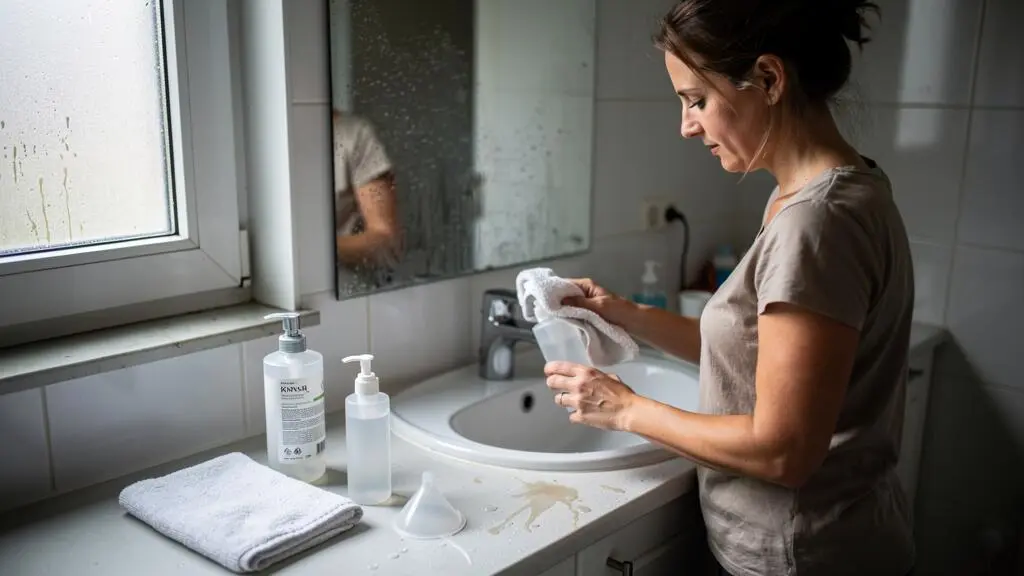
Refillable beauty packaging can reduce packaging waste in Belgium, but it is not automatically more hygienic or more sustainable than buying a new product. The outcome depends on the refill system, the cosmetic formula, the condition of the reusable container and how many times the packaging is actually reused.
A factory-sealed refill cartridge that fits directly into a compatible dispenser presents a different hygiene situation from pouring cleanser into a damp bottle or collecting lotion from a shared refill station. Likewise, replacing several disposable shampoo bottles may offer worthwhile packaging savings, while repeatedly washing a heavy reusable container does not necessarily improve every environmental indicator.
For Belgian consumers, the most practical approach is to evaluate each product separately. Shower gel, shampoo, moisturiser and face serum have different exposure patterns, formulation requirements and usage speeds. Understanding those differences makes it possible to reduce waste without taking unnecessary contamination risks.
Refillable beauty packaging: what matters most
- Hygiene: Factory-sealed, compatible refill systems generally limit handling-related contamination opportunities compared with open transfers, although individual designs and procedures matter.
- Sustainability: Refills can substantially reduce packaging impacts, but their contribution to the entire product life cycle may be much smaller.
- Daily practice: Start with frequently used rinse-off products, follow the manufacturer’s refill instructions and never casually mix old formula with a fresh refill.
- Why Can Refillable Beauty Packaging Be Less Hygienic if You Refill the Wrong Way?
- How to Refill Containers at Home Without Contaminating the Product, Using a Simple 4-Step Routine?
- In-Store Refill Station or Sealed Refill Pod: Which Is Safer for Skincare?
- The Residue Mistake That Can Spoil a Refill Faster Than the Original Bottle
- When Does Refillable Packaging Make Most Sense: Shower Products or Face Serums?
- Jar, Tube, or Pump: Which Packaging Is Safest if You Share a Bathroom?
- Solid Bars or Concentrates: Which Lowers Footprint More for Shower Routines?
- How Can You Cut Your Beauty Routine’s Environmental Footprint Without Making It Less Hygienic?
Why Can Refillable Beauty Packaging Be Less Hygienic if You Refill the Wrong Way?
Refillable beauty packaging can become less hygienic when transferring the product introduces microorganisms, moisture or residues that were not present in the original sealed packaging. The principal risks come from contaminated containers, poorly controlled refill dispensing and handling practices. Refilling does not inevitably cause contamination, but each additional transfer creates opportunities for it.
Factory-filled cosmetics are formulated, manufactured and packaged under controlled conditions. Once a consumer opens a container, its contents encounter a less controlled environment. Fingers, dispensing openings, bathroom water and reusable accessories can all become contamination routes.
A scientific review of cosmetic preservation strategies explains how packaging design influences microbial exposure. Airless dispensers and narrow openings can offer better protection than containers that repeatedly expose their contents.
Three potential weak points deserve attention:
- The container: Leftover product, trapped moisture and difficult-to-clean components may introduce contaminants into the refill. Persistent contamination within poorly cleaned mechanisms can be particularly difficult to identify visually.
- The refill format: An open pour exposes the formula and container opening during transfer. A factory-sealed cartridge designed for direct insertion can reduce these handling opportunities.
- The user: Unwashed hands, shared funnels, damp surfaces or contact between the refill nozzle and an unclean container can compromise otherwise careful handling.
Formula composition also matters. Water-containing cosmetics, such as toners, gels and liquid cleansers, require appropriate protection against microbial growth. Oils and water-free balms may present different microbial risks, but they are not immune to contamination or deterioration.
In Belgium, cosmetic products placed on the market, including refill products, are subject to the EU Cosmetics Regulation (EC) No 1223/2009. The regulation requires cosmetic products to meet safety requirements and undergo safety assessment. However, it does not guarantee that arbitrary consumer refilling practices preserve the safety conditions of the original product.
Before buying a refill, determine whether it is designed for the original dispenser and whether transferring the formula into another container is actually permitted. Those details lead directly to safer home-refilling habits.
How to Refill Containers at Home Without Contaminating the Product, Using a Simple 4-Step Routine?
The safest practical approach to home refilling is to follow the manufacturer’s instructions for the specific product and container, rather than assume every bottle can be washed and reused. When manual refilling is expressly permitted, a four-step routine helps minimise contamination: empty, clean and dry, disinfect if instructed, then transfer carefully and close.
Not all refill systems are designed to be washed or dismantled. Some use replaceable sealed cartridges; others permit pouring into a reusable bottle. The following routine applies only when the manufacturer authorises manual refilling and the container can be cleaned safely.
- Empty and inspect. Finish the previous product rather than adding fresh formula to an old layer. Check for visible residue, damage, discolouration or a malfunctioning dispenser. Replace unsuitable containers.
- Wash and dry completely. Follow the manufacturer’s cleaning method, including instructions for the cap and pump. Allow all washable components to dry thoroughly before reassembly. Do not assume that a pump’s inaccessible interior can be cleaned reliably.
- Disinfect only when recommended. Use only an approved disinfecting method compatible with the packaging material, and follow any required drying or rinsing instructions. Improvised chemical treatments can leave unwanted residues or damage the dispenser.
- Refill and seal promptly. With clean, dry hands and clean, dry accessories, transfer the compatible product without touching the inside of the bottle or dispensing nozzle. Close the container immediately and retain the refill’s batch and durability information.
Complete drying is especially important. Water remaining in the bottle may alter the intended formulation and preservation conditions. This does not mean that every drop of moisture automatically causes preservative failure, but it creates an avoidable uncertainty that the manufacturer may not have assessed.
Changing the original packaging design presents another problem. A formula intended for a protective pump may not have been evaluated for repeated finger contact in an open jar. The same applies to transferring products into decorative glass bottles with incompatible closures.
Five checks before your next beauty refill
- Read the product’s refill instructions and confirm that the exact container is reusable. Outcome: an explicit manufacturer-approved refill method.
- Inspect the empty bottle and dispensing mechanism. Outcome: a container with no visible residue, damage or suspicious change.
- Complete the recommended cleaning process and check for remaining moisture. Outcome: clean, fully dry accessible components.
- Prepare each funnel or transfer accessory according to the product instructions. Outcome: clean, dry equipment reserved for the transfer.
- Transfer the refill, close it and retain its identification details. Outcome: a sealed container with traceable batch and durability information.
If the manufacturer cannot confirm that the product is suitable for manual refilling, choose its designated cartridge system or keep using the original packaging. An approved procedure is more dependable than a universal household cleaning recipe.
In-Store Refill Station or Sealed Refill Pod: Which Is Safer for Skincare?
A factory-sealed refill pod designed for a compatible skincare dispenser is generally the more predictable hygiene option because it reduces opportunities for consumers to contact the formula during transfer. An in-store refill station can also be hygienic, but its safety depends on the equipment design, maintenance procedures, dispensing controls and conditions of use.
The difference is not simply whether refilling happens at home or in a shop. It is how many opportunities exist for contamination between manufacture and application.
With a sealed replacement cartridge, the product remains protected until installation. If the cartridge connects directly to a compatible pump without exposing its contents, fewer transfer steps are involved. A refill pouch that must be opened and poured into a bottle offers less of this handling protection, even if the pouch itself was factory-sealed.
In-store stations vary substantially. A closed reservoir, contact-free dispensing and a documented cleaning process can reduce hygiene concerns. Conversely, an exposed nozzle or poorly maintained shared dispensing system creates avoidable uncertainty.
Before using a refill station in a Belgian cosmetics shop or drugstore, ask three practical questions:
- Does the nozzle prevent contact with the customer’s container or hands?
- Can staff explain the station’s cleaning and maintenance schedule?
- Is the product stored in a closed reservoir with appropriate dispensing controls?
A further consideration is preservation. An open-dispensing system may require different formulation or packaging controls from a sealed cartridge. However, it would be incorrect to assume that all station products contain stronger preservatives or that identically branded products necessarily use different formulas. This must be checked at product level.
Availability and operating procedures can differ between Belgian retailers and individual stores. A recognisable retail name alone is not evidence that every station follows the same hygiene practices.
For facial skincare, a manufacturer-compatible sealed cartridge is a sensible default where the station’s hygiene controls are unclear. A well-maintained refill station remains a possible alternative, provided the product and dispensing process are suitable.
The Residue Mistake That Can Spoil a Refill Faster Than the Original Bottle
Adding fresh cosmetic product directly on top of old residue is a particularly avoidable refill mistake. It combines products with different exposure histories and may introduce contaminants or degraded ingredients into the new formula. The mixture no longer has the same clearly defined usage history as an untouched, factory-sealed refill.
Consider a bottle of body lotion that still contains a small amount of product after several months of use. Its remaining contents have already experienced repeated dispensing and storage conditions. Pouring new lotion into that bottle does not restore the original product’s condition.
The old layer may have undergone changes through oxygen exposure, temperature fluctuations or microbial contamination. The extent depends on the formula, packaging and conditions of use. Contamination is not inevitable, but mixing batches creates uncertainty that the original product safety assessment may not cover.
Some warning signs make the decision straightforward. If the remaining product smells unusual, has changed colour or texture, or is beyond its indicated period after opening, do not mix it with fresh product. Stop using suspicious products and follow the manufacturer’s disposal and container-cleaning guidance.
The Belgian Federal Public Health Service advises consumers to respect cosmetic durability information and periods after opening. Its Belgian Federal Public Health Service’s cosmetics advice also emphasises appropriate attention to labels and consumer precautions.
The period-after-opening symbol is not a reset button. A label showing 6M or 12M refers to the manufacturer’s intended use conditions; it should not be interpreted as guaranteeing the safety of a mixture containing older product.
Even when the formula appears unchanged, topping up makes it harder to identify which batch remains in the container and how long each portion has been open. Those problems matter if the product later develops an unusual appearance or becomes subject to a safety notice.
For a manufacturer-approved refill, begin with the appropriately prepared container specified in its instructions. If that preparation is impossible, replacing the container is safer than repeatedly topping it up.
When Does Refillable Packaging Make Most Sense: Shower Products or Face Serums?
Refillable packaging often makes more practical sense for frequently used shower products than for delicate facial serums. Shampoo and body wash are typically consumed regularly, making repeated packaging use easier to achieve. Facial serums may be used in smaller amounts and can have specific protection requirements, making container compatibility and hygienic dispensing especially important.
Shower products offer an accessible starting point because they can be replaced frequently and are designed for rinse-off use. However, shampoo and body wash still require suitable preservation, particularly in a humid environment. Rinse-off use does not make a contaminated formula harmless.
Facial serums demand closer attention to ingredients, dispensing and application conditions. Some formulas may be sensitive to oxygen or light, while others are comparatively stable. A refillable airless cartridge can preserve important packaging protections; an open jar may introduce exposures that were not part of the original design.
Three criteria help distinguish the options:
| Decision factor | More straightforward refill scenario | Scenario requiring extra caution |
|---|---|---|
| Usage speed | Regularly finished shampoo or body wash | Slowly consumed facial treatment |
| Application area | Routine rinse-off body or hair care | Products applied near eyes or on sensitive facial areas |
| Formula and packaging | Manufacturer-approved closed refill system | Water-based formula transferred into an unapproved open container |
| Handling requirements | Compatible replaceable cartridge | Repeated manual pouring with shared accessories |
A body lotion supplied in an appropriately designed refillable airless pump may offer a better hygiene arrangement than a long-lasting serum repeatedly exposed in a jar. Product category alone therefore cannot determine the best option.
Environmental benefits also depend on the full life cycle. A 2021 life-cycle assessment of shampoo refill options provides a useful illustration of why packaging savings must be interpreted carefully.
Approximately 70% versus 2.5%
In one Swiss shampoo case study, certain refill scenarios reduced packaging-related global warming potential by approximately 70%, while reducing the full shampoo life-cycle global warming potential by approximately 2.5%.
2021 shampoo life-cycle assessment, Sustainability. Results apply to the assessed shampoo and packaging scenarios, not to every refill sold in Belgium.
For the investigated shampoo system, the use phase was the dominant contributor to greenhouse gas emissions. This means that changing the bottle can help without necessarily being the largest environmental improvement available.
Belgian households beginning a refill routine can start with one frequently finished shower product and a manufacturer-approved system. More specialised facial products can remain in protective original packaging until a suitable refill alternative is available.
Jar, Tube, or Pump: Which Packaging Is Safest if You Share a Bathroom?
In a shared bathroom, a well-designed closed pump generally provides better protection against repeated finger contact than an open jar. A narrow-opening tube can also limit direct access to the formula. However, the actual hygiene outcome depends on dispenser design, formula preservation, how the product is handled and whether water enters the container.
Multiple household members may touch the same packaging, dispense products with wet hands or leave containers exposed to shower spray. These conditions increase the opportunities for contamination, especially when the product itself is repeatedly accessed.
Closed dispensers reduce the need to touch the formula directly. An airless system can provide additional protection against some forms of exposure, but not every conventional pump is airtight or prevents contamination through its dispensing opening.
Tubes offer a relatively narrow outlet, although touching that opening to the skin or leaving the cap open can undermine the benefit. Open jars expose a larger surface during use and invite direct finger contact.
For shared daily skincare, the following comparison provides a practical preference rather than an absolute safety ranking.
| Packaging | Potential hygiene advantage | Main handling concern |
|---|---|---|
| Closed pump | Limits routine direct contact with the contents | Dirty nozzle or incompatible refilling method |
| Squeeze tube | Narrow dispensing opening | Opening touching fingers, skin or wet surfaces |
| Open jar | Easy access without complex dispensing components | Repeated exposure to fingers, air and moisture |
Where a jar is necessary, dispense the product with a clean, dry spatula rather than dipping fingers into it. Do not leave the spatula resting on an unclean surface or share it between different cosmetic products without appropriate cleaning.
Droppers, brushes and rollerball applicators also deserve attention. Touching a dropper directly to facial skin before returning it to the bottle can transfer material back into the formula. Dispensing onto a clean hand, when consistent with the manufacturer’s instructions, avoids that contact route.
Keep all containers closed when not in use and away from direct shower spray. These simple measures are helpful whether the packaging is refillable or single-use.
Before replacing existing products with refillable versions, check whether the new system maintains an equally suitable dispensing arrangement. A reusable container offers little hygiene advantage if it exposes the contents more frequently.
Solid Bars or Concentrates: Which Lowers Footprint More for Shower Routines?
Solid bars can reduce the need for liquid packaging and transport of water, while concentrates can reduce packaging and transport weight by requiring dilution closer to use. Neither format is universally more sustainable. The outcome depends on ingredients, packaging, transport, preparation, product lifespan and the amount of water and energy consumed during showering.
A solid shampoo or cleansing bar may require little primary packaging and avoids the need to transfer a liquid formula into another bottle. For consumers concerned about contamination during home refilling, this can eliminate a particular handling step.
Nevertheless, solid products are not automatically free from hygiene considerations. A bar left in standing water can deteriorate or become unpleasant to use. Keeping it on a draining surface and following the manufacturer’s storage advice helps maintain its condition.
Concentrates retain some benefits of liquid formulations while reducing the amount of product transported in a ready-to-use state. However, the dilution process introduces important conditions. The manufacturer must explicitly authorise dilution, identify suitable water and container requirements, and provide appropriate storage and usage instructions.
Never dilute an ordinary cosmetic simply because it seems concentrated. Adding water to a finished formula without manufacturer approval may alter its preservation and performance.
| Criterion | Solid bars | Concentrates |
|---|---|---|
| Packaging | Can use minimal wrapping | May use smaller or lighter packs |
| Transport | Typically transport less water | Transport less water than equivalent ready-diluted liquids |
| Preparation | Usually ready to use | May require controlled dilution |
| Hygiene considerations | Drainage and storage between uses | Approved container, water quality and storage instructions |
| Cost comparison | Assess actual number of washes | Assess cost per prepared wash |
The Swiss shampoo life-cycle study discussed earlier also illustrates a broader limitation: packaging is only one component of environmental impact. Its results cannot establish whether a solid bar or concentrate has the lower footprint because those two alternatives were not directly compared.
For Belgian shoppers, calculating cost per wash is more meaningful than comparing shelf prices alone. A smaller product may last longer, but its performance depends on how much is actually used.
The best practical option is one that can be used completely, stored properly and incorporated into the existing shower routine without introducing unnecessary waste or unsafe dilution practices.
Key takeaways before changing your routine
- Prioritise product systems that minimise unnecessary handling, rather than choosing an open refill solely because it appears to use less packaging.
- Compare environmental claims at the correct level: packaging impacts and total product life-cycle impacts are not interchangeable.
- Assess each product’s usage frequency, application area and dispensing format before deciding whether to refill, switch to a solid or keep its original packaging.
How Can You Cut Your Beauty Routine’s Environmental Footprint Without Making It Less Hygienic?
Belgian consumers can reduce beauty packaging waste without compromising hygiene by making targeted substitutions rather than converting every product to a refillable format. Start with frequently used rinse-off products, favour well-designed sealed refills or suitable solid alternatives, preserve protective packaging for sensitive formulas, and follow product-specific cleaning and storage instructions.
The central distinction is between reducing unnecessary material and removing packaging features that serve a genuine protective function. A dispenser may appear wasteful because it contains more plastic than a refill pouch, yet still provide important control over product exposure.
Likewise, a reusable container is only environmentally helpful if it is used enough times, and under suitable conditions, to justify its manufacture and maintenance. The relevant comparison is the complete product-and-packaging system, not simply the weight of one empty bottle.
A sensible order of changes for everyday Belgian beauty routines is:
- Start with high-turnover rinse-off products. Review shampoo, body wash and hand-cleansing products first, particularly when a suitable solid or manufacturer-approved refill exists.
- Prefer protected refill designs. Select sealed cartridges or compatible dispensers that minimise direct contact with the cosmetic.
- Keep appropriate facial packaging. Do not sacrifice airless protection or controlled dispensing merely to move a serum into a reusable jar.
- Use approved refilling practices. Prepare reusable containers exactly as instructed and avoid topping up old product.
- Reduce unnecessary product consumption. Finish suitable products before replacing them, avoid purchasing excessive quantities and compare realistic per-use costs.
These changes can be guided by a short audit of the products already present in the bathroom. For every item, ask: How quickly is it finished? Where is it applied? What packaging format protects it?
A quickly consumed shower gel in a compatible pump may be an obvious refill candidate. A seldom-used treatment in a protective dispenser may be better left unchanged. An appropriately formulated solid cleanser may offer a simpler alternative when liquid refilling is inconvenient.
Environmental marketing claims should also be interpreted carefully. A package labelled recyclable does not establish that it will actually be collected and recycled locally. A product described as refillable does not establish how much environmental impact is saved over its entire life cycle.
Look for clear information about refill compatibility, packaging material, expected reuse and the conditions underlying any published environmental comparison. Where the evidence covers only packaging, it should not be presented as proof of equivalent whole-product savings.
Choose one frequently used product, check the manufacturer’s refill or solid-format instructions and compare it with what is already in the bathroom. That small, verifiable change is a more dependable starting point than replacing an entire beauty routine based on sustainability claims alone.
Are refillable beauty products subject to the same safety rules in Belgium as regular cosmetics?
Yes. Cosmetic products marketed in Belgium must comply with applicable EU cosmetic safety requirements, including safety assessment and labelling obligations. A refill format does not remove these requirements. However, compliance of the marketed product does not mean that every method of transferring it into an unrelated container has been evaluated as safe.
Does a refillable bottle need to be sterilised before every refill?
Not necessarily. There is no universal sterilisation requirement for every consumer refillable cosmetic bottle. The correct preparation depends on the manufacturer’s validated refill system and instructions. Cleaning and complete drying may be specified for manually refilled containers, whereas some sealed cartridge systems are designed to avoid washing the dispensing assembly. Do not improvise disinfection methods.
Can a cosmetic refill be used in a bottle from a different brand?
Only when the refill manufacturer confirms that the alternative container is compatible and the transfer method is suitable. Packaging materials, closures and dispensing systems may interact with the formulation or affect microbial protection. A bottle that fits the refill volume is not necessarily suitable for preserving the product.
Does refillable packaging always produce less plastic waste?
No. A refill can reduce the need for new primary packaging, but the total plastic used depends on the original container, refill material, replacement components and number of actual reuses. Environmental performance also involves manufacturing, transport, use and disposal. A lighter refill is not automatically proof of a lower total environmental footprint.
What should Belgian consumers do if a refilled product changes smell, colour or texture?
Stop using the product rather than adding more fresh formula to it. Check the manufacturer’s instructions and relevant durability information, and contact the brand or retailer if clarification is needed. Visible changes may indicate instability or contamination, although their absence does not guarantee that a product is microbiologically safe.