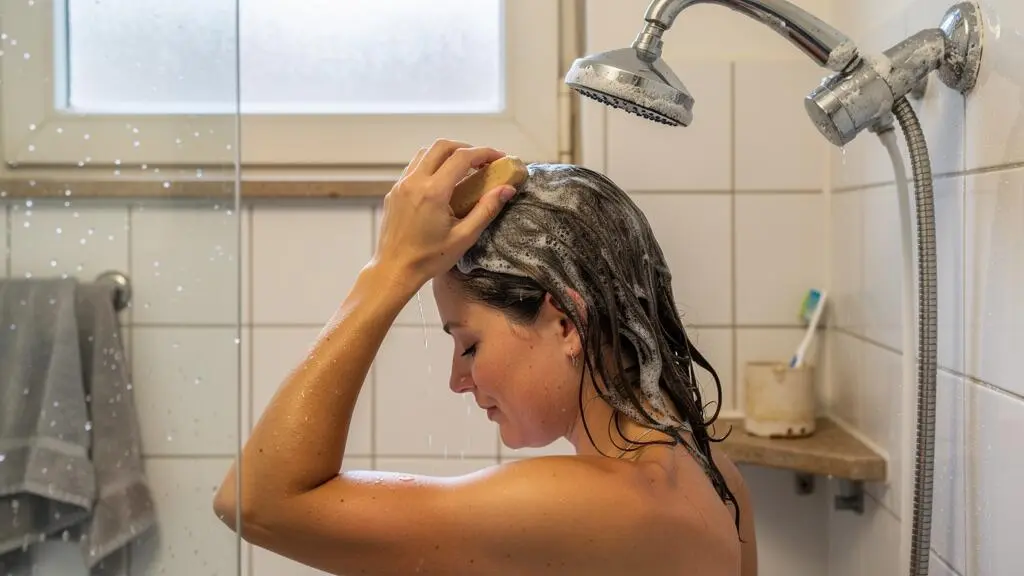
Switching from bottled shampoo to a solid bar can reduce plastic packaging, but the first few washes do not always go as planned. Hair that once felt soft may suddenly seem waxy, tangled or strangely heavy. In some Belgian households, the problem is not the solid format itself: it is the interaction between the cleansing formula and minerals in tap water.
Hard water contains calcium and magnesium. When these minerals react with traditional soap, they can form deposits that cling to hair even after rinsing. Modern solid shampoo bars made with synthetic detergents behave differently, which explains why one bar might leave a stubborn coating while another rinses away comfortably.
The solution starts with identifying the bar, checking local water hardness and adjusting washing technique. A suitable formula, measured application, thorough rinsing and occasional targeted cleansing can make a low-waste routine much easier to maintain without sacrificing scalp comfort or hair softness.
Solid shampoo and Belgian hard water: the essentials
- Identify the formula: traditional soap bars can react with hard-water minerals, while syndet shampoo bars avoid the same soap-scum reaction.
- Improve washing technique: use a small amount on thoroughly wet hair, concentrate on the scalp and rinse carefully.
- Treat persistent buildup selectively: consider a suitable chelating or clarifying product, followed by conditioning, rather than repeatedly stripping the hair.
- Why Can a Shampoo Bar Make Hair Feel Waxy After Only 3 Washes?
- How to Use a Shampoo Bar So It Rinses Clean Even With Hard Water?
- Syndet Bar or True Soap Bar: Which Is Less Likely to Leave Film on Hair?
- The Wet-Bar Storage Mistake That Makes Solid Bars Melt 2x Faster
- When Should You Alternate a Shampoo Bar With Chelating Washes in Belgium’s Hard Water?
- How to Do a Clarifying Rinse Once a Month Without Losing All Your Softness?
- How Do You Clarify Hair in Belgium Without Turning It Dry and Frizzy?
- Biodegradable Surfactants or Classic Ones: Which Cleans Better Without Tightness?
Why Can a Shampoo Bar Make Hair Feel Waxy After Only 3 Washes?
A traditional soap-based shampoo bar can make hair feel waxy after only a few washes because calcium and magnesium in hard water react with soap to form poorly soluble deposits. These deposits can remain on the hair shaft and accumulate with subsequent washing. Three washes is not a universal threshold, but buildup may become noticeable surprisingly quickly.
The underlying chemistry is straightforward. Traditional soap contains fatty-acid salts. In mineral-rich water, calcium and magnesium can react with these salts to form insoluble compounds commonly called soap scum. The U.S. Geological Survey explanation of hard water and soap residue describes why these deposits can remain on hair and make it dull or difficult to manage.
Hair does not necessarily feel coated after the first wash. Subsequent applications may add deposits to material that has not been fully removed. Natural sebum and leftover conditioning products can also contribute to a heavier sensation. A fine-haired person may notice reduced volume before someone with thicker hair notices a change.
Some brands describe temporary unpleasant texture as a transition phase. That explanation should not automatically be accepted when hair becomes progressively waxier.
- Temporary product excess: hair may feel noticeably better after using less shampoo and rinsing more thoroughly.
- Possible mineral buildup: a coated, dull or stiff feeling persists across washes, particularly with a traditional soap bar.
- Possible conditioning-product buildup: roots feel greasy or heavy despite adequate washing, especially after rich leave-in products.
A longer warm-water rinse can help reveal whether excess product is the main issue, but it is not a scientifically validated test for mineral deposits. Likewise, a squeaky sensation does not prove the hair is residue-free.
Persistent friction and tangling also matter. Hair that becomes difficult to detangle may experience more mechanical stress during brushing, especially when already fragile. Avoid aggressive combing while investigating the cause.
The most useful first experiment is to change how the bar is applied and rinsed. If that fails, identifying its cleansing ingredients becomes the next priority.
How to Use a Shampoo Bar So It Rinses Clean Even With Hard Water?
To rinse a shampoo bar clean in hard water, thoroughly wet the hair, create a modest amount of lather and apply it mainly to the scalp rather than repeatedly rubbing the bar along the lengths. Rinse carefully in sections. If waxiness persists, check whether the formula is traditional soap, because technique alone cannot prevent every mineral-soap reaction.
Solid bars make overapplication easy. Rubbing a bar directly across the same area several times can deposit more cleanser than necessary, particularly when hard water produces less lather. Lack of foam does not automatically mean insufficient cleaning.
Use this washing sequence:
- Thoroughly wet the scalp and hair, separating dense or curly sections so water reaches the roots.
- Rub the bar between wet hands to produce lather, or glide it briefly over the wet scalp if the manufacturer recommends direct application.
- Massage the scalp gently with fingertips and allow the foam to pass through the lengths during rinsing.
- Rinse section by section, checking the hairline, nape and areas behind the ears where product can remain.
- Assess the dried result before increasing the amount of shampoo at the next wash.
Allow more rinsing attention than the quick rinse sometimes used with liquid shampoo. Water should reach the roots consistently, but there is no scientifically established universal number of rinsing seconds. Hair that feels soft and clean without a persistent slippery coating is a more practical outcome than chasing a squeaky sensation.
Some people use a diluted apple cider vinegar or citric-acid rinse after traditional soap. Acidification may help address certain alkaline residues, but it should not be presented as a guaranteed way to dissolve all existing mineral deposits. The supplied scientific sources do not establish a universally safe or effective household dilution.
For readers considering an acidic rinse, a purpose-formulated product with manufacturer dilution and application instructions is more predictable than an improvised kitchen mixture. Keep acidic solutions away from the eyes and irritated skin, and discontinue use if stinging occurs. Avoid applying concentrated vinegar or citric acid directly to the scalp.
Local water hardness should guide the decision. The Flemish Environment Agency information on water hardness confirms that hardness varies across Flanders and advises checking the actual supply rather than assuming all tap water is equally hard.
For households elsewhere in Belgium, the relevant water supplier is the appropriate starting point. A broad Flanders-versus-Wallonia comparison cannot reliably describe an individual address.
Your five-step hard-water shampoo check
- Find your water supplier’s hardness information and record the stated value and unit.
- Read the shampoo bar’s ingredient list and write down whether it appears soap-based or syndet-based.
- At the next wash, apply less cleanser and record the approximate number of bar passes.
- Rinse every scalp section thoroughly and note whether dried hair feels clean, coated or tangled.
- Compare the result after several washes and decide whether to change the formula rather than repeatedly adding treatments.
If careful application and rinsing do not resolve the coating, the composition of the bar is likely more important than adding another rinsing step.
Syndet Bar or True Soap Bar: Which Is Less Likely to Leave Film on Hair?
A syndet shampoo bar is generally less likely than a traditional soap bar to leave calcium- and magnesium-based soap scum in hard water. Syndet means synthetic detergent: the cleansing system uses formulated surfactants rather than relying on conventional soap salts. However, a syndet is not automatically gentle, residue-free or suitable for every scalp.
Traditional soap is produced through the saponification of fats and oils with an alkali. Its cleansing ingredients may include sodium olivate, sodium cocoate or sodium palmate. These soap salts are typically alkaline and can form insoluble compounds with hard-water minerals.
Syndet bars may contain surfactants such as sodium cocoyl isethionate (SCI) or sodium lauroyl methyl isethionate. They can be formulated at a pH more appropriate for hair cleansing, although the final pH and mildness depend on the entire product.
A dermatological review of hair-cleansing formulations explains the difference between traditional soap and detergent-based shampoos, including the role of sequestering agents in managing calcium and magnesium.
The practical distinction is particularly important for dry, bleached, colour-treated, curly and fine hair, where friction, tangling or loss of softness may be more noticeable.
| Criterion | Traditional soap bar | Syndet shampoo bar |
|---|---|---|
| Typical cleansing chemistry | Saponified fatty-acid salts | Formulated synthetic surfactants |
| Hard-water reaction | Can form insoluble soap scum | Does not form the same conventional soap scum |
| Typical pH profile | Alkaline | Can be formulated nearer hair-friendly pH |
| Dry or colour-treated hair | Greater potential for manageability difficulties | Often a more practical starting point if suitably formulated |
| Additional routine | May require more residue management | May still need occasional clarifying or conditioning |
Ingredient lists provide useful clues, but they require careful reading. Sodium cocoate and sodium cocoylate are associated with soap-based cleansing, whereas sodium cocoyl isethionate is a different surfactant despite the similarity in names. An ingredient ending in « -ate » is not, by itself, proof of soap. Sodium hydroxide may also be used during manufacturing or for pH adjustment, so its presence alone does not classify a finished bar.
Packaging sometimes markets both types simply as shampoo bars. Look for the actual INCI list rather than relying on descriptions such as natural, artisanal or zero waste.
A traditional soap bar may remain an acceptable choice for someone whose hair tolerates it and whose washing routine consistently produces a comfortable result. A well-formulated syndet is nevertheless the more straightforward default when hard-water residue is already a problem.
Price and availability may influence the decision, but the provided sources do not establish a reliable price difference or retail-availability comparison for Belgium. Compare cost per use and performance rather than assuming one category is always cheaper.
Once the cleansing formula is suitable, protecting the bar from constant moisture helps make the low-waste switch practical over time.
The Wet-Bar Storage Mistake That Makes Solid Bars Melt 2x Faster
Leaving a solid shampoo bar in standing water can make it soften, lose shape and disappear faster than a bar allowed to dry between uses. The often-repeated claim that poor storage doubles consumption is not a universal measured result. Actual longevity depends on the formulation, humidity, drainage and time spent in contact with water.
Many solid cleansers absorb water at the surface. When a bar remains in a non-draining dish, the softened outer layer can dissolve or detach during the next shower. This wastes product even when very little cleanser reaches the hair.
A persistently wet bar and dish may also create less hygienic storage conditions. That does not mean every damp shampoo bar is unsafe, but keeping the product drained and following the manufacturer’s storage guidance is sensible.
The easiest storage solutions allow water to escape and air to circulate:
- Draining soap dish: choose a raised surface with open slots rather than a flat bowl that collects water.
- Magnetic holder: keep the bar suspended so its underside does not remain wet.
- Hanging mesh bag: allow drainage and airflow, provided the bag itself is not kept under continuous shower spray.
Position the holder away from the direct stream of the shower. In a poorly ventilated bathroom, moving the bar to a drier shelf after use may be more effective than changing the dish alone.
Dry storage can also make application easier to control. A consistently softened bar may release an unexpectedly large amount of product when rubbed against wet hair, increasing the risk of overapplication.
To judge whether the adjustment is worthwhile, observe how many washes a comparable bar provides under each storage arrangement. Use the same formula and similar washing habits; otherwise, a difference in longevity cannot confidently be attributed to storage.
Good storage helps prevent waste, but it does not remove deposits already on the hair. Persistent mineral-related coating requires a different approach.
When Should You Alternate a Shampoo Bar With Chelating Washes in Belgium’s Hard Water?
Consider alternating a shampoo bar with a chelating wash when a coated or dull sensation persists despite suitable cleansing and thorough rinsing, especially if local water is hard. Chelating ingredients bind mineral ions and help manage mineral-related deposits. There is no universally established weekly or monthly schedule: the choice should depend on symptoms, hair condition and product instructions.
A clarifying shampoo and a chelating shampoo can overlap in purpose, but their emphasis differs. Clarifying formulations are generally designed to remove accumulated sebum, styling products and other residues. Chelating formulations contain ingredients capable of binding metal ions, such as certain EDTA compounds or phytic acid.
Not every clarifying shampoo contains an effective chelating system. Likewise, seeing an ingredient name on a label does not prove the product will remove every existing mineral deposit. The complete formulation and its intended use matter.
Look for recurring signs rather than following a rigid calendar:
- Hair remains coated or unusually stiff after normal cleansing.
- Colour-treated hair appears dull, with changes that might also have other causes.
- Curls lose definition and become harder to detangle.
- Hair seems heavy despite using less conditioner or styling product.
Scalp itching should be interpreted cautiously. It may accompany irritation from a cleansing formula, fragrance or another scalp condition rather than indicating mineral buildup. Persistent itching, redness or scaling warrants professional assessment instead of increasingly aggressive cleansing.
When a chelating treatment is appropriate, follow the manufacturer’s contact time and frequency instructions, then condition the lengths as needed. Repeated strong cleansing can remove more sebum than desired and leave hair rough, particularly if the formula is unsuitable for frequently washed, coloured or fragile hair.
Regular swimmers face an additional consideration. Pool exposure may involve chlorine and dissolved metals, including copper in some circumstances. A product specifically designed for swimmers may be useful, but the required frequency depends on exposure, pool conditions and hair response rather than a universal rule.
After an occasional corrective wash, restoring manageability matters just as much as removing the coating. That is where a balanced clarifying and conditioning routine becomes useful.
How to Do a Clarifying Rinse Once a Month Without Losing All Your Softness?
A monthly clarifying routine can help remove accumulated product residue without leaving hair excessively dry if the cleanser is appropriate and conditioning follows immediately. Use a clarifying shampoo according to its directions, apply a moisturising conditioner or mask to the lengths and reduce the frequency if hair becomes rough. Monthly use is an optional starting point, not a proven ideal for everyone.
Clarifying is not the same as acid rinsing. A clarifying shampoo uses a cleansing system intended to remove retained oils and residues. An acidic rinse mainly changes the pH environment and may influence certain deposits; it does not substitute reliably for a formulated clarifying or chelating product.
For someone using a soap-based bar in hard water, combining several strong cleansing steps in one session may make it difficult to identify which treatment is helping and may increase dryness. Start with one appropriate intervention rather than applying a strong clarifier, acidic rinse and chelating product together.
A practical monthly routine, when clarification is actually needed, follows four steps:
- Wet the hair thoroughly and apply the clarifying product mainly where residue accumulates, following its label.
- Rinse fully without aggressively rubbing or repeatedly shampooing the lengths.
- Apply a moisturising conditioner or mask to damp, gently squeezed hair, concentrating on mid-lengths and ends.
- Leave the conditioning product on for its recommended time, rinse as directed and detangle gently.
A final cool-water rinse is optional for comfort. Although it is often described as sealing the cuticle, the supplied evidence does not establish that cool water alone produces that effect or prevents hard-water deposits.
After washing, a small amount of lightweight leave-in conditioner may improve manageability. A few drops of suitable hair oil can also reduce friction for some hair types, but excessive use may recreate the heavy feeling that prompted clarifying.
Avoid experimenting with unfamiliar strong cleansing products immediately before an important event or colour service. If the ends already feel brittle, prioritise a gentle routine and allow the hair’s response to determine whether future clarifying is necessary.
The next decision is whether the problem requires ordinary clarification, mineral-focused treatment or simply a less drying everyday cleanser.
How Do You Clarify Hair in Belgium Without Turning It Dry and Frizzy?
To clarify hair without excessive dryness or frizz, first identify the likely source of buildup, then choose the mildest effective cleansing approach. Product residue may respond to a suitable clarifying shampoo, while suspected mineral accumulation may justify a chelating formula. Curly, bleached and already-dry hair particularly benefits from gentle application and conditioning immediately afterwards.
Not every stiff or unpleasant hair texture comes from Belgian tap water. Rich styling products can accumulate, protein-heavy treatments may leave some hair feeling rigid, and unsuitable cleansers can create roughness without any mineral coating.
These sensations provide clues, not a definitive diagnosis:
| Observed problem | Possible explanation | First response |
|---|---|---|
| Greasy roots with heavy or coated lengths | Product, sebum or conditioning buildup | Review product quantities and consider gentle clarification |
| Stiff, dull hair after repeated soap-bar washing | Possible hard-water soap deposits | Check water hardness and change to a suitable syndet |
| Roughness after repeated protein treatments | Possible mismatch between conditioning products and hair needs | Review treatments before adding stronger cleansers |
| Dry, frizzy lengths after washing | Excessive cleansing, friction or insufficient conditioning | Use a gentler formula and prioritise manageability |
In Belgium, purpose-formulated clarifying shampoos may be found through drugstores, pharmacies, specialist haircare retailers and some low-waste shops. Check ingredient lists and usage instructions rather than assuming that a product marketed as detoxifying, natural or deep-cleaning is automatically appropriate.
DIY baking-soda washes are not a good default for fragile hair. Their alkalinity creates an avoidable concern when the aim is to reduce roughness and friction. Citric-acid products can be formulated for controlled pH adjustment, but homemade solutions without validated dilution instructions should not be treated as equivalent to tested cosmetic formulas.
For curls and frizz-prone hair, work in sections, concentrate shampoo on the scalp, avoid prolonged vigorous scrubbing and support detangling with conditioner. Hair friction is particularly relevant: a published study on shampoo pH and hair-fiber effects discusses how alkaline conditions can increase fiber charge and friction, potentially contributing to frizz and damage. The study does not establish an ideal shampoo pH for every product.
Household water hardness offers another useful piece of evidence. Check your supplier’s published figures and their measurement units before assuming that the same corrective routine will suit every Belgian address.
Once buildup is under control, maintaining softness depends mainly on choosing a cleanser suited to the scalp and hair rather than repeatedly treating the consequences of an unsuitable formula.
Key takeaways before choosing your next bar
- A bar’s low-waste credentials do not establish how gently it cleans or how well it performs in mineral-rich water.
- Assess scalp comfort and the condition of the lengths separately; a product can clean effectively yet leave hair difficult to manage.
- Consider surfactant composition, overall formulation and real-world washing results rather than relying on a natural-versus-synthetic label.
Biodegradable Surfactants or Classic Ones: Which Cleans Better Without Tightness?
Biodegradable surfactants are not automatically gentler than conventional ones, and strong cleansing does not necessarily mean better results. Biodegradability describes how a substance breaks down under specified environmental conditions; mildness describes its interaction with hair and skin. A comfortable shampoo bar depends on surfactant selection, concentration, pH and the complete formula, particularly in hard water.
Some surfactants derived from sugar or plant-based fatty materials, such as decyl glucoside and coco-glucoside, are commonly used in formulations designed for mild cleansing. Their origin alone, however, does not guarantee that a finished shampoo will suit sensitive skin.
Sodium cocoyl isethionate is another ingredient frequently found in solid shampoo products. It can support a relatively gentle cleansing system when formulated appropriately. Sulfate-based surfactants vary in cleansing behaviour and may be too strong for some dry or sensitive scalps, especially in formulas without adequate conditioning.
There is no reliable shortcut in which all sulfate-free bars are mild and all sulfate-containing bars are harsh. The combination of surfactants, their quantities and the accompanying ingredients determines the experience.
For shoppers in Belgium, the environmental decision also deserves precision. Biodegradability must be assessed under defined test conditions. Claims such as plant-derived, natural and biodegradable do not mean the same thing, and none independently proves that a product has a lower total environmental footprint.
Packaging still matters. A solid bar sold with minimal recyclable paper or cardboard can help reduce plastic packaging, but its environmental benefit should not be judged solely by the form of the cleanser. Product use, longevity, ingredients and packaging all contribute to the broader comparison.
Most importantly, a biodegradable surfactant does not automatically remove mineral buildup more effectively. The everyday bar and the occasional corrective treatment serve different purposes.
A practical evaluation period is to observe your hair and scalp over approximately two weeks, adjusting for how often you actually wash:
- Does the scalp feel comfortable after the hair has dried, without tightness or persistent itching?
- Do the lengths feel clean without becoming stiff, waxy or straw-like?
- Can the hair be detangled without noticeably increased friction?
- Does the bar remain practical to use without excessive product application?
If these outcomes remain satisfactory, there may be no reason to add special rinses or regular clarifying washes. If they deteriorate, reassess the formula, local water hardness and product quantities before purchasing another treatment.
The simplest sustainable next step is to check the ingredient list of your current bar, look up your household’s water hardness and test a suitable washing technique. Switching to a well-formulated syndet bar may resolve the problem without introducing multiple extra products.
Can hard water make hair feel waxy even when the shampoo bar is completely rinsed out?
Yes. Traditional soap can react with calcium and magnesium to form poorly soluble deposits that remain on the hair despite careful rinsing. Switching to a suitable syndet shampoo may help avoid this particular reaction.
Will installing a household water softener solve shampoo-bar residue?
Reducing calcium and magnesium can limit the hard-water soap reaction, but a water softener is not automatically necessary or appropriate for every home. First check your local water hardness and the relevant water supplier’s guidance. Changing the shampoo formula is often a simpler first step.
Can a solid shampoo bar be used on coloured or bleached hair?
Yes, but choose a formula specifically suitable for colour-treated or chemically processed hair. A well-formulated syndet is generally a more practical starting point than traditional alkaline soap, especially where hard-water deposits and tangling are concerns.
Are vinegar rinses necessary every time a shampoo bar is used?
No. A suitable syndet bar usually does not require an acidic rinse simply because it is solid. For traditional soap, some users experiment with acid rinses, but no universal household dilution or optimal frequency is established by the supplied evidence. Avoid concentrated solutions and products that irritate the skin.
Does a shampoo bar need to produce lots of foam to clean effectively?
No. Foam quantity is not a reliable measure of cleansing performance. Hard water can reduce the lather produced by traditional soap, and different surfactants generate different amounts of foam. Assess the result after rinsing and drying rather than adding more shampoo solely to create bubbles.